
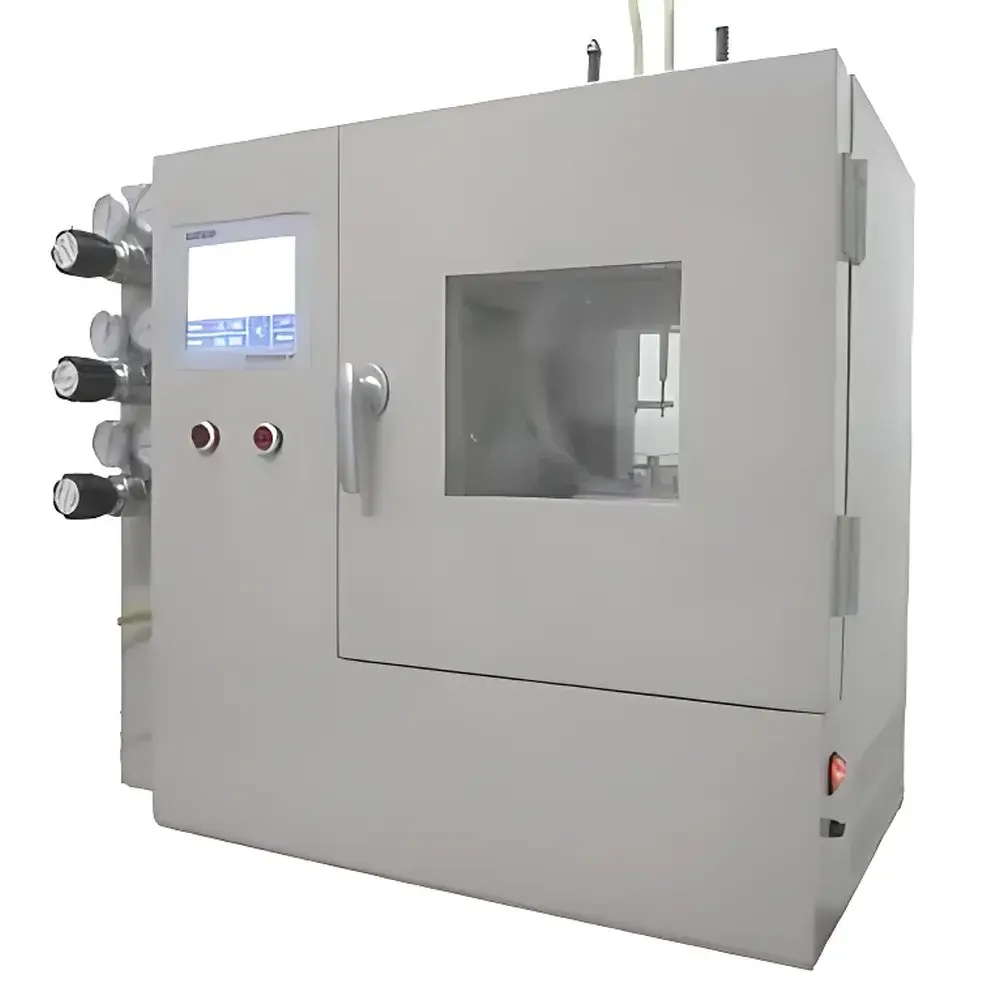
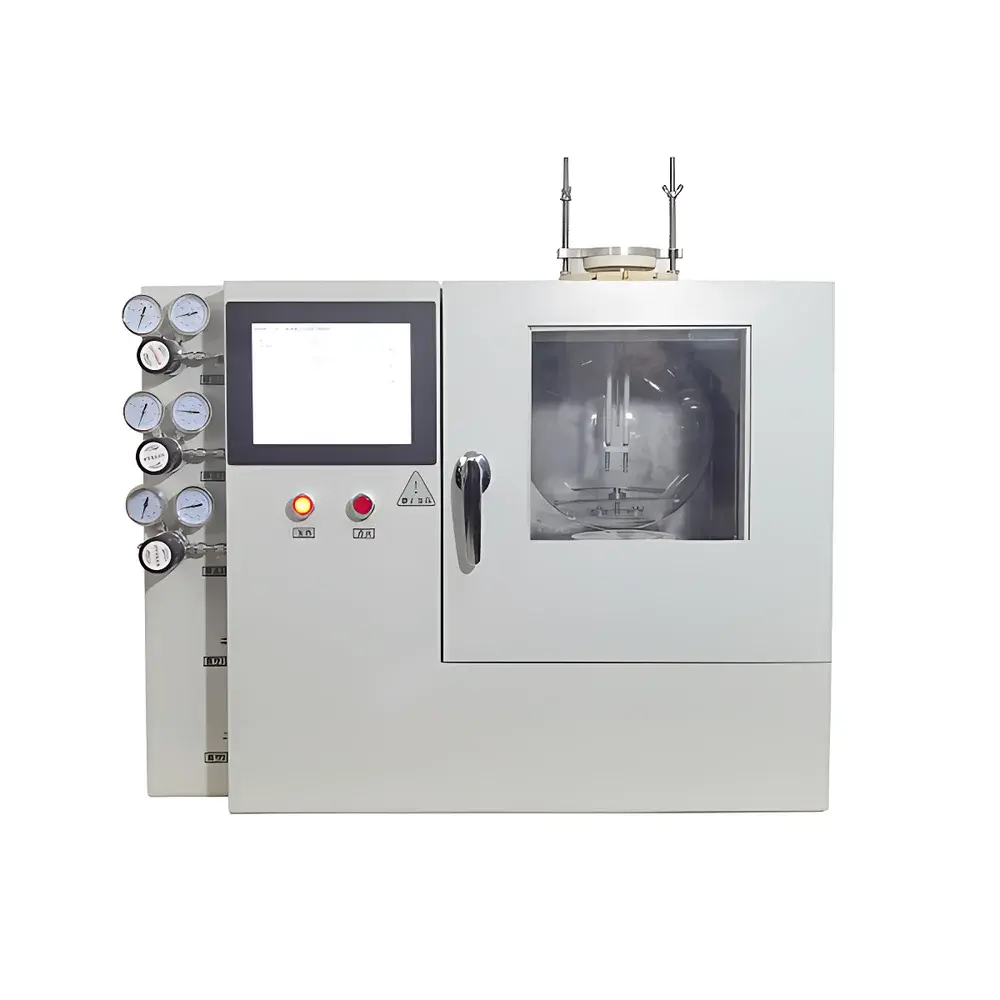
Xiatech FL6000 Automated Flash Point and Flammability Limit Tester
| Brand | Xiatech |
|---|---|
| Model | FL6000 |
| Origin | Shaanxi, China |
| Application Standards | ASTM E681, GB/T 21844, ASHRAE 34 |
| Temperature Range | Ambient to 200 °C |
| Pressure Range | Atmospheric |
| Temperature Control Accuracy | ±1.0 °C |
| Pressure Measurement Accuracy | 0.1% FS |
| Chamber Volume | 12 L (5 L optional) |
| Ignition Source | 15 kV / 30 mA spark |
| Viewing Window | Reinforced transparent explosion-proof quartz viewport |
| Stirring Method | Magnetic stirring |
| Flame Detection Criterion | Maximum flame propagation angle relative to electrode center |
| Communication Interface | USB |
| Power Supply | 220 V, 50 Hz |
| Operating Environment | 0–40 °C, ≤65% RH |
Overview
The Xiatech FL6000 Automated Flash Point and Flammability Limit Tester is a precision-engineered combustion test system designed for the quantitative determination of lower and upper flammability limits (LFL/UFL) of combustible gases and volatile vapors in air under controlled thermal and atmospheric conditions. Based on the fundamental principle of flame propagation dynamics in a confined spherical chamber, the FL6000 employs standardized ignition protocols and high-resolution optical observation to detect the critical concentration thresholds at which self-sustaining flame propagation occurs. Unlike open-flame or cup-based flash point testers, the FL6000 implements a closed-cup, constant-volume methodology aligned with internationally recognized test paradigms—including ASTM E681 (Standard Test Method for Concentration Limits of Flammability of Chemicals), GB/T 21844 (Chinese national standard for flammability limits of gases), and ASHRAE 34 (designation and safety classification of refrigerants). Its spherical 12 L glass reaction vessel minimizes wall quenching effects and ensures uniform mixing—critical for reproducible flame front development. The system operates at ambient pressure and supports temperature-controlled testing up to 200 °C, enabling evaluation of vapor-phase behavior across industrially relevant thermal regimes.
Key Features
- High-accuracy gas blending: Integrated high-stability pressure transducers (0.1% FS accuracy) and mass-flow-regulated vacuum filling ensure gas mixture preparation with ≤0.05% volumetric precision.
- Optically monitored combustion events: A reinforced quartz explosion-proof viewport coupled with an industrial-grade digital camera system enables real-time recording and frame-by-frame analysis of flame propagation geometry.
- Quantitative flame angle assessment: Proprietary image-processing algorithms measure the maximum flame propagation angle—the angular extent between the electrode axis and the farthest flame boundary on the chamber wall—as the primary pass/fail criterion for flammability onset.
- Multi-layered safety architecture: Includes interlocked access door, automatic pressure-relief valves, remote-triggered high-voltage ignition (15 kV/30 mA), and redundant hardware/software emergency shutdown protocols compliant with IEC 61508 SIL-2 functional safety principles.
- Fully automated workflow: Unified control software manages sequential operations—vacuum evacuation, temperature stabilization, precise gas dosing, magnetic stirring, timed ignition, and post-test purge—in a single-click sequence under Windows OS.
Sample Compatibility & Compliance
The FL6000 accommodates gaseous fuels (e.g., methane, propane, hydrogen), refrigerant blends (R-32, R-1234yf), solvent vapors (acetone, ethanol, toluene), and mixed hydrocarbon streams. It supports both pure-component characterization and binary/multi-component mixture studies per ASTM E681 Annex A4. All operational parameters—including temperature ramp profiles, dwell times, and ignition delay intervals—are configurable to meet method-specific requirements of ISO 8573-9 (compressed air purity), EN 1839 (explosion limit determination), and OSHA 1910.1200 (hazard communication). System validation documentation includes as-found/as-left calibration records traceable to NIM (National Institute of Metrology, China) standards.
Software & Data Management
The proprietary Xiatech Flammability Analysis Suite (v3.2) provides full GLP-compliant data handling: electronic signatures, audit trails, user-level access controls, and 21 CFR Part 11–ready export formats (CSV, PDF, XML). Each test generates a timestamped report containing raw pressure/temperature logs, annotated video frames, calculated LFL/UFL values (determined via bracketing protocol per ASTM E681 Section 8.3), and uncertainty estimates derived from repeatability studies (n ≥ 6 per concentration level). Data synchronization supports networked lab environments via secure HTTPS API endpoints.
Applications
- Refinery and petrochemical process safety: Screening of off-gas compositions prior to flare or incineration.
- HVAC&R system design: Flammability classification of next-generation low-GWP refrigerants per ASHRAE 34 Appendix B.
- Mine ventilation engineering: Methane-air mixture hazard mapping for coal seam degasification systems.
- Pharmaceutical solvent recovery: Validation of residual solvent concentrations in lyophilized product chambers.
- National metrology institutes: Reference material certification for flammability standards (e.g., certified gas mixtures for LFL verification).
FAQ
What standards does the FL6000 directly support?
ASTM E681, GB/T 21844–2008, and ASHRAE Standard 34–2023 are fully implemented in the instrument’s default test templates and reporting logic.
Can the FL6000 determine autoignition temperature (AIT)?
No—the FL6000 is specifically configured for flammability limit determination via spark ignition in a static spherical chamber; AIT requires continuous heating and hot-surface ignition per ASTM E659.
Is the 5 L chamber option validated against the 12 L configuration?
Yes—both volumes undergo identical geometric scaling verification and have published correlation factors for LFL/UFL equivalence per ISO/IEC 17025 accredited validation reports.
How is measurement uncertainty quantified for reported LFL/UFL values?
Uncertainty budgets include contributions from pressure sensor drift (k=2, 0.1% FS), temperature controller hysteresis (±0.8 °C), operator-defined concentration bracketing width, and inter-laboratory reproducibility (CV ≤ 2.1% for methane-air at 25 °C).
Does the system support integration with LIMS or MES platforms?
Yes—via RESTful API and configurable HL7/ASTM E1384 message schemas, with optional middleware for Siemens Opcenter or Thermo Fisher SampleManager compatibility.



