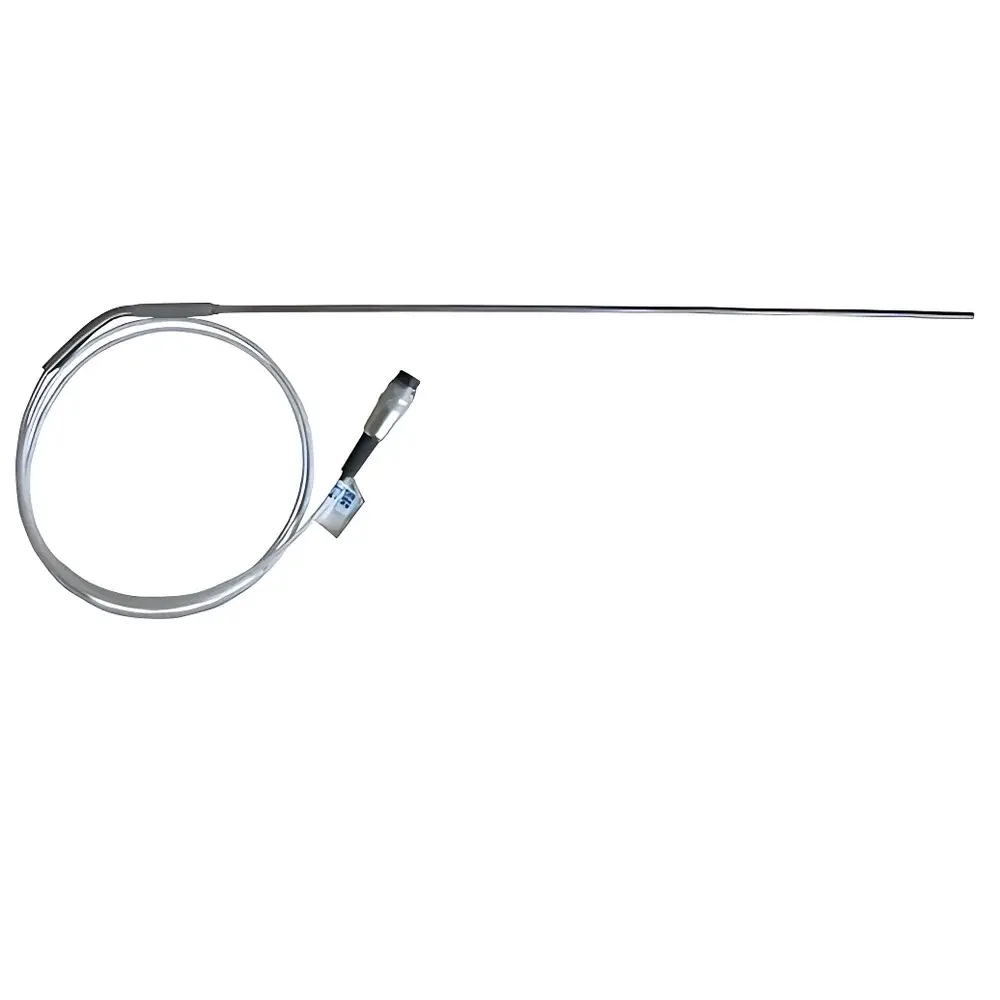
Xiatech T6000 Industrial-Grade Platinum Resistance Thermometer (PRT)
| Brand | Xiatech |
|---|---|
| Origin | Shaanxi, China |
| Model | T6000 |
| Temperature Range | -200 °C to +250 °C |
| Accuracy | ±0.02 °C |
| Probe Diameter Options | Φ4 mm, Φ5 mm, Φ6 mm |
| Probe Length Options | 50–400 mm |
| Construction | Hermetically Sealed, Waterproof (IP67 Rated), Stainless Steel Sheath |
| Sensor Element | Pt100 or Pt1000 (IEC 60751 Class A or AA) |
| Output | 2-wire / 3-wire / 4-wire configurable |
| Stability | ≤0.01 °C/year typical drift |
Overview
The Xiatech T6000 is an industrial-grade platinum resistance thermometer (PRT) engineered for high-accuracy, long-term temperature measurement in demanding process and laboratory environments. It operates on the fundamental physical principle that the electrical resistance of pure platinum exhibits a highly predictable, repeatable, and nearly linear relationship with absolute temperature—governed by the Callendar–Van Dusen equation for sub-zero ranges and polynomial calibration models per IEC 60751. Designed specifically for continuous operation in harsh industrial settings—including chemical reactors, HVAC control loops, sterilization validation, and thermal calibration baths—the T6000 integrates a precision Pt100 or Pt1000 sensing element housed within a robust, hermetically sealed stainless steel probe. Its metrological performance meets Class A and AA tolerances per IEC 60751, ensuring traceable accuracy of ±0.02 °C at 0 °C, with full-range stability maintained over extended service life.
Key Features
- High Metrological Accuracy: Certified to IEC 60751 Class A (±(0.15 + 0.002|t|) °C) or optional Class AA (±(0.10 + 0.0017|t|) °C), delivering uncertainty as low as ±0.02 °C at reference points—suitable for applications requiring ISO/IEC 17025-compliant calibration transfer.
- Extended Operational Range: Validated for continuous use from –200 °C (liquid nitrogen immersion) to +250 °C (high-temperature ovens and autoclaves), with thermal shock resistance tested per IEC 60751 Annex B.
- Configurable Physical Geometry: Standard probe diameters of Φ4 mm, Φ5 mm, and Φ6 mm; insertion lengths from 50 mm to 400 mm; custom geometries—including reduced-tip profiles, angled housings, and threaded or flanged mounting options—are available upon request to meet ASME B16.5, DIN 43772, or customer-specific mechanical interface requirements.
- Environmental Robustness: IP67-rated enclosure with seamless 316L stainless steel sheath; pressure-resistant up to 10 bar (static); resistant to condensation, steam, caustic vapors, and mild corrosive media encountered in pharmaceutical wet processing and food-grade CIP cycles.
- Electrical Interface Flexibility: Supports 2-wire (for short-distance OEM integration), 3-wire (standard industrial configuration), and 4-wire (lab-grade null-resistance measurement) lead arrangements—enabling compatibility with PLC analog inputs, DAQ systems, and dedicated PRT transmitters compliant with HART® or Modbus RTU protocols.
Sample Compatibility & Compliance
The T6000 is compatible with all standard temperature measurement and control instrumentation accepting Pt100/Pt1000 inputs. Its construction adheres to RoHS Directive 2011/65/EU and REACH Regulation (EC) No. 1907/2006. Calibration certificates are provided with NIST-traceable uncertainty statements, supporting compliance with FDA 21 CFR Part 11 (when used with audit-trail-capable readout systems), EU GMP Annex 15 (Qualification of Temperature Sensors), and ISO 13485:2016 (for medical device manufacturing environments). For sterile process applications, optional autoclavable variants (validated per ISO 17665-1 for 121 °C/15 min cycles) are available.
Software & Data Management
While the T6000 is a passive sensor requiring external signal conditioning, it is fully interoperable with industry-standard data acquisition platforms—including National Instruments LabVIEW™, Keysight PathWave, and Siemens Desigo CC—via supported analog input modules or smart transmitters. When paired with Xiatech’s optional T-Link™ calibration management software (sold separately), users gain automated calibration scheduling, deviation tracking, certificate generation (PDF + CSV), and electronic record retention aligned with ALCOA+ principles (Attributable, Legible, Contemporaneous, Original, Accurate, Complete, Consistent, Enduring, Available).
Applications
- Validation of sterilization cycles (autoclaves, depyrogenation tunnels, VHP chambers)
- In-line temperature monitoring in API synthesis, fermentation, and lyophilization processes
- Reference-grade mapping of environmental chambers (ICH Q5A, ISO 14644-3)
- Thermal profiling of battery cell formation and aging test rigs
- Calibration laboratory transfer standards for dry-block calibrators and liquid-bath references
- Long-term drift studies in geothermal and cryogenic infrastructure
FAQ
Is the T6000 suitable for use in explosive atmospheres?
No—the standard T6000 is not intrinsically safe or ATEX-certified. For hazardous area deployment, consult Xiatech’s Ex-rated variants (e.g., T6000-ATEX Series), which integrate certified barriers and explosion-proof housings meeting IEC 60079-0 and IEC 60079-11.
Can the probe be immersed in aggressive solvents such as acetone or concentrated HNO₃?
The 316L stainless steel sheath offers broad chemical resistance but is not impervious to halogenated acids or hot concentrated oxidizers. Material compatibility must be verified case-by-case using NACE MR0175/ISO 15156 guidelines; alternative Hastelloy® C-276 sheaths are available for severe corrosion environments.
What is the recommended recalibration interval?
Per ISO/IEC 17025:2017 Clause 7.8.3, initial recalibration is advised annually; however, interval adjustment based on risk assessment (e.g., frequency of thermal cycling, exposure severity, historical stability data) is permitted—and commonly extended to 2 years for stable, low-stress installations with documented drift ≤0.005 °C/year.