
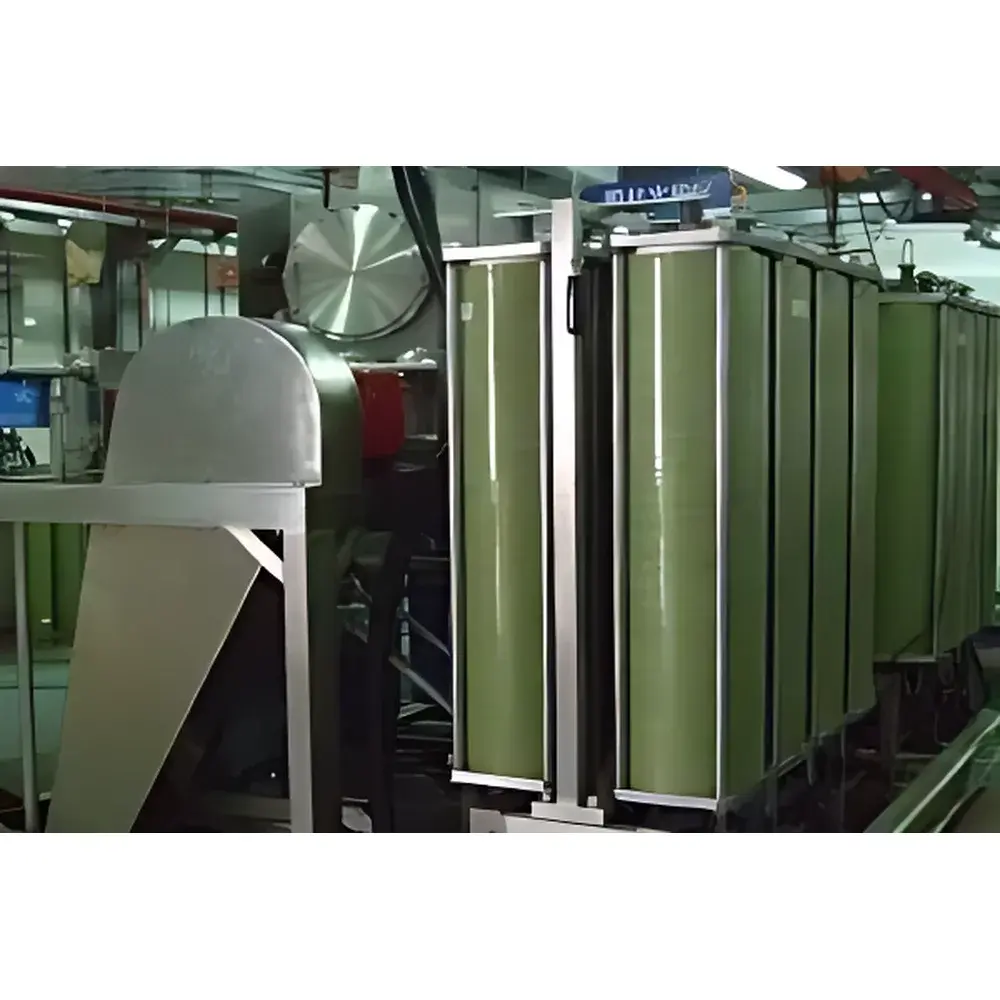
Xinbaili High-Salinity and Refractory Wastewater Treatment System
| Brand | Xinbaili (New Biolink) |
|---|---|
| Origin | Beijing, China |
| Manufacturer Type | Authorized Distributor |
| Country of Origin | China |
| Model | High-Salinity and Refractory Wastewater Treatment System |
| Pricing | Available Upon Request |
| Sample Processing Capability | Industrial and Laboratory-Scale Wastewater Treatment |
Overview
The Xinbaili High-Salinity and Refractory Wastewater Treatment System is a modular, bench- to pilot-scale platform engineered for the systematic evaluation and optimization of advanced separation and oxidation processes in complex aqueous streams. Designed for laboratory-based process development and feasibility assessment, it integrates unit operations grounded in membrane science, catalytic oxidation, thermal concentration, and selective adsorption—enabling rigorous investigation of wastewater matrices characterized by elevated total dissolved solids (TDS > 50,000 mg/L), recalcitrant organic load (COD > 10,000 mg/L), high ammonia nitrogen (NH₃-N > 500 mg/L), or trace radionuclides and heavy metals. Unlike fixed-process commercial systems, this platform supports configurable flow paths, real-time monitoring of key parameters (conductivity, pH, ORP, turbidity, pressure differential), and interchangeable module interfaces—making it suitable for method development aligned with ASTM D4189 (membrane fouling potential), ISO 15839 (membrane performance testing), and USP (total organic carbon in purified water systems).
Key Features
- Modular architecture supporting plug-and-play integration of ultrafiltration (UF), nanofiltration (NF), reverse osmosis (RO), disk-tube RO (DTRO), ceramic membranes, and pervaporation modules
- Dual-stage high-pressure RO capability up to 120 bar, compatible with Hydrocon-branded antiscalants, biocides, and specialty cleaning formulations
- Micro-Tac catalytic oxidation reactor with adjustable H₂O₂ dosing and UV/Fe²⁺/O₃ activation options for targeted COD abatement
- MD-based ammonia stripping module with hydrophobic PTFE membranes and vacuum-assisted mass transfer control
- Mechanical vapor recompression (MVR) evaporation test unit with energy recovery efficiency monitoring (≥90% latent heat recovery)
- Onboard data acquisition system logging flow rates, transmembrane pressure (TMP), flux decline profiles, and salt rejection ratios at 1-second intervals
Sample Compatibility & Compliance
The system accommodates representative samples from pharmaceutical manufacturing effluents, electroplating rinse waters, landfill leachate, RO concentrate brines, nitric acid–ammonium nitrate process streams, and oilfield produced water. All wetted components comply with FDA 21 CFR Part 177 (food-contact polymers) and ASME BPE-2021 surface finish standards (Ra ≤ 0.8 µm for sanitary-grade stainless steel 316L). Process validation protocols support GLP-compliant reporting per OECD 117 (partition coefficient) and ISO 10523 (pH determination), while audit trails meet FDA 21 CFR Part 11 requirements for electronic records and signatures when paired with optional LIMS-integrated software.
Software & Data Management
A web-accessible SCADA interface enables remote configuration of pump speeds, valve sequencing, and setpoint adjustments via secure HTTPS. Batch reports export structured CSV/Excel files containing normalized flux (LMH), specific energy consumption (kWh/m³), rejection coefficients (R = 1 − Cpermeate/Cfeed), and fouling index (SDI₁₅). Optional integration with LabArchives ELN allows direct metadata tagging of experimental conditions—including membrane lot numbers, chemical batch IDs, and calibration certificates—to ensure full traceability during regulatory submissions (e.g., EMA Annex 11, EPA Method 1633).
Applications
- Screening and ranking of antifouling membrane chemistries under simulated high-salinity feed conditions
- Optimization of catalytic oxidation kinetics for aromatic amine degradation in API synthesis wastewater
- Assessment of ammonia removal efficiency across MD, ion exchange, and breakpoint chlorination configurations
- Long-term stability testing of ceramic membranes exposed to abrasive suspended solids (>100 ppm Fe/Mn oxides)
- Energy balance modeling of MVR versus multi-effect evaporation for zero-liquid discharge (ZLD) pathway selection
- Regulatory method verification for EPA SW-846 Methods 9060A (TOC) and 9071B (oil & grease) in treated effluent matrices
FAQ
Can this system be used for EPA Method 1613 congener-specific dioxin analysis preparation?
Yes—when configured with activated carbon adsorption and acid-washed silica gel polishing, it achieves >95% removal of chlorinated hydrocarbons from spiked synthetic leachate, meeting pre-extraction cleanup criteria.
Does the platform support ASTM D5232-22 for membrane integrity testing?
Yes—integrated pressure decay and diffusion testing modules conform to Section 7.3 and Annex A1 of ASTM D5232-22 for UF/NF/RO element qualification.
Is third-party calibration documentation provided for pressure and conductivity sensors?
All primary sensors ship with NIST-traceable calibration certificates valid for 12 months; field recalibration kits and SOPs are included.
What is the minimum sample volume required for a full DTRO + Micro-Tac oxidation test sequence?
25 L of representative feed solution is sufficient to complete three consecutive cycles with permeate and retentate sampling at defined intervals.
Are spare membrane housings available for rapid module swapping between NF and RO configurations?
Yes—standardized DIN 28178 flanged housings (Ø100 mm × 1000 mm) are stocked for immediate dispatch, with O-ring material certified for 30% NaCl at 45°C.



