
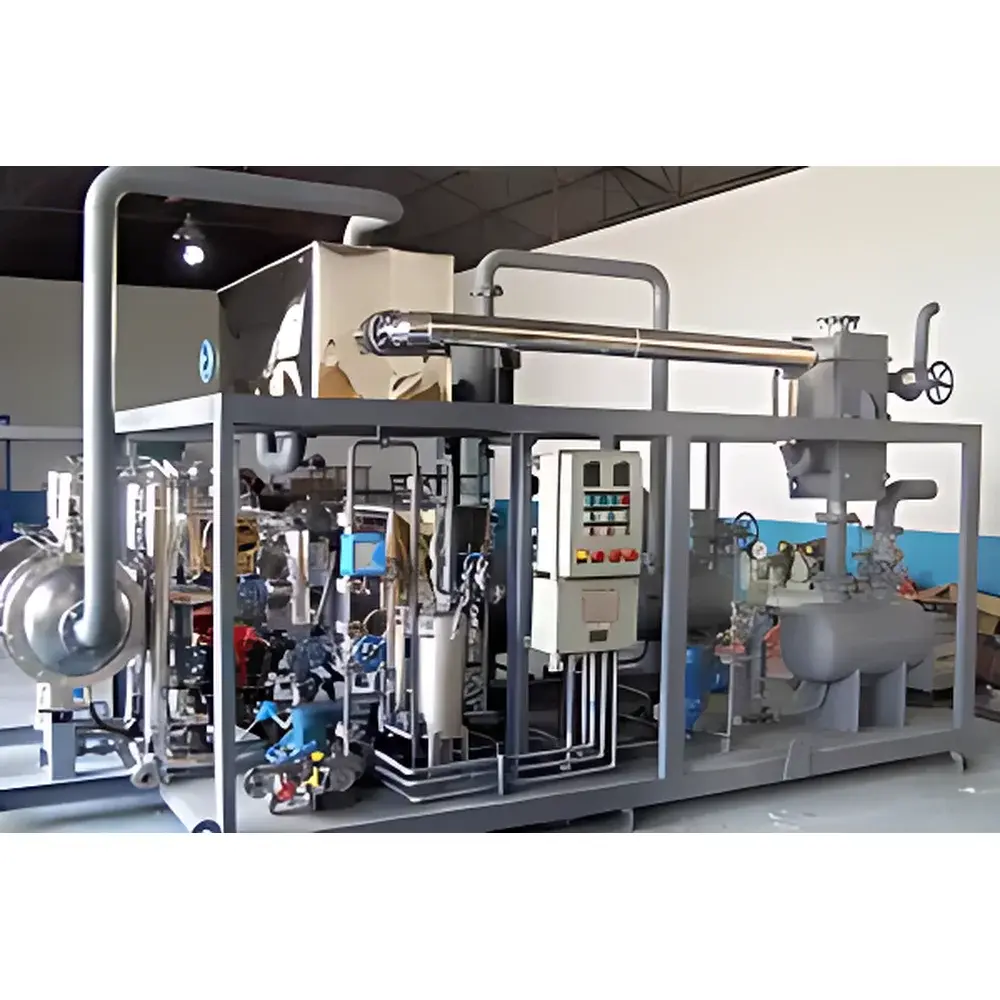
Xinbaili PV-1000 Permeation Vaporization Membrane System
| Brand | Xinbaili (New Biolink) |
|---|---|
| Origin | Beijing, China |
| Manufacturer Type | Authorized Distributor |
| Country of Origin | China |
| Model | PV-1000 |
| Pricing | Upon Request |
| Sample Processing | Aqueous Organic Waste Stream Dehydration |
| Membrane Type | Inorganic Ceramic Composite Membrane |
| Operating Temperature Range | Up to 140 °C |
| Separation Driver | Partial Vapor Pressure Gradient |
| Core Mechanism | Solution–Diffusion Coupled with Molecular Sieving |
Overview
The Xinbaili PV-1000 Permeation Vaporization Membrane System is an engineered separation platform designed for high-selectivity dehydration of organic solvents and azeotropic or near-azeotropic mixtures. It operates on the fundamental principle of pervaporation—a membrane-based, non-equilibrium separation process driven by a partial vapor pressure gradient across a dense, selective barrier. Unlike distillation or adsorption, pervaporation bypasses thermodynamic limitations imposed by vapor–liquid equilibrium, enabling energy-efficient removal of trace water (<100 ppm) from heat-sensitive, flammable, or high-boiling organics—including ethanol, isopropanol, THF, acetone, ethyl acetate, and chlorinated solvents. The PV-1000 integrates inorganic ceramic composite membranes—specifically engineered for thermal stability, chemical resistance, and long-term mechanical integrity—into a modular, skid-mounted configuration suitable for laboratory-scale process validation, pilot-scale feasibility studies, and small-batch production support in regulated environments.
Key Features
- Inorganic ceramic composite membrane architecture: Enables stable operation up to 140 °C, excellent resistance to organic solvents, and minimal fouling under continuous feed conditions.
- High separation factor (αH₂O/organic): Achieves >1,000 selectivity for water over common organics—resulting in permeate streams with <50 ppm residual solvent and retentate streams meeting USP/EP-grade anhydrous specifications.
- Energy efficiency: Reduces specific energy consumption by ≥50% versus conventional azeotropic distillation or molecular sieve regeneration cycles—validated per ASTM E2977-21 guidelines for comparative process energy analysis.
- Compact footprint: Modular design occupies ≤20% of the floor space required for equivalent-capacity batch distillation units; ideal for ISO Class 7 cleanroom integration or constrained QC lab environments.
- Automated process control: Equipped with integrated vacuum regulation (≤1 mbar absolute), feed temperature monitoring (±0.3 °C), transmembrane flux feedback loop, and programmable logic controller (PLC) interface compliant with IEC 61131-3 standards.
Sample Compatibility & Compliance
The PV-1000 accommodates liquid-phase feeds with total suspended solids (TSS) <5 mg/L and viscosity <50 cP at operating temperature. Compatible feed streams include fuel-grade ethanol (wet or denatured), pharmaceutical-grade IPA, pesticide synthesis intermediates, electronic-grade acetone, and food-grade ethyl acetate. All wetted components meet ASME BPE-2022 surface finish requirements (Ra ≤ 0.4 µm), and the system supports full GMP documentation packages—including IQ/OQ protocols, material traceability (ASTM F899-22), and corrosion resistance certification per NACE MR0175/ISO 15156. Membrane modules are certified for use under FDA 21 CFR Part 11-compliant data acquisition systems when paired with validated SCADA software.
Software & Data Management
Control and data logging are managed via Xinbaili’s proprietary PVMonitor™ v3.2 software suite—deployed on Windows 10 IoT Enterprise with TLS 1.2 encryption and role-based user access (admin/operator/auditor). Real-time parameters—including permeate flux (kg/m²·h), water removal rate (g/h), membrane ΔP (kPa), and cumulative energy consumption (kWh/kg H₂O)—are logged at 1-second intervals with automatic timestamping and digital signature. Audit trails comply with ALCOA+ principles (Attributable, Legible, Contemporaneous, Original, Accurate, Complete, Consistent, Enduring, Available) and support 21 CFR Part 11 electronic record retention for ≥15 years. Export formats include CSV, PDF report templates (per ISO/IEC 17025 Annex A.3), and direct integration with LIMS via RESTful API.
Applications
- Renewable fuels: Final-stage dehydration of bioethanol (ASTM D4806) and biobutanol to meet EN 15376 specification limits.
- Pharmaceutical manufacturing: Solvent recovery and re-use in API crystallization (ICH Q5D), lyophilization cycle support, and cleaning validation (PDA TR29).
- Fine chemicals: Continuous dehydration of reaction media containing acid chlorides, Grignard reagents, or lithium aluminum hydride—where thermal instability precludes distillation.
- Electronics manufacturing: Production of ultra-high-purity solvents (≥99.999%) for photoresist formulation and wafer cleaning (SEMI F57-0320).
- Environmental engineering: On-site treatment of solvent-contaminated wastewater streams prior to discharge (EPA Method 8270D compliance support).
FAQ
What feed pretreatment is required prior to PV-1000 operation?
Feed streams must be filtered to ≤5 µm (absolute rating) and degassed to prevent membrane pore blocking and vacuum pump oil contamination. Optional inline coalescers and activated carbon polishing are available as add-on modules.
Can the PV-1000 handle corrosive or halogenated solvents?
Yes—the inorganic ceramic membrane and Hastelloy C-276 wetted path components are qualified for continuous exposure to HCl-saturated IPA, chloroform, and dichloromethane per ISO 9223 corrosion classification C5-M.
How is membrane lifetime validated and monitored?
Flux decay rate is tracked against baseline performance curves; replacement is recommended when normalized water flux drops >15% over 500 operational hours. Each membrane batch includes accelerated aging test reports per ISO 15184 Annex B.
Is the system compatible with hazardous area classifications?
The standard configuration meets ATEX Zone 2 / NEC Class I, Division 2 requirements. Explosion-proof variants (ATEX Zone 1 / NEC Class I, Division 1) are available upon request with third-party IECEx certification.
Does Xinbaili provide method transfer support for regulatory submissions?
Yes—application engineers collaborate on process validation protocols aligned with ICH Q2(R2), USP <1225>, and EU GMP Annex 15, including robustness testing, uncertainty quantification, and comparability assessments versus legacy separation methods.



