
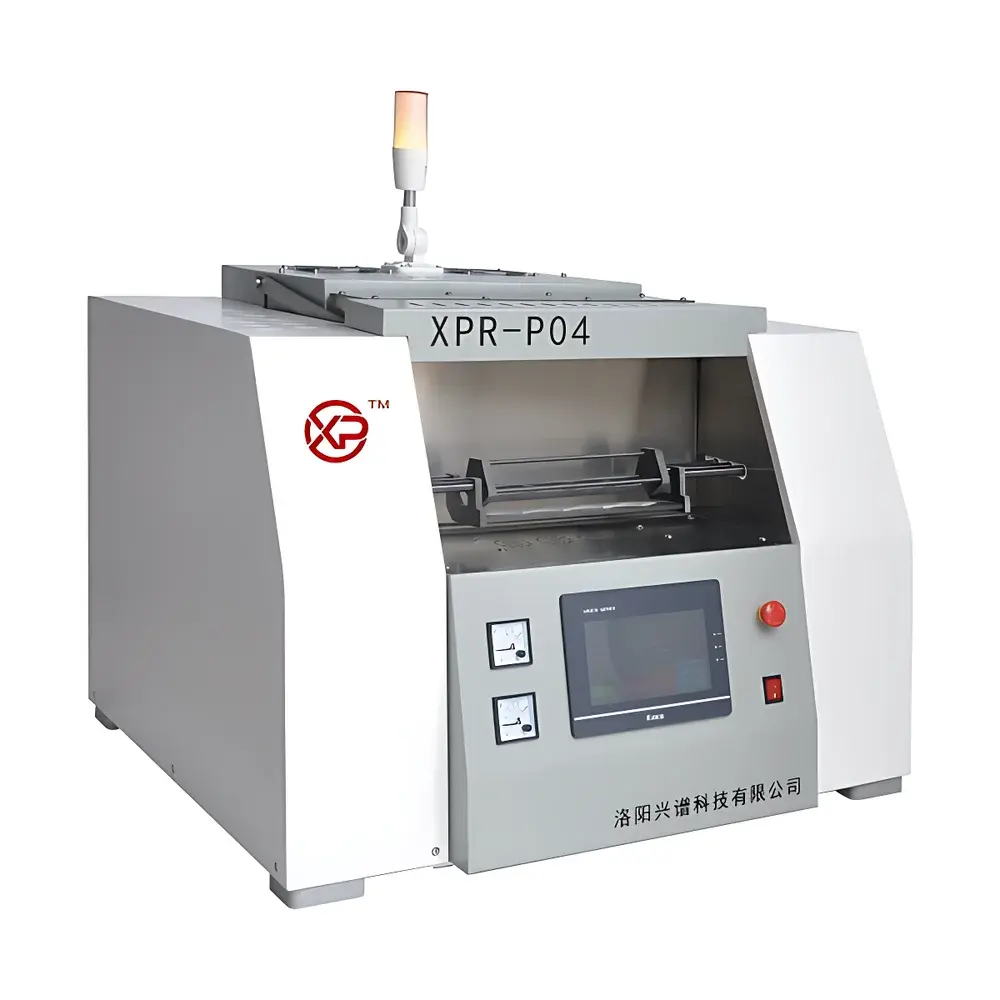
Xingpu XPR-P04 Multi-Position Fusion Machine for XRF and ICP Sample Preparation
| Brand | Xingpu |
|---|---|
| Model | XPR-P04 |
| Type | Automated Fusion Machine |
| Heating Element | Silicon Carbide Rods |
| Temperature Range | 0–1300 °C |
| Control Accuracy | ±1 °C (S-type Pt/Rh Thermocouple) |
| Rated Power | 10 kW |
| Oscillation Amplitude | 0–60° adjustable |
| Sample Capacity | 1–4 positions |
| Fusion Mold Ejection | Automatic Tilt Casting |
| Crucible Set | 50 g Fusion Crucible + 30 g Mold Crucible |
| Dimensions (L×W×H) | 810 × 750 × 610 mm |
Overview
The Xingpu XPR-P04 is an automated multi-position fusion machine engineered for high-precision, reproducible preparation of homogeneous glass beads from solid inorganic samples—primarily for subsequent quantitative elemental analysis by wavelength-dispersive X-ray fluorescence (WD-XRF) or inductively coupled plasma (ICP-OES/MS) spectroscopy. It operates on the principle of high-temperature flux fusion: powdered samples are mixed with alkaline fluxes (e.g., lithium tetraborate/lithium metaborate), heated to full melt (>1000 °C), homogenized via controlled mechanical oscillation, and cast into preheated molds under inert or ambient atmosphere. The XPR-P04 integrates a four-position rotating sample carousel with synchronized lid actuation, crucible insertion, thermal ramping, oscillatory mixing, and gravity-assisted tilt casting—enabling fully unattended batch processing while maintaining strict thermal uniformity and minimizing operator exposure to high-temperature zones.
Key Features
- Four-position independent fusion station with synchronized mechanical oscillation (0–60° amplitude, adjustable frequency), ensuring uniform melt homogenization without manual stirring.
- Cold-state sample loading/unloading: integrated safety interlock prevents furnace door opening during heating; all crucible handling occurs at ambient temperature.
- Automatic tilt-casting mechanism: precisely timed mold ejection via programmable angular displacement eliminates manual pouring, reduces thermal shock to platinum–gold (Pt–Au) crucibles, and extends service life by up to 40% compared to static casting methods.
- High-stability temperature control: S-type platinum–rhodium thermocouple feedback loop with ±1 °C accuracy across the full 0–1300 °C range; silicon carbide heating elements provide rapid thermal response and long-term stability.
- Robust industrial architecture: stainless steel insulated chamber, ceramic fiber lining, and reinforced crucible support trays designed for continuous operation in ISO/IEC 17025-accredited laboratories.
- Modular crucible configuration: standard 50 g capacity fusion crucibles and 30 g preheated casting molds—compatible with ASTM D5630, ISO 9556, and GB/T 20127 series fusion protocols.
Sample Compatibility & Compliance
The XPR-P04 accommodates a broad spectrum of geological, metallurgical, cementitious, and environmental matrices—including ores, slags, alloys, fly ash, soils, and refractory ceramics—provided they are comminuted to ≤75 µm and compatible with lithium-based flux systems. All fusion cycles comply with critical regulatory frameworks governing analytical sample preparation: procedures align with ASTM E2489 (Standard Practice for Fusion of Siliceous and Aluminosilicate Materials), ISO 8513 (XRF sample preparation by fusion), and USP <730> (for pharmaceutical excipient certification). The instrument’s thermal profile logging, user-accessible audit trail, and password-protected method storage support GLP/GMP documentation requirements and FDA 21 CFR Part 11 readiness when paired with validated LIMS integration.
Software & Data Management
The XPR-P04 operates via an embedded industrial PLC controller with a 7-inch resistive touchscreen HMI. Users define and store up to 99 fusion programs—including ramp rates (°C/min), hold times, oscillation parameters, tilt angle timing, and cooling profiles—with timestamped execution logs. All thermal and motion event data are exportable via USB 2.0 as CSV files for traceability. Optional RS-485 Modbus RTU interface enables bidirectional communication with laboratory information management systems (LIMS) or centralized SCADA platforms—supporting automated job dispatch, real-time status monitoring, and electronic record archiving per ALCOA+ principles.
Applications
- Routine production of fused glass discs for major/minor/trace element quantification in mining QA/QC labs.
- Preparation of certified reference material (CRM) blends for method validation and instrument calibration.
- High-throughput fusion of stainless steel, aluminum, and copper alloy powders prior to ICP analysis.
- Processing of heterogeneous slag and cement clinker samples requiring matrix homogenization beyond grinding alone.
- Research-scale development of novel flux ratios and fusion kinetics studies under controlled thermal–mechanical conditions.
FAQ
What types of fluxes are compatible with the XPR-P04?
Lithium tetraborate (Li₂B₄O₇), lithium metaborate (LiBO₂), and their eutectic mixtures (e.g., 66.7% Li₂B₄O₇ + 33.3% LiBO₂) are fully supported; fluoride-containing fluxes require optional corrosion-resistant chamber lining.
Can the XPR-P04 be used for sulfur-rich samples like pyrites?
Yes—when operated under argon purge (optional accessory) and with appropriate flux excess (≥10:1 flux-to-sample ratio), sulfur retention exceeds 95% per ISO 12677 Annex C.
Is platinum–gold crucible conditioning required before first use?
Yes—standard protocol includes three empty-cycle burnouts at 1100 °C to stabilize the Pt–Au surface oxide layer and minimize analyte adsorption in subsequent runs.
Does the system support remote diagnostics or firmware updates?
Firmware updates are performed locally via USB; remote diagnostic access requires optional Ethernet gateway module and IT-approved network segmentation.
What maintenance intervals are recommended for the oscillation drive mechanism?
Lubrication of the cam-driven tilt linkage is advised every 500 operational hours; full gear inspection is scheduled at 2,000-hour intervals per the maintenance logbook.



