
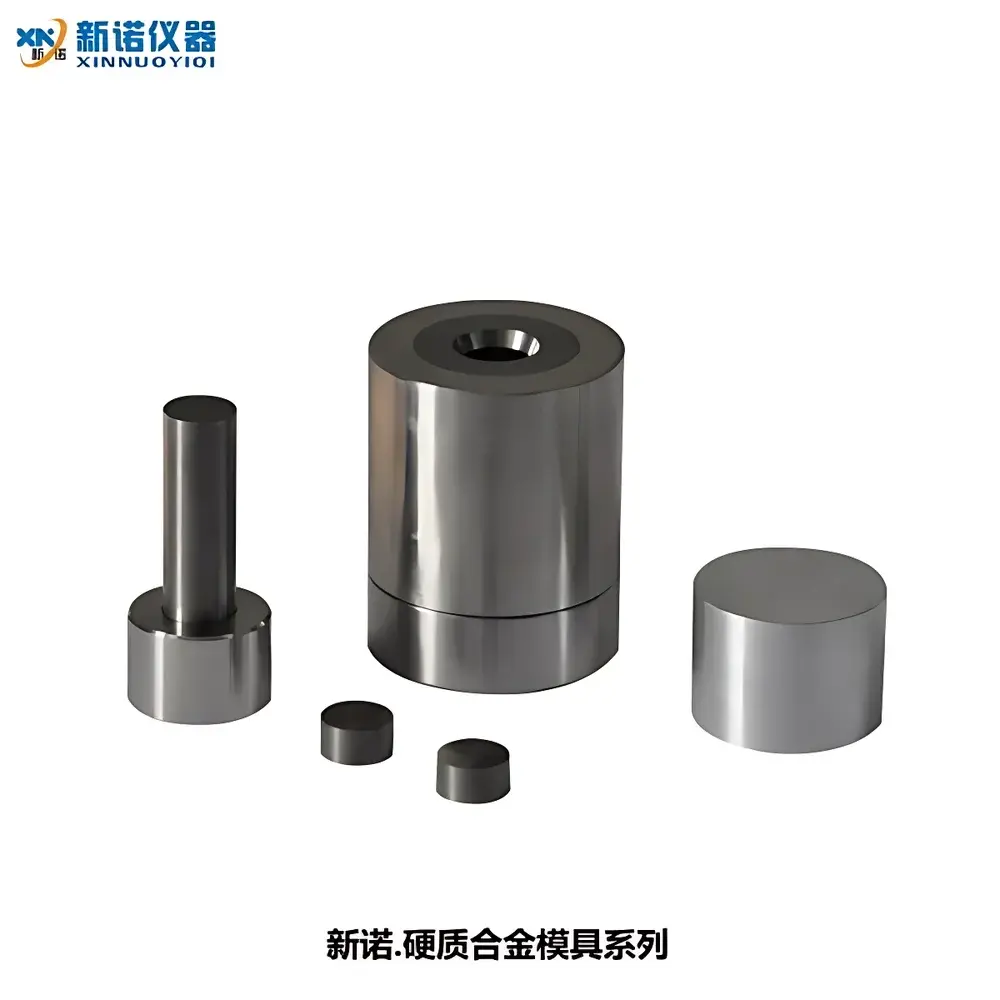
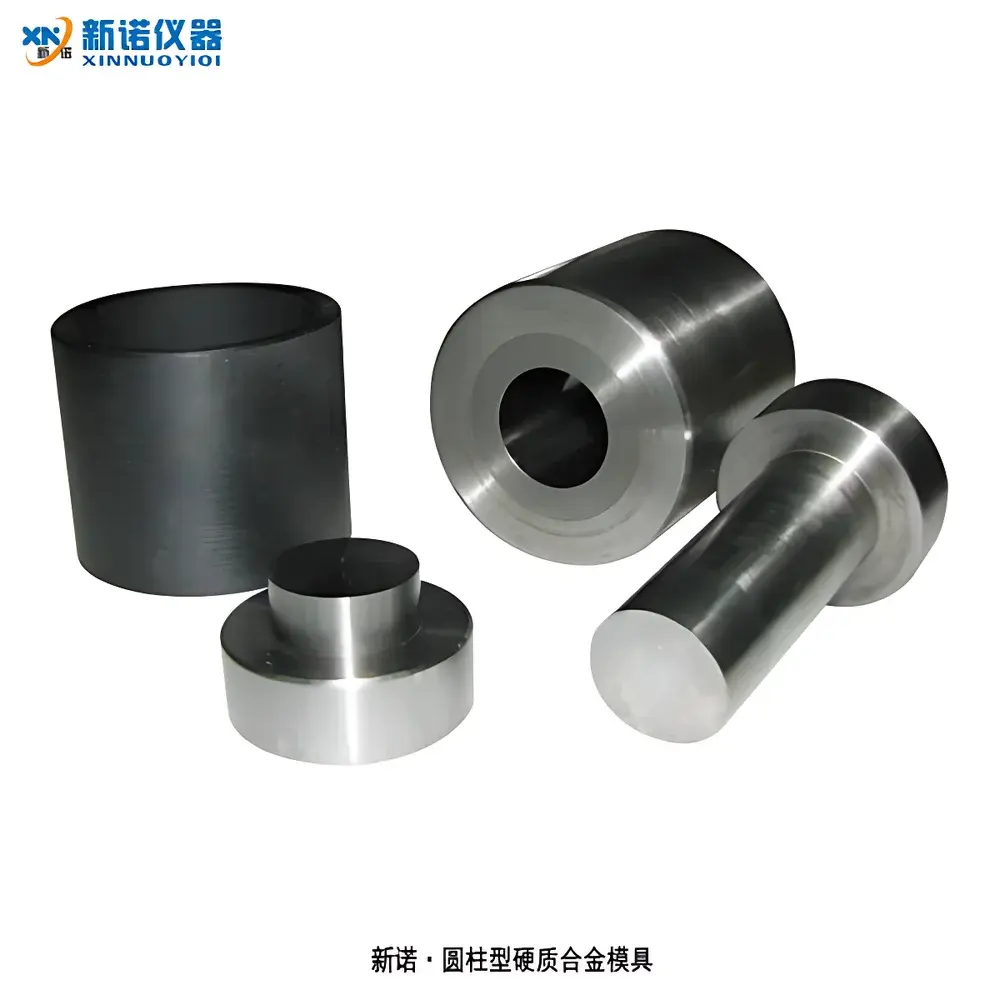
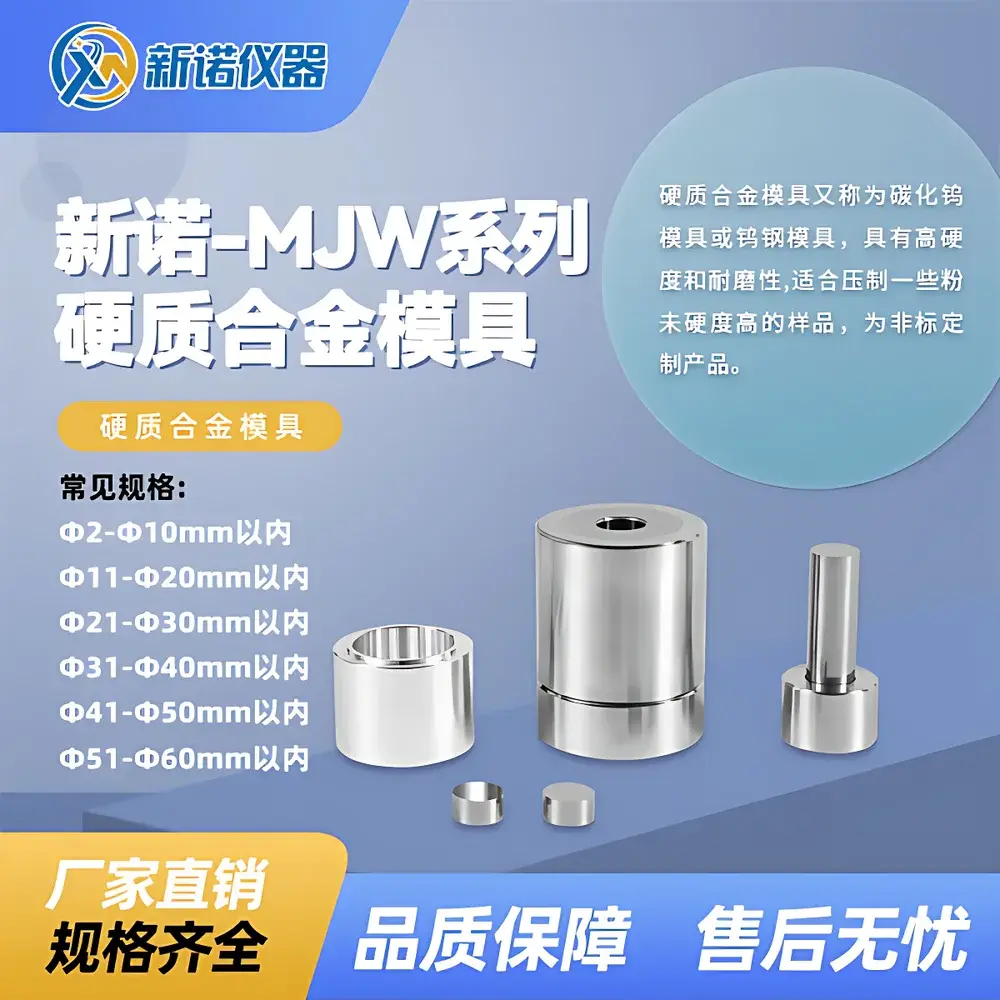
XINNUO Tungsten Carbide Pellet Die Set for Laboratory Powder Press
| Brand | XINNUO |
|---|---|
| Origin | Shanghai, China |
| Manufacturer Type | Direct Manufacturer |
| Product Category | Domestic |
| Die Diameter Range | Φ3–Φ60 mm |
| Unit Price Range | USD 140–2,150 (FOB Shanghai) |
Overview
The XINNUO Tungsten Carbide Pellet Die Set is a precision-engineered tooling solution designed exclusively for laboratory-scale powder compaction and pellet formation in analytical sample preparation workflows. Constructed from sintered tungsten carbide (WC–Co), these dies leverage the intrinsic material properties of ultra-high hardness (HRA ≥90), exceptional wear resistance, dimensional stability under high compressive loads (up to 40 tons), and thermal resilience—retaining mechanical integrity up to 800 °C. Unlike standard stainless-steel or hardened tool-steel dies, tungsten carbide dies minimize die wall friction, reduce particle adhesion, and ensure consistent green density across repeated pressing cycles—critical for quantitative X-ray fluorescence (XRF), Fourier-transform infrared (FTIR), and X-ray diffraction (XRD) sample analysis where pellet homogeneity directly impacts measurement reproducibility.
Key Features
- Monolithic tungsten carbide construction with cobalt binder (typically 6–12% Co by weight), providing uniform microstructure and isotropic mechanical response
- Cylindrical and rectangular die configurations available—standardized for compatibility with manual, hydraulic, and automated laboratory pellet presses (e.g., XINNUO YP series, Specac, Pike Technologies, and Carver presses)
- Surface finish: Ra ≤0.2 µm on die bore and punch contact surfaces, minimizing powder retention and enabling rapid cleaning between samples
- Tight tolerance control: ±0.005 mm on inner diameter and parallelism <0.01 mm across die height—ensuring concentricity and uniform pressure transmission
- Non-standard customization supported: custom diameters (Φ3–Φ60 mm), aspect ratios, stepped geometries, and optional surface coatings (e.g., TiN or CrN) for enhanced release in hygroscopic or sticky matrices
Sample Compatibility & Compliance
These dies accommodate a broad spectrum of inorganic and organic powders—including metal oxides, geological standards, pharmaceutical excipients, catalysts, battery cathode materials (e.g., LiCoO₂, NMC), and ceramic precursors—without deformation or galling. All dies are manufactured in accordance with ISO 9001-certified production protocols. Dimensional conformity is verified using coordinate measuring machines (CMM) traceable to NIM (National Institute of Metrology, China). While not certified to ASTM E1759 or ISO 17025 as standalone instruments, the dies meet mechanical requirements specified in ASTM D7709 (Standard Practice for Preparation of Solid Samples for FTIR Analysis) and ISO 21047 (XRF—Preparation of Solid Samples by Pressing Pellets). No regulatory certification (e.g., FDA, CE) applies, as dies are classified as consumable tooling—not medical or safety-critical devices.
Software & Data Management
As passive mechanical tooling, the die set requires no embedded firmware, drivers, or software integration. However, its dimensional consistency supports full auditability within GLP/GMP-compliant environments: each die batch is assigned a unique traceability code linked to raw material lot numbers, sintering parameters, and CMM verification reports. Customers may incorporate die identification into LIMS or electronic lab notebooks (ELN) via standardized naming conventions (e.g., “XINNUO-WC-DIE-Φ13.00-202405-LOT789”). No data logging or connectivity features are provided—consistent with industry practice for precision tooling components.
Applications
- Preparation of pressed pellets for wavelength-dispersive XRF (WDXRF) and energy-dispersive XRF (EDXRF) quantitative analysis
- FTIR transmission and ATR sample support for polymer, pharmaceutical, and forensic powder analysis
- Formation of dense green bodies for sintering trials in advanced ceramics R&D
- Reference material homogenization and matrix-matched calibration pellet fabrication
- High-pressure phase studies requiring inert, non-reactive containment during cold isostatic pressing (CIP)
FAQ
Are these dies compatible with non-XINNUO press systems?
Yes—standardized outer dimensions and mounting interfaces ensure mechanical compatibility with most commercial laboratory pellet presses, including Carver, Specac, PIKE, and PerkinElmer models. Custom adapters are available upon request.
What is the typical lead time for non-standard sizes?
Standard diameters (Φ3–Φ40 mm) ship within 5–7 business days; custom geometries (e.g., rectangular, stepped, or >Φ40 mm) require 12–18 working days post-design approval.
Do you provide calibration certificates or test reports?
Yes—each order includes a Certificate of Conformance listing measured dimensions, surface roughness, and material composition per batch. CMM inspection reports are available upon request at no additional cost.
Can these dies be refurbished or reconditioned after extended use?
Tungsten carbide dies are not regrindable due to brittleness and risk of microcracking. We recommend replacement upon visible edge chipping or measurable bore diameter deviation exceeding ±0.01 mm.
Is there a minimum order quantity (MOQ) for custom configurations?
No MOQ—single-piece custom orders are accepted. Pricing scales with complexity, not volume.



