
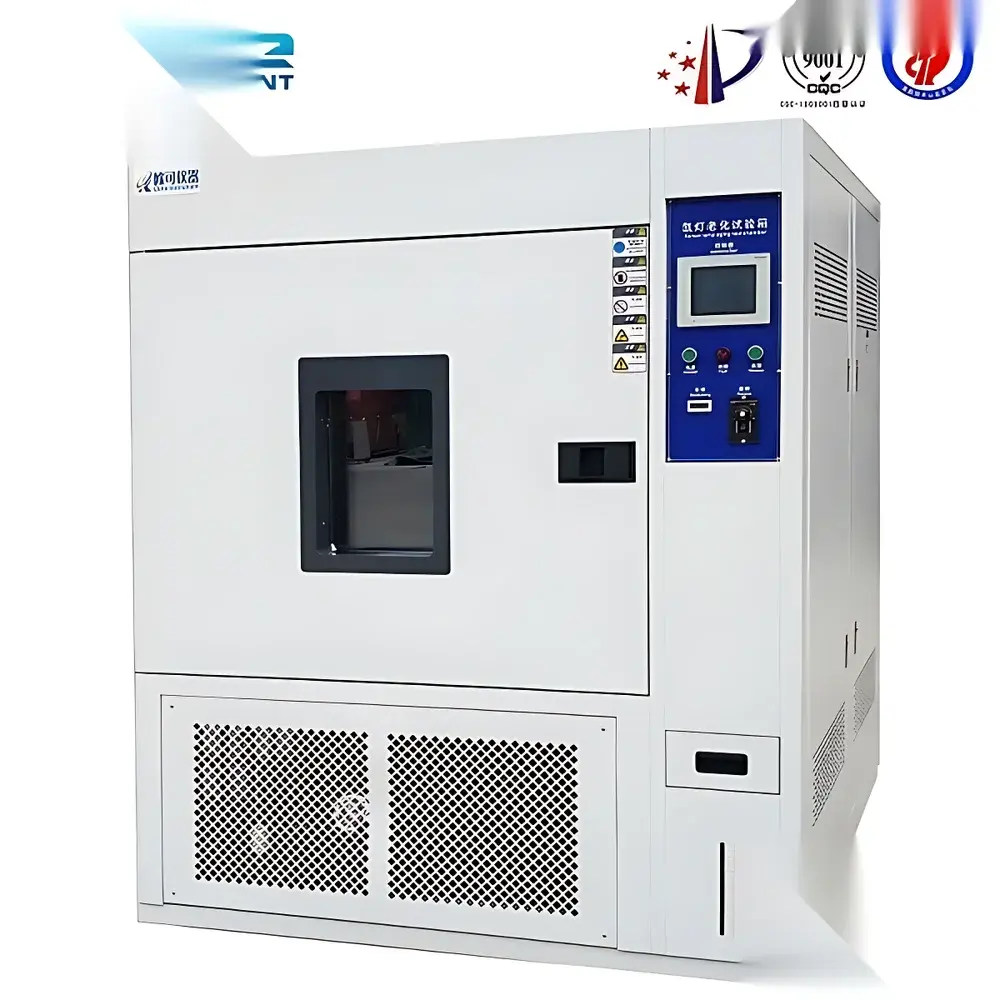
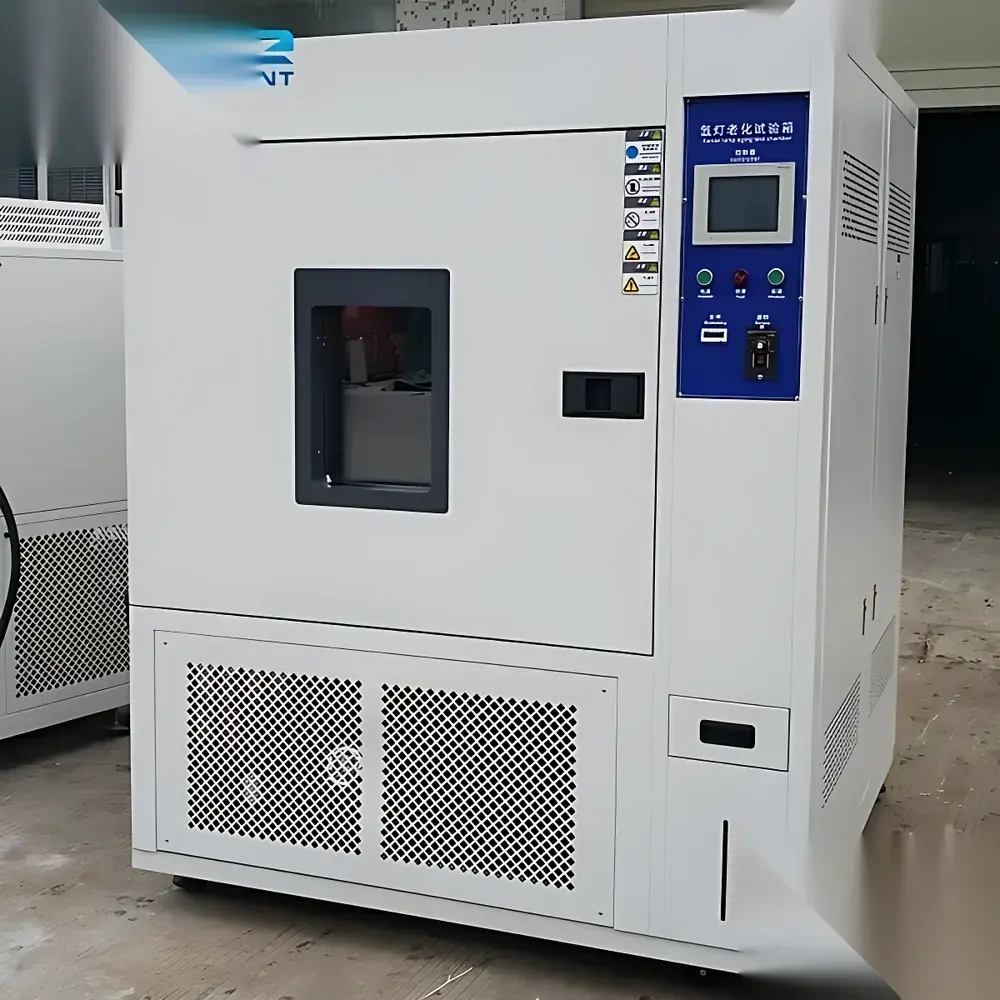
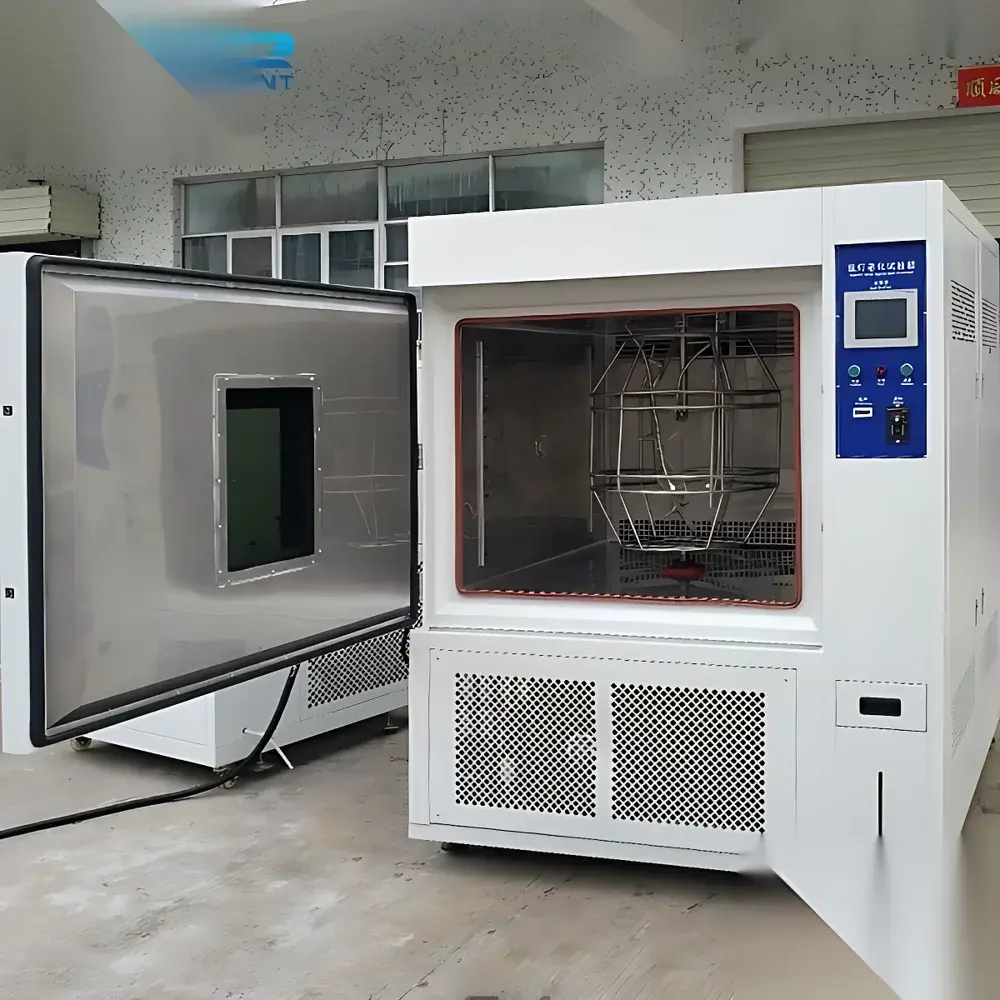
XL-1000 Research-Grade Xenon Arc Weathering Test Chamber
| [Working Chamber | 400 × 1100 × 400 mm (D×W×H) |
|---|---|
| External Dimensions | 850 × 1330 × 1000 mm (D×W×H) |
| UV-A Spectral Range | 320–380 nm |
| Irradiance Control | Adjustable up to 0.7 W/m² @ 340 nm |
| Humidity Range (Irradiation Phase) | 45–80 %RH |
| Condensation Humidity | ≥95 %RH |
| Condensation Temperature | 40–60 °C (±3 °C tolerance) |
| Light Exposure Temperature | 50–60 °C (±3 °C tolerance) |
| Black Panel Temperature Range | 30–60 °C (±1 °C tolerance) |
| Temperature Resolution | 0.1 °C |
| Water Tray Depth | ≤30 mm with Auto-Fill Control |
| Control Logic | Independent & Cyclic Programmable Irradiation/Condensation Phases (up to 999 h per segment)] |
Overview
The XL-1000 Research-Grade Xenon Arc Weathering Test Chamber is engineered for precise simulation of solar radiation, thermal cycling, humidity, and moisture condensation effects on polymeric, coated, and composite materials. It employs a stabilized xenon arc lamp as the light source, spectrally filtered to replicate terrestrial sunlight across UV, visible, and near-infrared wavelengths—particularly critical for evaluating photochemical degradation mechanisms such as chain scission, oxidation, and pigment fading. Unlike UV fluorescent or metal halide systems, xenon arc technology delivers full-spectrum irradiance closely aligned with ASTM G155 and ISO 4892-3 reference conditions, making it the internationally accepted benchmark for accelerated weathering validation in R&D laboratories and quality assurance environments.
Key Features
- High-fidelity spectral output compliant with ISO 4892-3, ASTM D4329, D4587, D5208, and GB/T 16422.3—ensuring data traceability to international material qualification protocols.
- Dual-phase environmental control: independent programming of irradiation (with black panel temperature monitoring) and condensation cycles, each configurable up to 999 hours with seamless transitions.
- PID self-tuning temperature regulation system coupled with stainless-steel water-jacketed chamber heating for uniform thermal distribution and minimal gradient deviation (±3 °C tolerance).
- Fixed-position broadband UV radiometer calibrated at 340 nm, eliminating operator-dependent probe alignment errors and supporting long-term irradiance stability verification.
- Corrosion-resistant interior constructed from imported AISI 304 stainless steel; exterior finished with electrostatically applied epoxy-polyester coating over cold-rolled A3 steel for durability and cleanroom-compatible surface integrity.
- Integrated condensate management via U-shaped sediment trap and vortex-style drainage, minimizing mineral deposit accumulation and enabling routine maintenance without disassembly.
Sample Compatibility & Compliance
The XL-1000 accommodates flat-panel specimens up to 100 mm thick and irregularly shaped components mounted on adjustable sample racks. Its chamber geometry supports standardized specimen holders per ASTM D4329 (flat panels), ISO 4892-3 (exposed area ≥ 0.02 m²), and GB/T 16422.3 (minimum exposure zone dimensions). The system meets essential regulatory framework requirements for method validation under GLP-compliant testing workflows, including audit-ready operational logs, parameter lockout functionality, and hardware-level irradiance calibration traceability. While not pre-certified to FDA 21 CFR Part 11, its programmable logic controller architecture supports integration with validated LIMS or ELN platforms requiring electronic signature and change-control capabilities.
Software & Data Management
The embedded microprocessor-based controller provides real-time display of black panel temperature, chamber humidity, irradiance intensity, and elapsed cycle time. All setpoints and actual values are logged at user-defined intervals (1–60 min) to internal non-volatile memory (≥30 days’ data retention). Export is supported via RS-232 serial interface for CSV-formatted time-series acquisition into third-party analysis tools (e.g., MATLAB, JMP, or LabVIEW). Optional Ethernet module enables remote monitoring and alarm notification via SMTP or Modbus TCP—facilitating multi-chamber fleet management in centralized QA labs. Calibration records—including radiometer zero-offset verification and thermocouple drift compensation—are stored separately with date/time stamps and operator ID fields.
Applications
This chamber serves as a core tool for comparative durability assessment across sectors where long-term outdoor performance prediction is mission-critical: aerospace sealants and radome coatings; automotive exterior trim and headlamp lenses; architectural cladding systems and roofing membranes; medical device polymer housings exposed to sterilization + ambient storage; and photovoltaic encapsulant materials subjected to combined UV/humidity stress. Its ability to replicate diurnal wet/dry transitions—via controlled condensation onset at elevated dew point—enables mechanistic study of hydrolytic degradation pathways in polyesters, polyurethanes, and silicone elastomers under accelerated yet physically representative conditions.
FAQ
What standards does the XL-1000 directly support out-of-the-box?
It is configured to meet the spectral, irradiance, temperature, and humidity parameters defined in ISO 4892-3, ASTM G155, ASTM D4329, GB/T 16422.3, and JIS D0205 without hardware modification.
Can the black panel temperature sensor be recalibrated onsite?
Yes—the thermocouple is field-replaceable and traceable to NIST-certified references; calibration procedures and tolerance limits are documented in the technical manual.
Is condensation generated solely by cooling the chamber walls, or is active humidification involved?
Condensation is achieved exclusively through controlled wall-cooling (chilled water or refrigerant circuit), per ASTM G154 Cycle 1 methodology—no steam or ultrasonic humidifier is used, ensuring reproducible dew-point kinetics.
Does the system include irradiance uniformity mapping data?
A certified uniformity report (±15% across 80% of exposed area at 340 nm) is supplied with each unit, measured per ISO 4892-3 Annex B using a motorized XY scanning radiometer.
What maintenance intervals are recommended for the xenon lamp and filter assembly?
Lamp replacement is advised every 1,500 hours of operation; outer borosilicate and inner quartz filters require inspection every 500 hours and replacement every 3,000 hours or when transmittance drops below 90% of initial value.



