
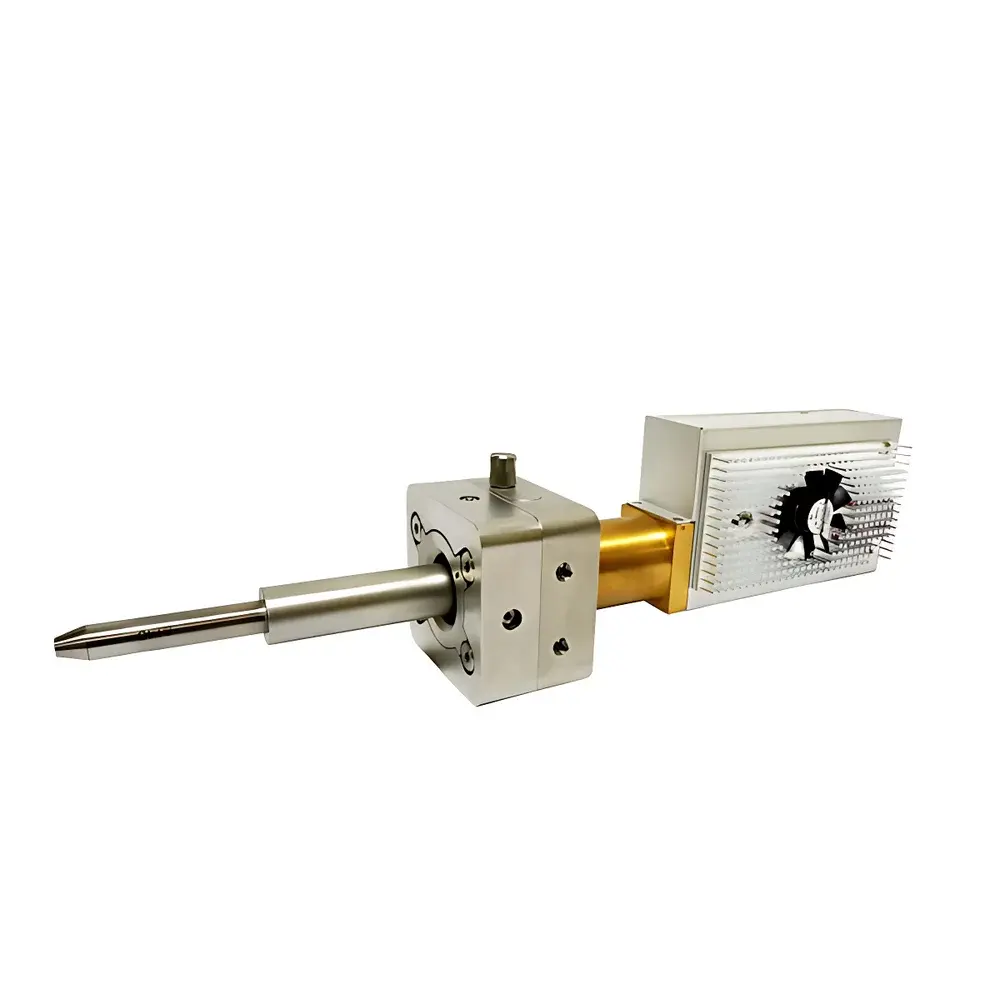
XOS Mini-Beam Compact Microfocus X-ray Source with Polycapillary Optics
| Brand | XOS |
|---|---|
| Origin | USA |
| Model | Mini-Beam |
| Tube Type | Metal-Ceramic |
| Target Materials | Ag, Rh, W, Cu, Cr |
| Operating Voltage | 4–60 kV |
| Beam Current | 5–200 µA |
| Max Power | 12 W |
| Cooling | Forced Air |
| Operating Temp | –10 to +50 °C |
| Input Power | 110/220 VAC, 50/60 Hz |
| Dimensions | 305 × 102 × 76 mm (12 × 4 × 3 in) |
| Weight | 1.95 kg (4.3 lbs) |
| Focal Spot Size | ≤5 µm FWHM @ Rh Kα (20.162 keV) |
| Flux Gain vs. Pinhole | >1000× |
| Capillary Options | PF-004/PF-010/PF-020/PF-050 (focusing) & PC-004/PC-006/PC-010/PC-015 (collimating) |
Overview
The XOS Mini-Beam is a compact, air-cooled microfocus X-ray source engineered for high-brightness, low-power laboratory and OEM integration applications. It leverages a metal-ceramic X-ray tube architecture combined with polycapillary optic coupling to deliver exceptional photon flux density at sub-10 µm focal spots—enabling high-resolution micro-XRF, thin-film metrology, and benchtop XRD/WDS systems. Unlike conventional pinhole collimation, the Mini-Beam integrates directly with commercially available focusing or parallel-beam polycapillary lenses, achieving >1000× higher photon throughput at equivalent source power. Its modular mechanical interface—featuring precision-machined kinematic mounts and optical alignment fiducials—ensures repeatable, sub-arcminute beam positioning without requiring external alignment tools or vacuum re-entry. Designed for continuous-duty operation between –10 °C and +50 °C, the Mini-Beam meets IEC 61010-1 safety standards for Class I electrical equipment and supports flexible target selection (Ag, Rh, W, Cu, Cr) to optimize characteristic line emission for specific elemental or diffraction applications.
Key Features
- Sub-5 µm focal spot size (FWHM) at Rh Kα (20.162 keV), verified via knife-edge scanning and NIST-traceable beam profiling
- Modular polycapillary compatibility: interchangeable focusing (PF-series) and collimating (PC-series) optics with standardized flange interfaces
- Integrated removable filter holder supporting custom thin-film filters (e.g., Ni, Al, Pd) for spectral tailoring and background suppression
- USB 2.0 interface for real-time parameter control (kV, µA, exposure timing) and firmware updates; no external HV controller required
- Forced-air thermal management enabling stable output over extended acquisitions—no water cooling or chiller dependency
- Compact footprint (305 × 102 × 76 mm) and lightweight construction (1.95 kg) optimized for space-constrained platforms including handheld analyzers and automated wafer inspection stages
Sample Compatibility & Compliance
The Mini-Beam is compatible with solid, powdered, and thin-film samples across non-destructive elemental analysis and crystallographic characterization workflows. Its low-power design (≤12 W) eliminates radiation shielding requirements beyond standard cabinet interlocks per ANSI N43.3 and EU Directive 2013/59/Euratom. When integrated into certified analytical instruments, the source supports GLP-compliant data acquisition under ISO/IEC 17025 and ASTM E1621 (micro-XRF), E1361 (thin-film thickness), and E975 (XRD residual stress). All target materials and tube operating parameters are documented per RoHS 2011/65/EU and REACH Annex XIV substance restrictions.
Software & Data Management
XOS provides the Mini-Beam Control Suite—a cross-platform application (Windows/macOS/Linux) supporting scriptable acquisition via Python API (PyMiniBeam SDK). The software logs all operational parameters (kV, µA, runtime, temperature, filter ID) with timestamped metadata compliant with FDA 21 CFR Part 11 audit trail requirements. Raw intensity data exports to industry-standard formats (CSV, HDF5, SPE) for downstream processing in PyMCA, DIFFRAC.SUITE, or custom MATLAB/Python pipelines. Firmware updates preserve calibration coefficients and maintain traceability to factory reference measurements.
Applications
- Micro-XRF mapping of heterogeneous geological samples and electronic components with lateral resolution down to 10 µm
- Non-contact thickness measurement of electroplated layers (Ni, Au, Sn) on PCBs and semiconductor interconnects
- Phase identification and crystallite size analysis in battery cathode powders using benchtop XRD with PC-series collimators
- In-line quality control of coated pharmaceutical tablets via elemental distribution imaging
- Custom OEM integration into portable LIBS–XRF hybrid spectrometers and synchrotron beamline pre-focusing stations
FAQ
What is the minimum achievable focal spot size, and how is it measured?
The Mini-Beam achieves ≤5 µm FWHM at Rh Kα, measured using a tungsten knife-edge scan under controlled vacuum conditions and deconvolved against detector point-spread function per ISO 20658.
Can the Mini-Beam operate continuously at maximum power?
Yes—forced-air cooling enables uninterrupted operation at 12 W (60 kV × 200 µA) for >8 hours with thermal drift <0.3% in tube current.
Is remote monitoring of tube health supported?
Yes—the USB interface reports real-time anode temperature, filament emission current, and arcing events; predictive maintenance alerts are configurable in Control Suite.
Are custom target materials available beyond the standard Ag/Rh/W/Cu/Cr set?
Yes—XOS offers Mo, Co, and Fe targets upon request, subject to regulatory approval and lead time validation.
Does the Mini-Beam require periodic recalibration?
No—factory-calibrated kV/µA sensors and beam position stability eliminate routine recalibration; annual verification against NIST-traceable reference sources is recommended for ISO 17025 compliance.




