
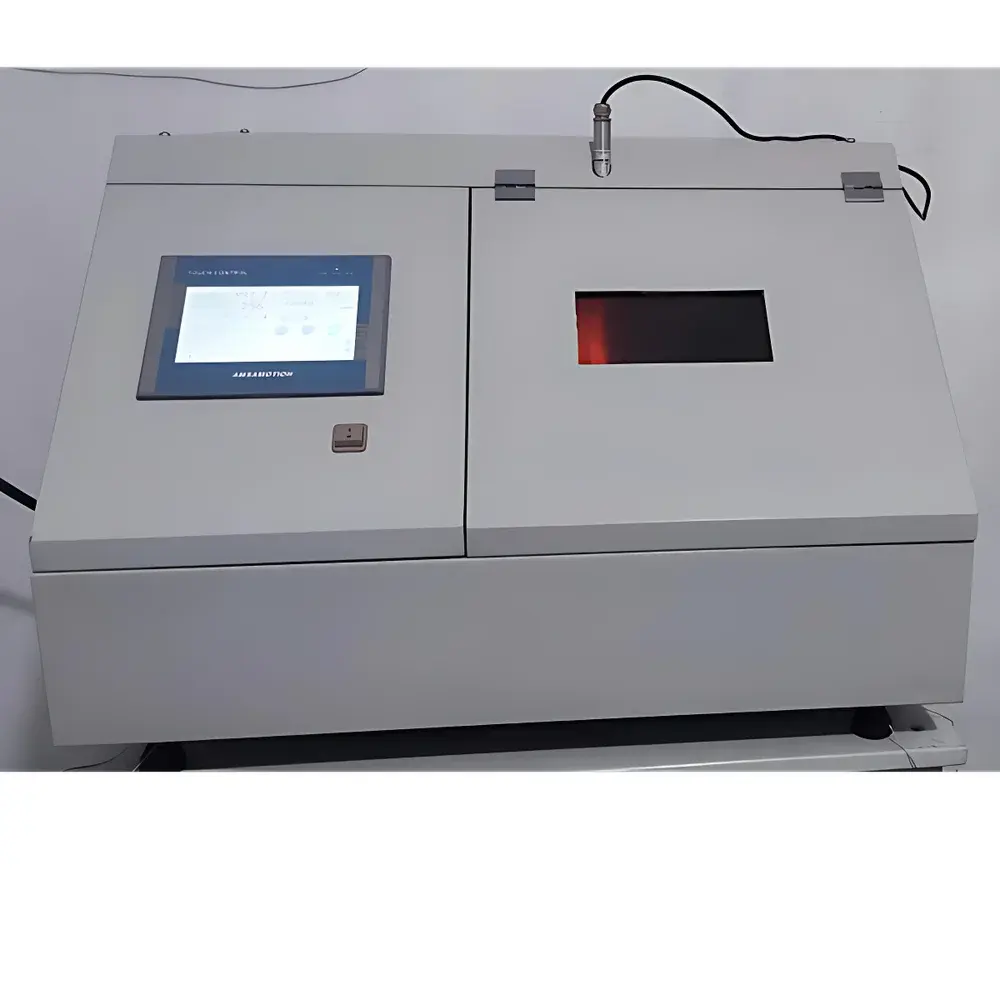
XQ 4.0 Automatic Tipping High-Frequency Fusion Machine for XRF Sample Preparation
| Brand | XQ |
|---|---|
| Origin | Liaoning, China |
| Manufacturer Type | Authorized Distributor |
| Country of Origin | China |
| Model | XQ 4.0 |
| Quotation | Upon Request |
| Throughput | 8 samples/hour |
| Operating Temperature Range | 1100–1300 °C |
| Dimensions (L×W×D) | 800×720×560 mm |
Overview
The XQ 4.0 Automatic Tipping High-Frequency Fusion Machine is a dedicated sample preparation instrument engineered for quantitative X-ray fluorescence (XRF) spectrometry. It employs high-frequency induction heating to melt and homogenize inorganic solid samples—including geological materials (rocks, soils, ores), industrial slags, coal ash, and metallurgical residues—in platinum–gold (Pt–Au) crucibles. The process follows a precisely controlled thermal sequence: pre-oxidation (600–800 °C), high-temperature fusion (1100–1300 °C), dynamic mixing via crucible oscillation, automatic tipping for mold filling, controlled cooling, and final glass disc ejection. Unlike resistive furnace-based fusion systems, the XQ 4.0 delivers rapid thermal response (<60 s to reach fusion temperature), minimal thermal inertia, and superior energy efficiency—enabling on-demand operation without prolonged standby cycles. Its architecture conforms to core requirements for ISO 9516-1 (XRF fusion methodology), ASTM E2462 (standard practice for fused bead preparation), and supports GLP-compliant traceability when integrated with validated software workflows.
Key Features
- Automatic tipping mechanism ensures consistent, repeatable glass disc formation with zero manual intervention during pouring.
- Programmable pre-oxidation stage (600–800 °C) mitigates volatile loss and sulfur interference in sulfide-rich or organic-bearing matrices.
- High-frequency induction coil (operating frequency ≥250 kHz) provides uniform volumetric heating, minimizing thermal gradients across the Pt–Au crucible and reducing segregation risk.
- Microprocessor-controlled thermal profile with up to 8 user-defined methods, each storing target temperatures, ramp rates, hold times, oscillation parameters, and tipping angles.
- Low-voltage induction circuitry (≤48 V AC secondary side) enhances operator safety and complies with IEC 61000-6-4 electromagnetic compatibility standards.
- Crucible oscillation system generates controlled vortex flow during melting, improving homogeneity—particularly critical for heterogeneous ores and slag samples.
- Integrated cooling stage with programmable air-blast rate ensures reproducible thermal history, minimizing residual stress and micro-cracking in final beads.
Sample Compatibility & Compliance
The XQ 4.0 accommodates standard 32 mm or 40 mm diameter Pt–Au crucibles and compatible graphite or borosilicate molds. It supports common fusion fluxes including lithium tetraborate (Li₂B₄O₇), lithium metaborate (LiBO₂), and mixed Li₂B₄O₇–LiBO₂ formulations. Sample mass range: 0.2–1.0 g; typical dilution ratios: 1:10 to 1:50. The system meets mechanical and electrical safety requirements per IEC 61010-1 for laboratory equipment. While not certified to UL or CE as a complete system (due to distributor status), all subassemblies—including power supply, controller, and induction unit—bear relevant RoHS and EMC declarations. Documentation supports audit readiness for ISO/IEC 17025 accredited laboratories performing XRF analysis.
Software & Data Management
The embedded control interface features a 7-inch TFT-LCD touchscreen with multilingual support (English, Spanish, German, Chinese). All method parameters—including temperature setpoints, dwell times, oscillation frequency (0–3 Hz), and tipping delay—are logged with timestamp, operator ID, and sample ID. Export options include CSV files via USB port for integration into LIMS or QA/QC databases. Audit trail functionality records parameter changes, emergency stops, and calibration events—aligning with FDA 21 CFR Part 11 principles when paired with electronic signature protocols. Remote diagnostics are available via optional Ethernet module (IEEE 802.3 compliant).
Applications
- Preparation of homogeneous glass discs from silicate rocks, clays, and sediments for major and minor element quantification by wavelength-dispersive (WDXRF) and energy-dispersive (EDXRF) spectrometers.
- Routine fusion of cement raw meals, fly ash, and blast furnace slags in quality control labs adhering to EN 196-2 and ASTM C114.
- Trace metal analysis in environmental soil extracts where pre-oxidation prevents carbon-induced matrix effects.
- High-throughput sample preparation in contract testing laboratories serving mining, cement, and metallurgical sectors—achieving 8 certified reference material (CRM) beads per hour with <2% RSD for SiO₂, Al₂O₃, Fe₂O₃ across replicate runs.
FAQ
What crucible types and sizes are supported?
Standard 32 mm and 40 mm outer-diameter Pt–Au crucibles (95% Pt / 5% Au) are compatible. Graphite crucibles are not recommended due to reactivity at >1000 °C.
Does the system support ASTM E2462-compliant fusion protocols?
Yes—pre-oxidation, controlled fusion time (180–300 s), and defined cooling profiles are fully programmable to meet ASTM E2462 Annex A1 requirements.
Can method parameters be locked to prevent unauthorized modification?
Yes—administrator-level password protection enables role-based access control for method editing, calibration, and system configuration.
Is remote monitoring or integration with laboratory information management systems (LIMS) possible?
USB data export is standard; optional Ethernet connectivity enables Modbus TCP or OPC UA communication for LIMS integration.
What maintenance intervals are recommended for the induction coil and cooling system?
Induction coil inspection every 12 months; air filter cleaning every 200 operating hours; annual verification of thermocouple calibration against NIST-traceable reference standards.



