
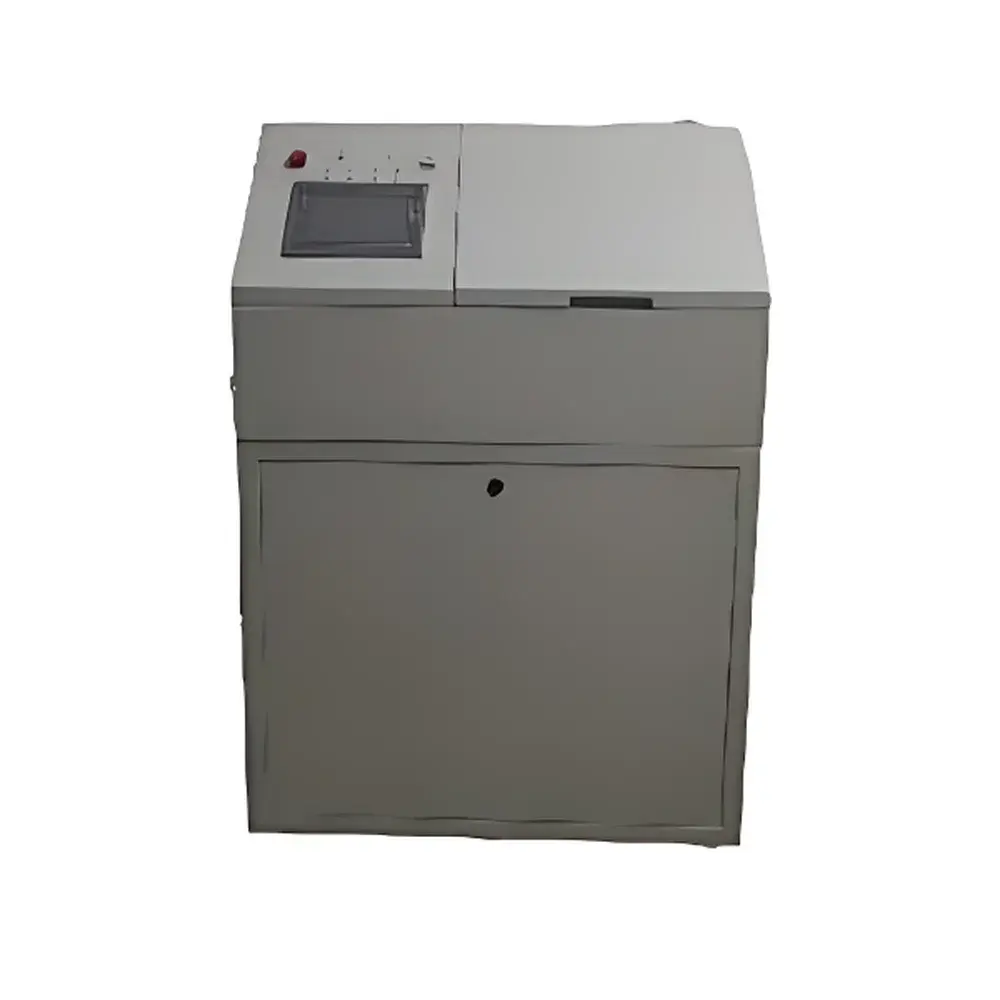
XQ3.1 High-Frequency Fusion Machine for XRF Sample Preparation
| Brand | XQ |
|---|---|
| Origin | Liaoning, China |
| Manufacturer Type | Authorized Distributor |
| Country of Origin | China |
| Model | XQ 3.1 |
| Quotation | Available Upon Request |
| Throughput | 24 Samples/Hour |
| Operating Temperature Range | 1100–1300 °C |
| Dimensions (L×W×D) | 850 × 690 × 1210 mm |
Overview
The XQ3.1 High-Frequency Fusion Machine is an engineered solution for standardized, reproducible glass disc preparation in wavelength-dispersive (WDXRF) and energy-dispersive (EDXRF) spectrometry laboratories. It employs high-frequency induction heating—operating at 27 MHz—to rapidly and uniformly heat platinum–gold alloy crucibles containing sample–flux mixtures. Unlike resistive or gas-fired furnaces, this method delivers precise thermal control with minimal thermal inertia, enabling rapid ramp rates and stable dwell temperatures essential for homogenizing refractory matrices such as silicates, oxides, slags, coal ash, geological samples, and metallurgical residues. The system integrates a programmable pre-oxidation stage (600–800 °C), followed by controlled fusion (1000–1300 °C), dynamic crucible rotation to induce laminar vortex mixing, and automated mold casting and cooling. Designed specifically for XRF compliance workflows, it eliminates compositional segregation and ensures high-density, bubble-free glass discs with ≤0.5% relative standard deviation (RSD) in major oxide replicates across consecutive runs.
Key Features
- High-frequency induction heating (27 MHz) with fast thermal response and low power standby consumption
- Programmable dual-stage thermal profile: pre-oxidation (600–800 °C) + fusion (1000–1300 °C), each with independent ramp rate and dwell time control
- Motor-driven crucible oscillation (0–60 rpm) during melt phase to generate controlled rotational flow—enhancing homogeneity and minimizing stratification
- Low-voltage heating architecture (≤48 V AC secondary circuit) compliant with IEC 61000-6-2/6-4 immunity and safety standards
- Microprocessor-based controller with 16 preset method slots, real-time temperature logging, and password-protected parameter editing
- Integrated cooling module with forced-air quenching and automatic disc ejection mechanism for cycle times ≤2.5 minutes per sample
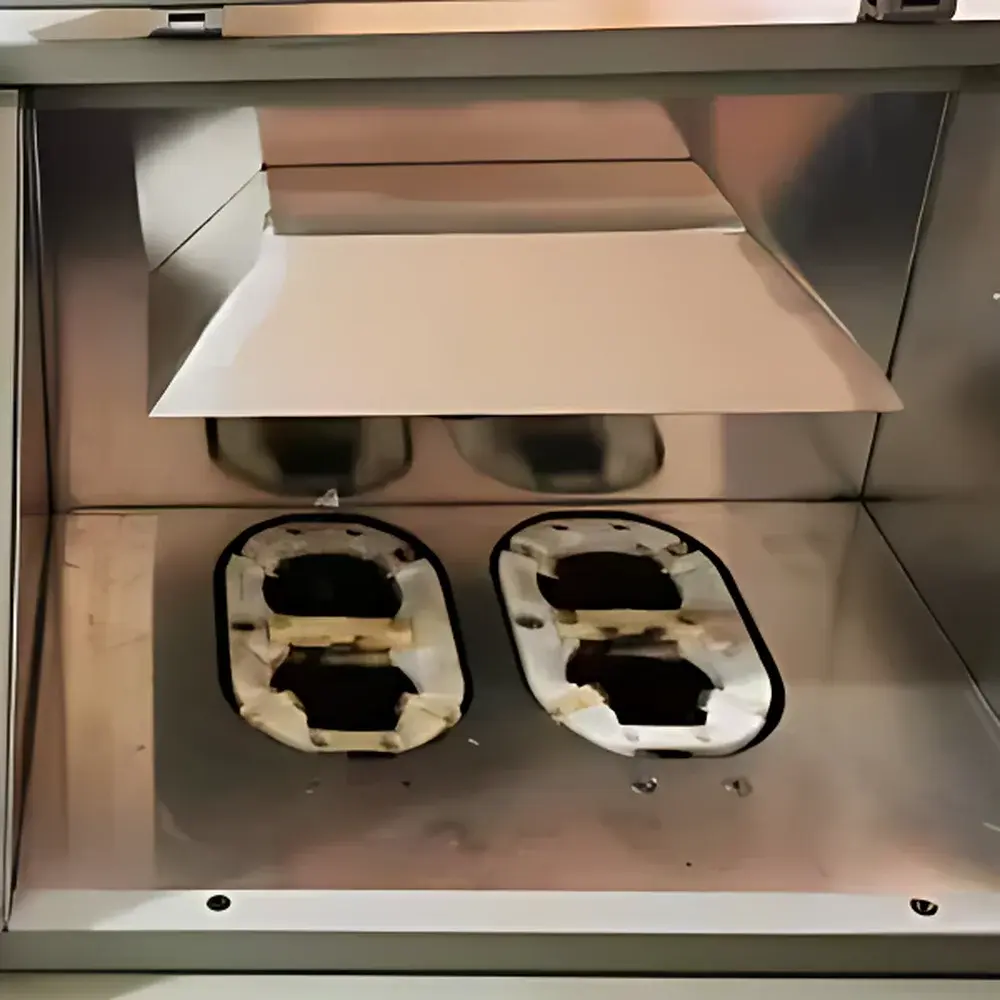
- Stainless-steel insulated chamber with ceramic fiber lining and interlocked access door meeting EN 61000-3-11 harmonic emission limits
Sample Compatibility & Compliance
The XQ3.1 accommodates standard 32 mm platinum–gold (Pt–Au, 95:5 wt%) crucibles and matching graphite or stainless-steel molds. It supports common XRF flux systems—including lithium tetraborate (Li₂B₄O₇), lithium metaborate (LiBO₂), and mixed Li₂B₄O₇/LiBO₂ blends—as well as oxidizers (e.g., NH₄NO₃, V₂O₅) for sulfide or organic-rich matrices. All thermal profiles are traceable to NIST-traceable thermocouples (Type S, ±0.5 °C accuracy at 1200 °C). The instrument complies with ISO 8596:2022 (XRF sample preparation), ASTM D5630-22 (ash fusion testing), and GLP-aligned audit trail requirements via optional RS232/USB data export. Optional firmware upgrade enables 21 CFR Part 11–compliant electronic signatures and user-access-level management.
Software & Data Management
The embedded control interface provides real-time graphical display of temperature vs. time curves, crucible rotation speed, and elapsed cycle duration. Up to 1000 complete run logs—including date/time stamp, method ID, operator code, peak temperature, and final disc weight—are stored onboard with timestamped CSV export capability. An optional Windows-based PC application (XQ-FusionSuite v3.2) enables remote method deployment, batch report generation (PDF/Excel), statistical process monitoring (SPC charts), and integration with LIMS via ODBC drivers. All software modules undergo annual validation per ISO/IEC 17025:2017 Annex A.2 requirements for analytical software qualification.
Applications
- Preparation of fused beads for quantitative major- and minor-element analysis (SiO₂, Al₂O₃, Fe₂O₃, CaO, MgO, Na₂O, K₂O, TiO₂, P₂O₅) in geochemical exploration and mining QA/QC
- Routine cement clinker and raw meal analysis per ASTM C114 and EN 196-2 protocols
- Coal ash characterization in power generation and environmental compliance testing
- Slag and matte analysis in non-ferrous metallurgy (Cu, Ni, Zn, Pb processing)
- Refinery catalyst residue screening under ASTM D7343 and IP 501 guidelines
- Research-grade glass disc fabrication for calibration standard development and matrix-matched reference material production
FAQ
What crucible materials are compatible with the XQ3.1?
Platinum–gold (95:5) crucibles are standard; platinum–rhodium (90:10) variants may be used upon request with adjusted temperature calibration.
Does the system support GLP-compliant audit trails?
Yes—when equipped with optional firmware package XQ-GLP v2.1, it records operator ID, method version, timestamped parameter changes, and thermal deviations exceeding ±5 °C.
Can pre-oxidation parameters be customized per sample type?
Yes—each of the 16 stored methods includes independent pre-oxidation setpoint, ramp rate, and hold time fields.
Is external cooling water required?
No—the integrated air-cooling system meets thermal dissipation requirements for continuous operation at rated throughput.
How is temperature accuracy verified?
Factory calibration uses dual-point verification against NIST-traceable blackbody sources at 800 °C and 1200 °C; users may perform field verification using certified Pt–Rh thermocouple check points.
Related Products



