
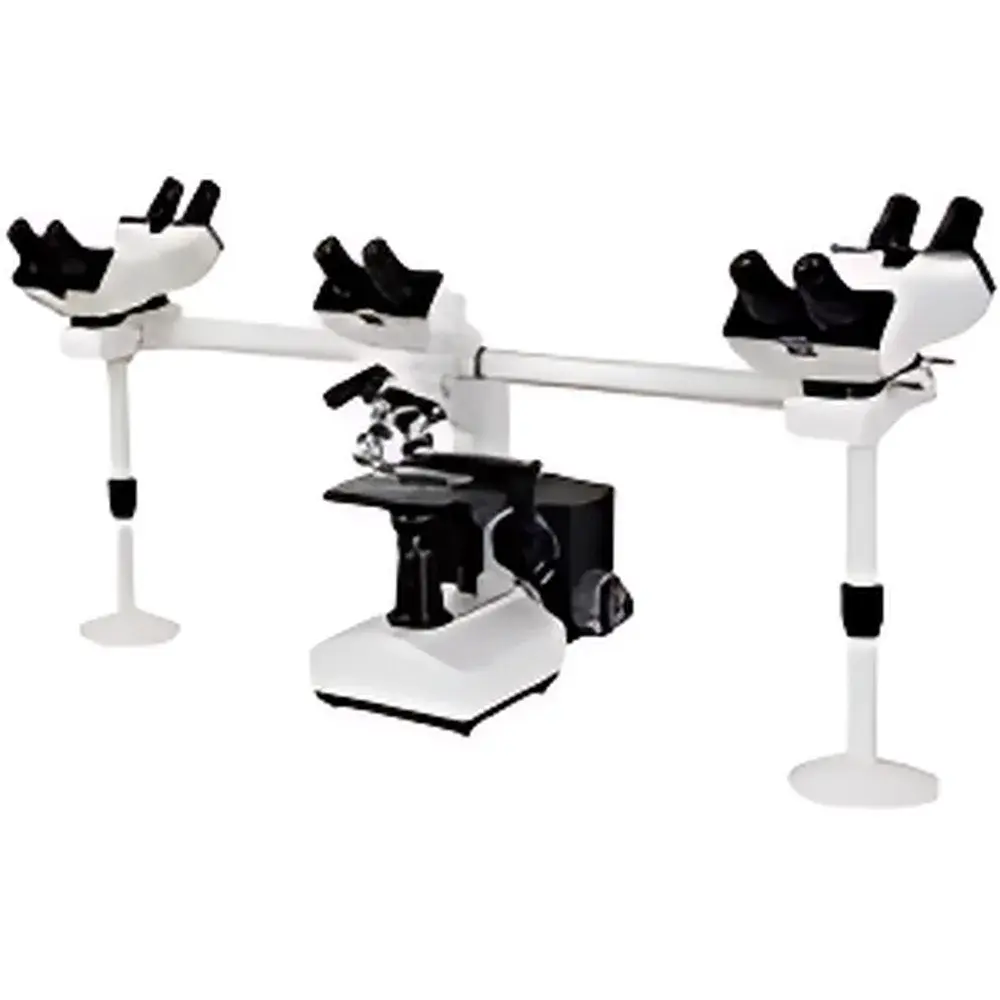
XSZ-N510 Series Multi-Observer Biological Microscope
| (Manufacturer | Zhejiang-based OEM |
|---|---|
| Origin | China |
| Model | XSZ-N510 Series |
| Price Range | USD 280 – 700) |
| [Origin | Zhejiang, China |
| Manufacturer Type | Authorized Distributor |
| Regional Classification | Domestic (PRC) |
| Model | XSZ-N510 Series |
| Price | USD 280–700 |
| Observation Head | Translational binocular head, 45° inclination |
| Auxiliary Viewing Ports | 5 monocular viewing tubes, 45° inclination |
| Eyepieces | Wide-field WF10× (10 pcs) |
| Nosepiece | Outward-facing quadruple nosepiece |
| Objectives | Achromatic 4×, 10×, 40×, 100× (oil immersion) |
| Condenser | Abbe condenser, NA 1.25 |
| Focus Mechanism | Coaxial coarse/fine adjustment |
| fine focus graduation | 2 µm |
| Stage | Dual-layer mechanical stage, 140 × 140 mm |
| travel range | 75 × 50 mm |
| Illumination | S-LED with continuous brightness control |
| Optional Lamps | 6 V / 20 W halogen |
| Optional High-Power Lamp | 24 V / 100 W halogen |
| Teaching Pointer | Green LED pointer with adjustable intensity] |
Overview
The XSZ-N510 Series Multi-Observer Biological Microscope is engineered for collaborative microscopy in academic teaching laboratories, clinical training environments, and quality-assured histopathology education settings. Designed around the principle of simultaneous multi-user optical observation, it enables up to five trainees—including instructors—to view the identical field of view in real time without image splitting or digital latency. Its optical architecture adheres to standard Köhler illumination geometry, ensuring uniform brightness, high contrast, and minimal chromatic aberration across all magnification levels. The system integrates achromatic objective lenses (4×, 10×, 40×, and oil-immersion 100×) with an Abbe condenser (NA 1.25) to support both brightfield and basic phase contrast applications. Mechanical stability is achieved via a rigid cast-aluminum frame and coaxial focusing mechanism calibrated to 2 µm fine-focus resolution—critical for precise z-stack acquisition during live tissue observation or slide-based morphological assessment.
Key Features
- Five independent 45° inclined monocular viewing ports—each optically coupled to the same primary image plane, eliminating parallax and preserving native resolution.
- Translational binocular observation head for instructor use, featuring interpupillary distance adjustment and diopter compensation.
- Wide-field WF10× eyepieces (10 pcs included) with 18 mm field number, optimized for extended visual comfort during prolonged sessions.
- Outward-facing quadruple nosepiece ensures unobstructed access and smooth, repeatable objective switching—even with bulky accessories mounted.
- S-LED illumination system delivers stable, flicker-free white light (CCT ≈ 5500 K), with analog dimming control supporting quantitative intensity calibration per ASTM E2912-22.
- Dual-layer mechanical stage (140 × 140 mm) with low-friction linear bearings and engraved vernier scales for reproducible specimen repositioning.
- Green LED teaching pointer—integrated into the optical path—with independent brightness control to highlight subcellular features without compromising ambient light conditions.
Sample Compatibility & Compliance
The XSZ-N510 accommodates standard 1 × 3 inch (25 × 75 mm) glass microscope slides and circular coverslips (18–22 mm diameter), compatible with permanent mounting media (e.g., DPX, Canada balsam) and aqueous-based live-cell imaging chambers. Its optical design supports unstained, stained (H&E, Giemsa, Gram), and semi-permeabilized specimens. While not certified for ISO 13485 or FDA 510(k) clearance as a diagnostic device, the instrument meets IEC 61010-1 safety requirements for laboratory electrical equipment and complies with EN 60825-1 for Class 1 LED optical radiation. It is routinely deployed in GLP-aligned histology training programs where traceability of observational outcomes is maintained through procedural documentation—not instrument-based audit trails.
Software & Data Management
The XSZ-N510 operates as a standalone optical platform without integrated digital capture. However, its trinocular port (optional accessory) supports C-mount adapters for third-party CMOS cameras compliant with USB3 Vision or GigE Vision standards. When paired with validated imaging software (e.g., NIS-Elements, ZEN Blue, or open-source MicroManager), users may implement timestamped image acquisition, region-of-interest annotation, and batch metadata tagging—enabling alignment with ISO/IEC 17025 documentation workflows. No proprietary firmware or cloud connectivity is embedded; all configuration remains local and non-volatile, satisfying institutional IT security policies requiring air-gapped instrumentation.
Applications
- Undergraduate and graduate histology/laboratory medicine instruction, where consensus interpretation of tissue architecture is pedagogically essential.
- Clinical pathology residency orientation, facilitating side-by-side comparison of normal vs. neoplastic morphology under instructor guidance.
- Biotechnology training labs conducting QC of cell culture morphology, mitotic index scoring, or microbial identification protocols.
- Veterinary diagnostic education, particularly for comparative anatomy modules requiring simultaneous visualization of species-specific tissue variants.
- Regulatory-compliant internal training under ISO 9001 or CAP accreditation frameworks—where observational consistency across multiple raters must be demonstrably maintained.
FAQ
Is the XSZ-N510 suitable for oil-immersion microscopy?
Yes—the 100× achromatic objective is designed for immersion oil (n = 1.515) and achieves theoretical resolution limits consistent with Abbe’s diffraction criterion at λ = 550 nm.
Can the green LED teaching pointer be disabled or removed?
The pointer module is mechanically integrated but electrically isolated; it may be deactivated via front-panel switch without affecting optical throughput or alignment.
What maintenance intervals are recommended for the S-LED illumination system?
No scheduled replacement is required—the S-LED has a rated lifetime of ≥25,000 hours at nominal drive current; output stability is verified annually using a NIST-traceable photometer per CLSI EP17-A2 guidelines.
Does the microscope support phase contrast or darkfield accessories?
Phase contrast is achievable with optional annuli and phase objectives; darkfield requires a dedicated condenser (sold separately) compatible with the 1.25 NA Abbe mount.
Is mechanical stage calibration traceable to national standards?
Stage movement is factory-calibrated using laser interferometry; certificate of conformance (with uncertainty budget) is provided upon request for metrological validation.




