
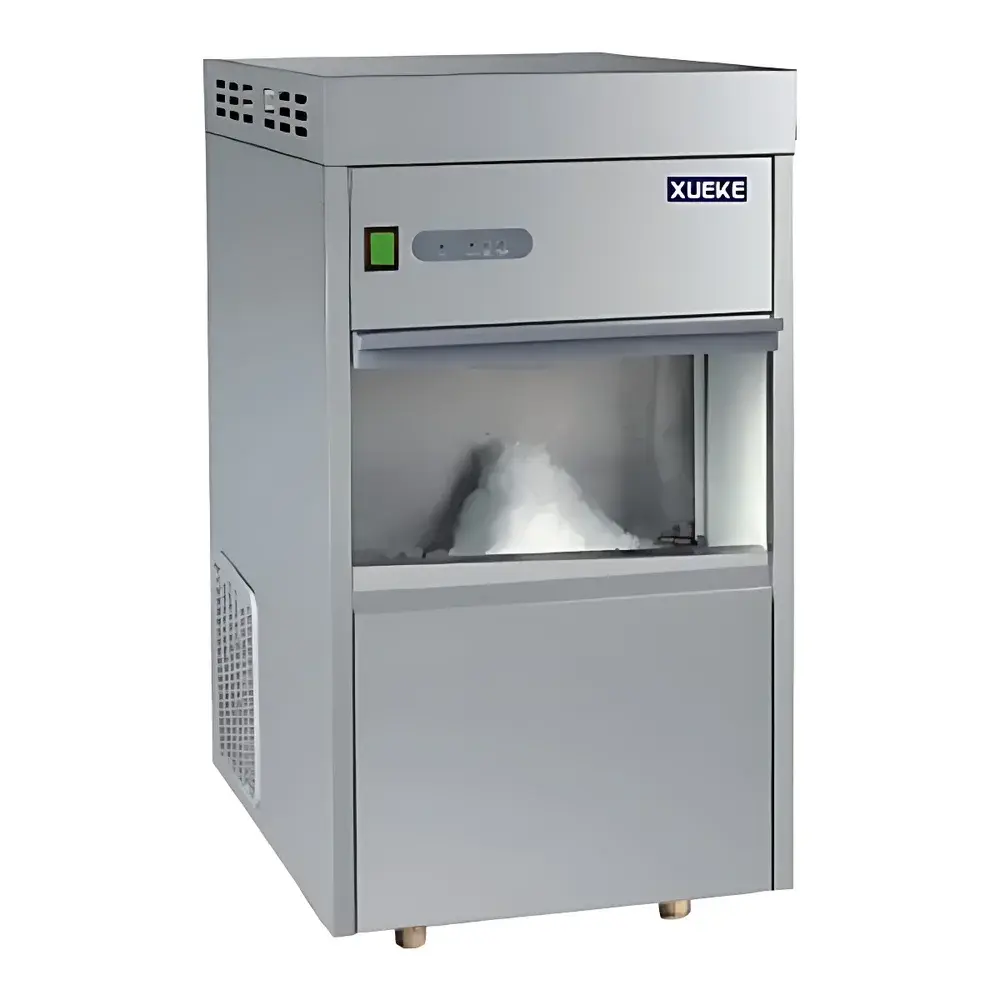
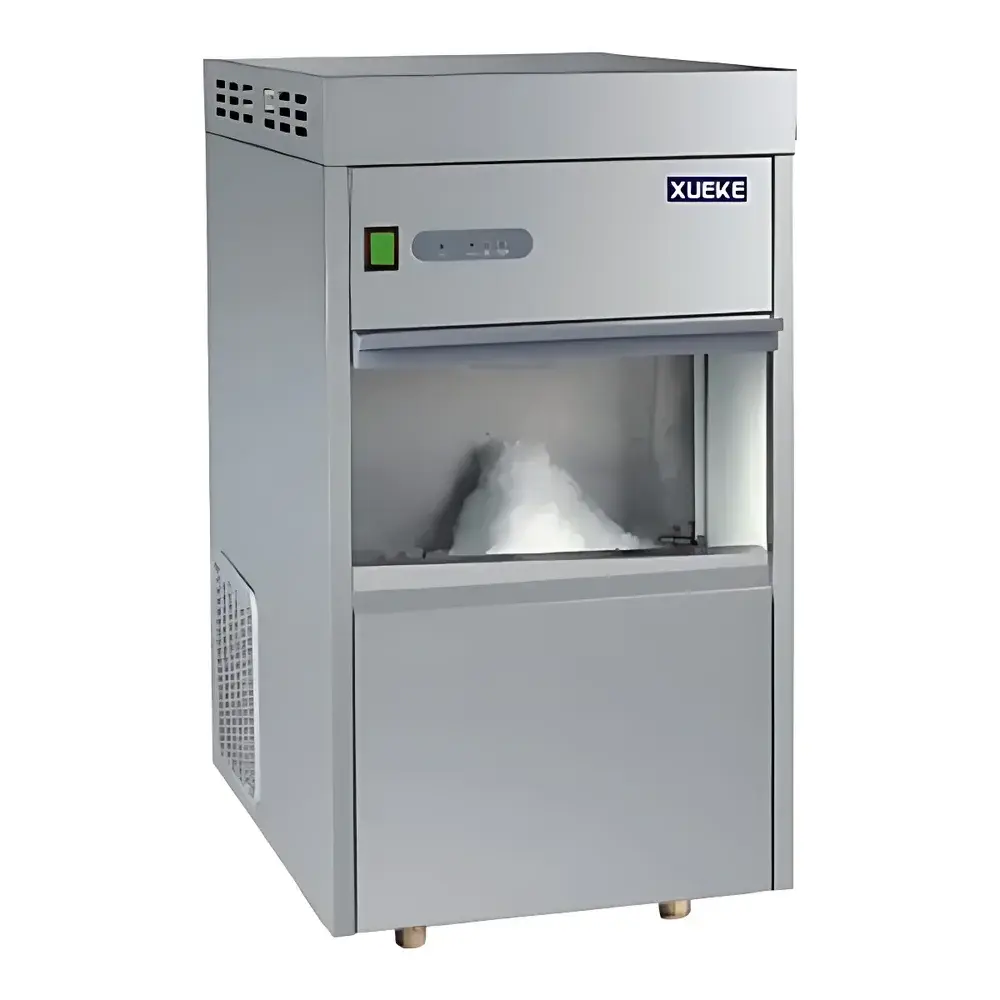
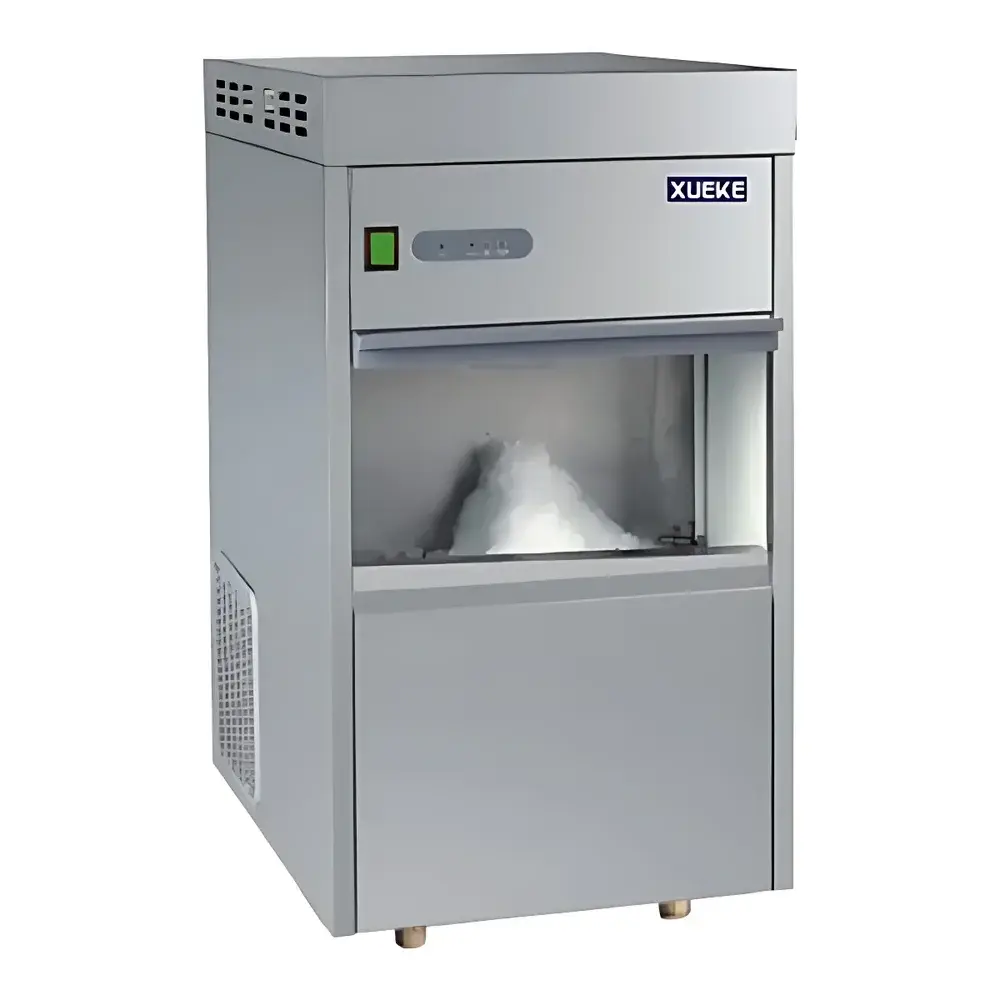
XUEKE IMS-20 Compact Flake Ice Machine
| Brand | XUEKE |
|---|---|
| Origin | Jiangsu, China |
| Model | IMS-20 |
| Ice Production Capacity | 20 kg/24 h |
| Ice Storage Capacity | 10 kg |
| Water Consumption | ≤0.8 L/h |
| Cooling Method | Air-cooled |
| Power Rating | 180 W |
| Dimensions (W×D×H) | 300 × 493 × 547 mm |
| Net Weight | 32 kg |
| Construction | Full Stainless Steel Enclosure |
| Compressor Type | High-Efficiency R290 Refrigerant-Compatible Hermetic Compressor |
| Control System | Microprocessor-Based Fully Automatic Controller |
| Ice Form | Irregular, Fine Flake Ice (Typical Particle Size: 1–3 mm Thickness, <5 mm Diameter) |
| Safety & Monitoring | Full Diagnostic Display (Ice Full, Low Water, Fault Code Indication) |
Overview
The XUEKE IMS-20 Compact Flake Ice Machine is a purpose-engineered laboratory-scale refrigeration system designed to generate high-surface-area flake ice for precise thermal management in scientific and clinical workflows. Unlike cubed or nugget ice generators, the IMS-20 employs a direct-expansion evaporator drum with optimized surface geometry and controlled water film distribution to produce irregular, thin (1–3 mm), low-density flake ice—ideal for rapid thermal transfer, uniform sample chilling, and stable ice-bath formation. Its compact footprint (300 × 493 × 547 mm) and air-cooled condenser eliminate the need for external water drainage or chilled water loops, making it suitable for benchtop deployment in biosafety cabinets, analytical labs, histology suites, and point-of-care environments. The unit operates on an environmentally compliant R290 refrigerant system and integrates a hermetically sealed, low-noise compressor engineered for continuous duty cycles typical of 24/7 research facility operation.
Key Features
- Fully automatic microprocessor control with real-time status display: ice full, low water level, and system fault diagnostics (including evaporator frost detection and compressor overtemperature alerts)
- Full stainless steel (AISI 304) construction—corrosion-resistant, non-porous, and compatible with ISO 14644-1 Class 5 cleanroom maintenance protocols
- Optimized flake ice morphology: irregular shape and sub-5 mm particle dimensions ensure >95% packing density reduction versus cubed ice, enabling faster equilibration in enzymatic assays, PCR prep, and tissue homogenization
- Air-cooled condenser with intelligent fan speed modulation—reduces ambient heat load and eliminates dependency on facility cooling water infrastructure
- Low power draw (180 W nominal) and minimal water consumption (≤0.8 L/h during active production)—supports energy-conscious lab certification (e.g., LEED EBOM v4.1 Lab Energy Performance)
- Integrated ice level sensor and automatic harvest cycle termination prevent overfilling and mechanical stress on the storage bin
Sample Compatibility & Compliance
The IMS-20 delivers consistent flake ice suitable for temperature-sensitive applications requiring rapid, non-damaging thermal stabilization—including electrophoresis buffer cooling, centrifuge rotor pre-chilling, cryopreservation media preparation, and cold-chain validation studies. Its stainless steel wetted surfaces comply with FDA 21 CFR Part 11 requirements for material traceability when used in GLP/GMP-regulated environments. While not certified to UL 61010-1 or IEC 61000-6-3 out-of-the-box, the unit meets CE-marked EMC and LVD essential requirements per EN 61000-6-2 and EN 61000-6-4 when installed per manufacturer’s ventilation and grounding specifications. All electrical components are rated IP20; optional IP54-rated enclosure kits are available for humid or saline-exposed settings (e.g., marine biology labs).
Software & Data Management
The IMS-20 features embedded firmware with non-volatile memory for up to 100 operational event logs—including start/stop timestamps, ice harvest frequency, fault codes, and cumulative runtime. Though it lacks Ethernet or USB connectivity, its RS-232 serial interface (optional adapter) supports integration into centralized lab monitoring systems (e.g., LabVantage LIMS or Thermo Fisher SampleManager) via Modbus RTU protocol. Audit trails meet ALCOA+ principles for data integrity when exported manually using vendor-provided CSV template. Firmware updates are performed via secure SD card—no internet connection required—ensuring compliance with air-gapped network policies common in regulated biotech facilities.
Applications
- Pre-analytical sample conditioning: maintaining whole blood, CSF, and plasma at 0–4 °C during transport and processing
- Enzyme kinetics studies requiring sub-10 °C reaction quenching without dilution or pH shift
- Cryo-sectioning support: providing immediate, dry flake ice for specimen freezing stages in microtomes
- Calibration verification: serving as a stable, reproducible thermal mass for thermometer and thermocouple validation per ASTM E74-22
- Cell culture workstations: localized cooling of reagent racks and pipette tips to minimize thermal drift during sensitive transfection protocols
- Pharmaceutical stability testing: supporting ICH Q5C temperature mapping studies in controlled environment chambers
FAQ
What is the typical ice particle size produced by the IMS-20?
Flake ice thickness averages 1–3 mm, with lateral dimensions ranging from 2 to 5 mm; morphology varies slightly based on ambient humidity and inlet water temperature.
Can the IMS-20 be installed inside a fume hood or biological safety cabinet?
Yes—provided minimum clearance of 100 mm around all vents is maintained and exhaust airflow does not exceed 0.5 m/s at the unit’s intake grille.
Is potable water supply mandatory?
Yes. The unit requires deionized or filtered potable water (≤500 µS/cm conductivity, ≤1 ppm total dissolved solids) to prevent scaling and sensor drift.
Does the IMS-20 support remote monitoring or alarm relay outputs?
Standard configuration includes a dry-contact fault relay (NO/NC); optional OEM modules add SNMP trap support and analog 4–20 mA output for ice level telemetry.
What maintenance intervals are recommended for uninterrupted operation?
Daily visual inspection of water inlet filter; biannual descaling with citric acid solution (0.5% w/v); annual compressor oil analysis if operated >4,000 hours/year.
Related Products



