
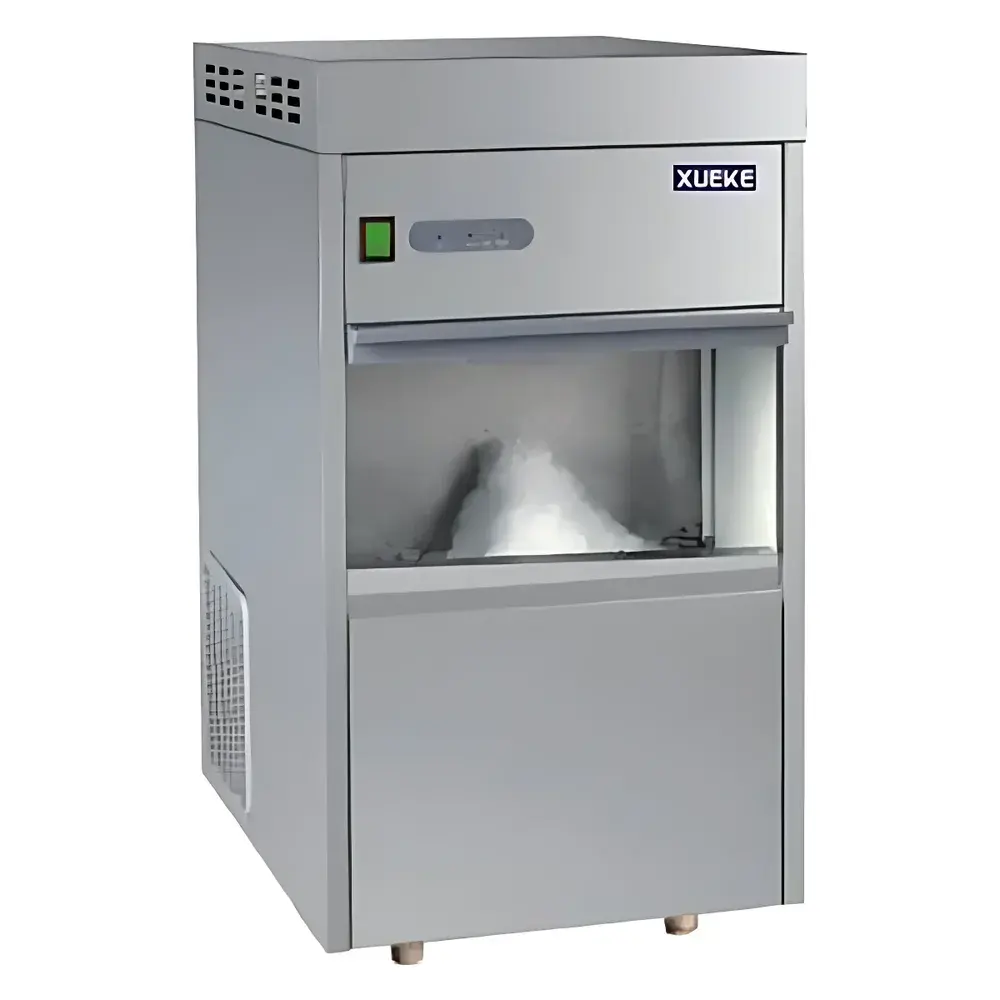
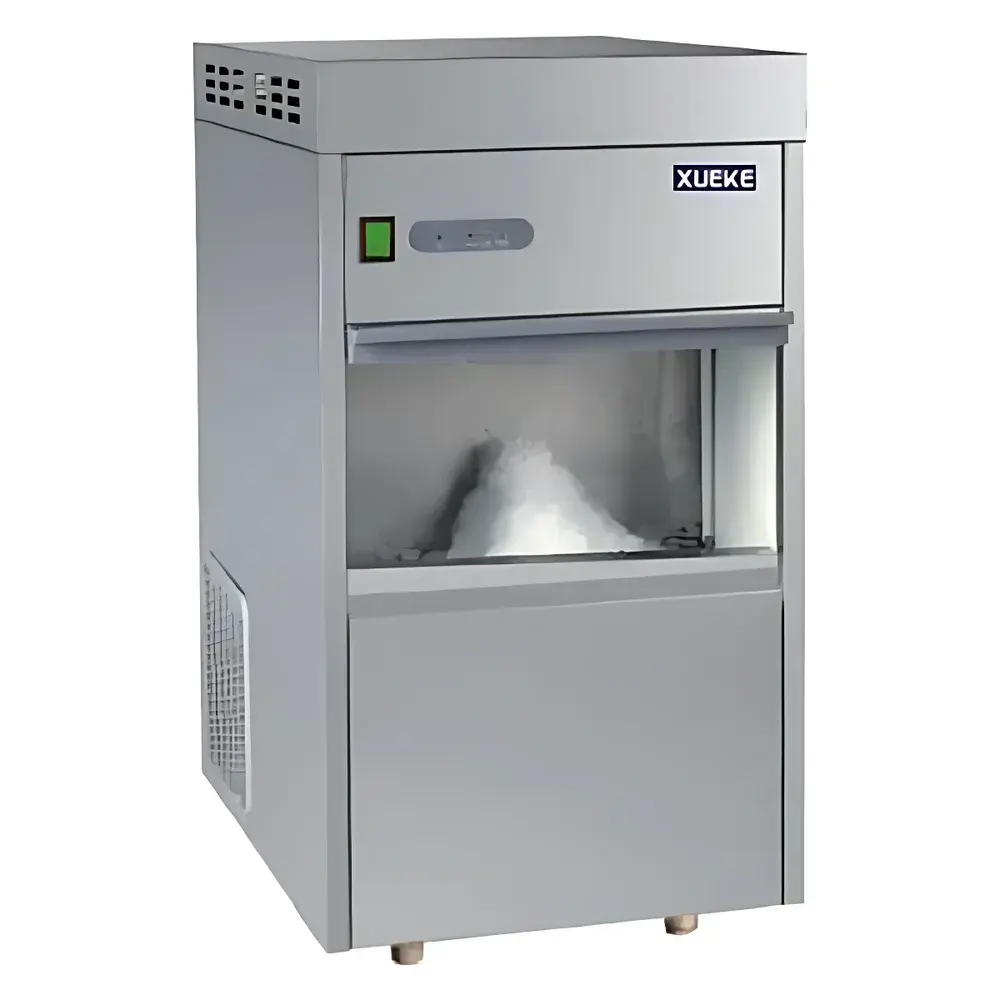
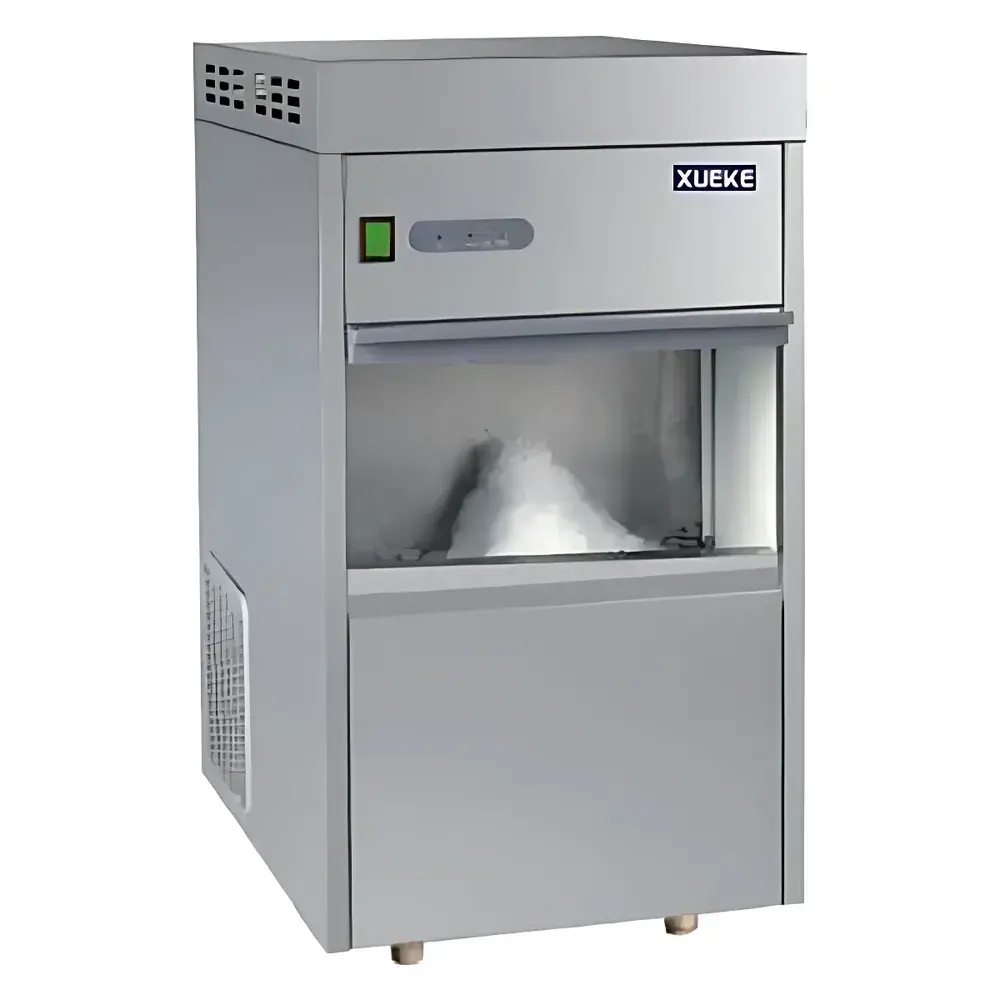
XUEKE IMS-70 Laboratory Flake Ice Maker
| Brand | XUEKE |
|---|---|
| Origin | Jiangsu, China |
| Model | IMS-70 |
| Ice Production Capacity | 70 kg/24 h |
| Storage Capacity | 25 kg |
| Water Consumption | ≤2.0 L/h |
| Cooling Method | Air-cooled |
| Power Consumption | 420 W |
| Dimensions (W×D×H) | 548 × 611 × 883 mm |
| Net Weight | 57 kg |
| Ice Type | Irregular flake ice (fine granular, high surface-area-to-volume ratio) |
| Compressor | High-efficiency R290 or R600a refrigerant-compatible hermetic compressor |
| Control System | Microprocessor-based digital controller with LED interface |
Overview
The XUEKE IMS-70 Laboratory Flake Ice Maker is an engineered solution for consistent, on-demand production of fine, irregular flake ice—optimized for laboratory cold-chain applications requiring rapid thermal transfer and uniform sample cooling. Unlike cubed or cylindrical ice forms, flake ice exhibits a high surface-area-to-volume ratio and low density, enabling rapid submersion and temperature equilibration in biological sample baths, centrifuge cooling trays, electrophoresis setups, and enzymatic reaction vessels. The unit employs a direct-expansion evaporator drum system: water is evenly distributed over a refrigerated stainless-steel drum surface; as it freezes, thin layers of ice adhere and are continuously scraped off by rotating augers, yielding dry, free-flowing flakes approximately 1–3 mm in thickness and variable lateral dimensions (typically <5 mm). This process operates without phase-change additives or external freezing media, ensuring purity compliance for non-sterile but contamination-sensitive lab environments. The IMS-70 integrates an R290/R600a-compatible hermetic compressor—selected for low global warming potential (GWP), energy efficiency, and stable operation under continuous partial-load cycling typical of laboratory duty cycles.
Key Features
- Microprocessor-controlled operation with real-time status monitoring via LED display: ice level, water supply status, compressor runtime, and fault diagnostics (e.g., sensor open-circuit, evaporator frost lock, high head pressure)
- Automatic ice harvest cycle triggered by built-in ice-level sensors; halts production when storage bin reaches 25 kg capacity to prevent compaction and bridging
- Air-cooled condensing system eliminates need for dedicated chilled water infrastructure—ideal for labs without central HVAC tie-ins or floor drainage
- Stainless-steel ice-contact surfaces (drum, auger, storage bin liner) conform to FDA 21 CFR §178.3570 for indirect food contact and support routine disinfection with ethanol or quaternary ammonium solutions
- Low standby power draw (<8 W) during idle periods; full-cycle energy consumption calibrated at 420 W nominal, supporting ISO 50001-aligned lab energy management protocols
- Compact footprint (548 × 611 × 883 mm) designed for under-bench installation or freestanding placement adjacent to biosafety cabinets or cold rooms
Sample Compatibility & Compliance
The IMS-70 produces non-sterile, microbiologically inert flake ice suitable for temperature maintenance—not direct sample contact—during routine analytical workflows. Ice is generated from potable municipal or deionized water supplied via standard 3/8″ push-fit tubing; no internal water purification is integrated, so feed-water quality must meet CLSI EP23-A guidelines for laboratory utility water (conductivity ≤5 µS/cm, total viable count <10 CFU/mL). The unit complies with IEC 61000-6-3 (EMC emission limits) and IEC 61000-6-2 (immunity to electrostatic discharge and RF fields), ensuring stable performance near sensitive instrumentation such as NMR spectrometers or mass spectrometers. While not certified to ISO 13485 or FDA 21 CFR Part 820, its construction and control architecture align with GLP Annex 11 principles for traceable, auditable equipment operation—data logs (via optional RS485 Modbus RTU interface) support 21 CFR Part 11-compliant electronic record retention when paired with validated LIMS software.
Software & Data Management
The IMS-70 features a standalone embedded controller with no cloud connectivity or proprietary software dependency. Operational parameters—including cumulative operating hours, number of ice cycles, and fault event timestamps—are stored in non-volatile memory and accessible via service menu navigation. For integration into centralized lab infrastructure, the optional RS485 serial port supports Modbus RTU protocol (address 0x01, baud rate 9600, 8N1), enabling read-only polling of real-time ice level (% full), compressor status (ON/OFF), and error code registers (e.g., E01 = low water, E03 = high discharge temperature). These signals may be ingested by building management systems (BMS) or lab-wide IoT platforms using standard OPC UA or MQTT bridges—facilitating predictive maintenance scheduling and energy usage benchmarking across multi-unit deployments.
Applications
- Cold sample preparation for histology tissue embedding and cryosectioning
- Temperature stabilization during PCR setup, restriction digests, and ligase reactions
- Cooling of HPLC autosampler trays and LC-MS source compartments
- Buffer pre-chilling prior to FPLC column equilibration
- Short-term preservation of primary cell suspensions during flow cytometry staining protocols
- Calibration verification of portable thermometers and data loggers using ice-point reference baths (per ASTM E1137/E1137M)
FAQ
What water quality is required for optimal IMS-70 performance?
Potable water meeting local drinking standards is acceptable; however, for extended evaporator life and reduced descaling frequency, feed water should have hardness <100 ppm CaCO₃ and silica <10 ppm. Deionized water is recommended where available.
Can the IMS-70 operate continuously in ambient temperatures above 32°C?
Rated ambient operating range is 10–32°C. Above 32°C, ice production declines nonlinearly due to reduced condenser efficiency; sustained operation above 35°C may trigger thermal shutdown.
Is the flake ice produced sterile or pyrogen-free?
No. The IMS-70 is not a medical device and does not provide sterilization or endotoxin removal. Ice is intended for external thermal management only.
Does the unit include a water filtration system?
No. External sediment and carbon filtration (e.g., 5-micron + activated carbon cartridge) is strongly advised to prevent nozzle clogging and scale buildup.
How often does the evaporator require manual cleaning?
Under typical lab use with filtered feed water, descaling every 6–12 months using citric acid-based solution (pH 2.5–3.0) is sufficient. Cleaning intervals shorten proportionally with water hardness increase.
Related Products



