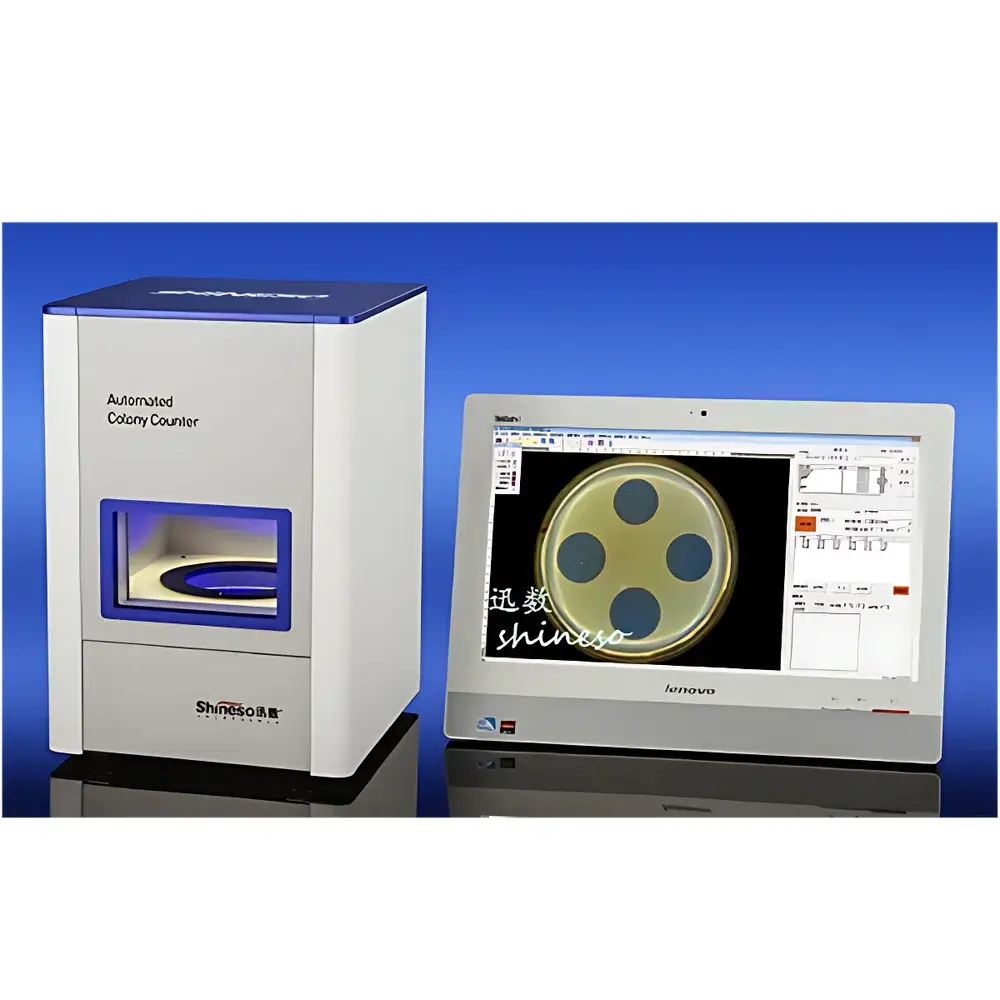
Xunshu Czone 6 Automated Colony Counter and Zone-of-Inhibition Analyzer
| Brand | Xunshu |
|---|---|
| Origin | Zhejiang, China |
| Manufacturer Type | Direct Manufacturer |
| Instrument Type | Fully Automated Colony Counter & Zone-of-Inhibition Measurement System |
| Sample Types | Liquid media, Solid media (pour plate, spread plate, membrane filtration, spiral plate, commercial test strips) |
| Petri Dish Capacity | 35–150 mm diameter |
| Counting Speed | 20,000 colonies/sec |
| Counting Resolution | 0.01 mm |
| Imaging Sensor | 14 MP, 1/2.3" CMOS |
| Included Software | Colony Analysis Suite, Automatic Zone-of-Inhibition Measurement Module |
Overview
The Xunshu Czone 6 is a fully automated digital imaging system engineered for high-precision colony enumeration and quantitative zone-of-inhibition (ZOI) analysis in microbiological quality control, antimicrobial susceptibility testing, and regulatory-compliant laboratory workflows. It operates on the principle of high-resolution digital image acquisition coupled with adaptive segmentation algorithms—leveraging multi-spectral illumination and sub-pixel spatial calibration to resolve morphologically diverse colonies and subtle inhibition boundaries. Designed for ISO 7218, USP /, CLSI M07/M100, and EUCAST-compliant environments, the Czone 6 supports GLP/GMP data integrity requirements through role-based access control, audit-trail-enabled software, and electronic record retention per FDA 21 CFR Part 11 guidelines.
Key Features
- Multi-modal illumination architecture: Integrated transmissive white LED array (uniform 50–7000 lux, 3100–5800 K tunable), embedded diffuse reflectance lighting (96-LED + nano-reflective surface), dark-field blue/white hybrid backlight, and 254 nm UV for chamber decontamination.
- Optimized optical path: Fixed-focus 8 mm f/1.4–f/16 lens with ≥150 lp/mm resolution, paired with a USB 3.0 14 MP 1/2.3″ color CMOS sensor delivering ≤0.01 mm colony resolution and ≤0.002 mm ZOI edge resolution.
- Intelligent illumination control: Concealed pop-up panel with 5 independent light mode selections, 4-channel continuous brightness adjustment, and dual-channel color temperature tuning—enabling real-time optimization for varying agar opacity, pigment intensity, or background heterogeneity.
- Advanced algorithmic segmentation: Hybrid approach combining level-set multi-model thresholding, dynamic parameter adjustment, bias-estimation clustering, and morphology-guided classification for accurate separation of clustered, irregular, or low-contrast colonies.
- Dual-module software suite: Pre-validated colony analysis engine supporting pour/spread/membrane/spiral/test-strip workflows; plus Szone ZOI measurement engine with three detection modes—auto-edge detection, circle-fitting approximation, and manual 3-point circle definition—for robustness across assay variability.
Sample Compatibility & Compliance
The Czone 6 accommodates standard microbiological sample formats including 35–150 mm Petri dishes, membrane filters (e.g., nitrocellulose, polycarbonate), and commercial chromogenic test strips (3M Petrifilm™ for total aerobic count, S. aureus, coliforms, and E. coli). Its illumination flexibility ensures consistent performance across opaque media (e.g., blood agar), pigmented substrates (e.g., CHROMagar™), and low-biomass samples. The system meets functional verification criteria outlined in ISO 4833-2:2013 (microbiological methods—horizontal method for enumeration of microorganisms) and supports validation documentation packages required for ISO/IEC 17025-accredited laboratories.
Software & Data Management
The bundled software implements a three-tier user permission model (“Manager”, “Operator”, “Reviewer”) with encrypted local database storage and optional network backup. Each colony count or ZOI measurement generates an immutable electronic record containing: original image, processed binary mask, metadata (sample ID, dilution factor, plate diameter), applied parameters, manual corrections (with timestamped audit trail), and export-ready reports in PDF or Excel format. All operations—including illumination configuration changes, algorithm parameter adjustments, and region-of-interest annotations—are logged with operator ID and timestamp. Data exports support traceability for internal audits and external inspections under GxP frameworks.
Applications
- Pharmaceutical QC: Enumeration of bioburden in non-sterile products (USP ) and sterility test membrane filters (USP ).
- Food & beverage safety: Quantitative assessment of total viable counts, coliforms, and pathogen-specific colonies per ISO 4833-1 and ISO 16649 series.
- Clinical microbiology: Standardized disk diffusion assays (CLSI M02/M100) with reproducible ZOI diameter measurement for AST reporting.
- Academic research: High-throughput screening of antimicrobial compounds, biofilm inhibition studies, and microbial ecology profiling via colony morphology clustering.
- Environmental monitoring: Air/surface sampling analysis using membrane filtration and RODAC plates in cleanroom qualification (ISO 14644-1).
FAQ
Does the Czone 6 comply with FDA 21 CFR Part 11 requirements?
Yes—the software enforces electronic signature capability, audit-trail logging, and role-based access control aligned with Part 11 Subpart B technical safeguards.
Can it process spiral plates and membrane filters without manual intervention?
Yes—dedicated one-click modules are pre-configured for spiral plate counting (per ISO 7218 Annex D) and black-grid membrane filter analysis, including automatic grid line removal and background artifact suppression.
What is the minimum detectable colony size and how is calibration verified?
The system resolves features down to 0.01 mm diameter; calibration is performed using NIST-traceable stage micrometers, with optional user-initiated recalibration and deviation logging.
Is third-party software integration supported (e.g., LIMS or ELN)?
Yes—via standardized CSV and XML export protocols; API access is available under enterprise licensing for direct LIMS synchronization.
How is data integrity maintained during power failure or unexpected shutdown?
All active analyses are auto-saved at 30-second intervals; unsaved edits trigger confirmation prompts, and corrupted sessions recover from last stable checkpoint without loss of raw image or metadata.