
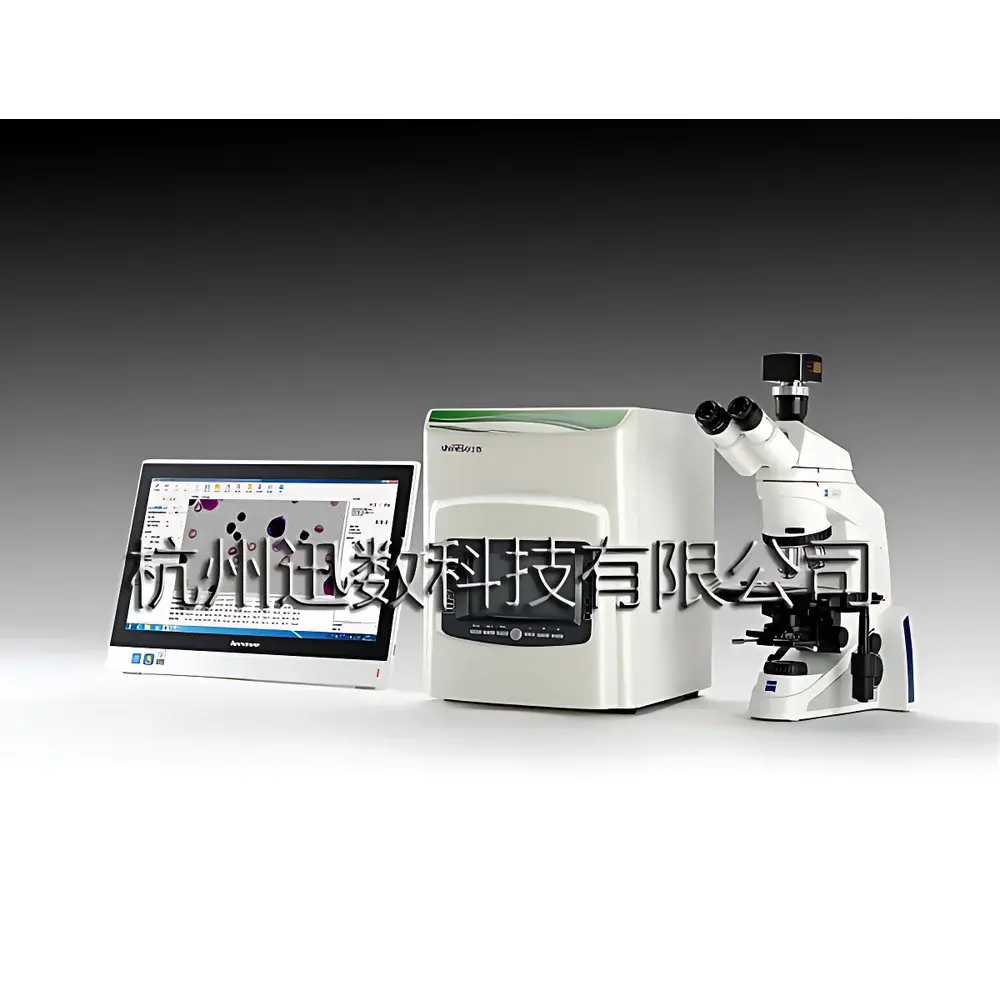
Xunshu GenTox 5 Integrated Micronucleus Analyzer, Colony Counter & Cell Counter
| Brand | Xunshu |
|---|---|
| Origin | Zhejiang, China |
| Manufacturer Type | OEM Manufacturer |
| Country of Origin | China |
| Model | GenTox 5 |
| Pricing | Upon Request |
Overview
The Xunshu GenTox 5 is a fully integrated, regulatory-grade imaging and analysis platform engineered for high-throughput genotoxicity assessment, microbial enumeration, and quantitative cell morphology analysis. It combines three core analytical modalities—micronucleus scoring (per OECD 474 and ISO 10993-3), colony-forming unit (CFU) enumeration (per ISO 4833-1, USP <61>, and ASTM E2694), and digital cell morphometry—within a single, unified hardware and software architecture. The system leverages a Zeiss Axio Lab.A1 upright microscope equipped with precision mechanical stage, halogen illumination, and five-objective turret (5×–100× oil), coupled with a scientific-grade Sony ExView HAD CCD camera (1-inch sensor, 6.0 MP, 4.54 µm pixel size) for high-fidelity brightfield image acquisition. All analytical workflows are governed by deterministic algorithms compliant with GLP principles, including full audit trail logging, role-based access control, and electronic signature enforcement per FDA 21 CFR Part 11 requirements.
Key Features
- Triple-modal imaging engine: Simultaneous support for micronucleus assay (mouse bone marrow or peripheral blood), Ames test colony counting, and suspension/culture cell quantification.
- Zeiss-certified optical path: Axio Lab.A1 microscope with N-Achroplan objectives (5×/0.15 to 100×/1.25 oil), integrated 12 V/50 W stabilized halogen source, and 0.9–1.25 NA condenser optimized for high-contrast hematoxylin-eosin and Giemsa-stained specimens.
- Scientific imaging sensor: Sony ICX694AQG(C) CCD with 1-inch optical format, USB 3.0 interface, exposure range 0.06 ms–1000 s, and calibrated photometric linearity for quantitative intensity analysis.
- Adaptive stochastic resonance (ASR) image enhancement: A physics-based signal amplification technique that selectively enhances weak chromatin staining signals while suppressing lymphocyte and granulocyte interference via mutual information entropy optimization in bistable systems.
- Four-tier security architecture: System Administrator, Data Manager, Operator, and Reviewer roles with strict separation of duties, immutable audit logs, and automatic timestamped record of all user actions—including parameter changes, data edits, and report approvals.
- Regulatory-compliant reporting: PDF and Excel exports with embedded metadata (sample ID, dilution factor, plate dimensions, operator ID, review timestamp), digital watermarking, and tamper-evident electronic signatures.
Sample Compatibility & Compliance
The GenTox 5 supports standardized sample formats across regulatory frameworks: mouse polychromatic erythrocyte (PCE) smears for micronucleus scoring (OECD TG 474); 90 mm Petri dishes (pour, spread, membrane filtration, spiral, 3M™ Petrifilm™, and multi-well plates) for microbial enumeration; and suspension cultures (e.g., CHO, HEK293, primary PBMCs) for viability and confluence analysis. All software modules enforce method-specific validation criteria—e.g., PCE/NCE classification thresholds aligned with ICH S2(R2) guidance, colony size filters compliant with ISO 4833-1 Annex B, and cell segmentation parameters traceable to ISO 21569:2020. The system satisfies data integrity requirements under EU Annex 11, USP <1058>, and WHO TRS 992 Annex 5 for computerized system validation.
Software & Data Management
Three dedicated, validated application suites operate within a shared database framework: (1) Micronucleus Analysis Software (MICAS) implements deep-learning-assisted PCE identification, ASR-enhanced micro-nuclei detection, and automated PCE/RBC ratio calculation; (2) Colony Analysis Software (CAS) provides six intelligent counting modes—including “small-colony priority”, “same-color clustering”, and “media-background subtraction”—with dynamic level-set segmentation for heterogeneous agar surfaces; (3) Cell Morphology Suite (CMS) delivers sub-pixel contour measurement (diameter, area, circularity, Feret diameter) using adaptive edge detection and morphological operators. All modules feature built-in calibration management, parameter versioning, and full revision history. Audit trails capture user identity, action type, timestamp, affected dataset, and pre/post-change values—retained for ≥30 years per internal retention policy.
Applications
The GenTox 5 serves as a central instrument in pharmaceutical genotoxicity screening laboratories (ICH M7), contract research organizations performing GLP-compliant safety testing, academic toxicology departments conducting rodent micronucleus assays, and QC microbiology units validating sterilization processes per ISO 11140 and USP <51>. Its dual-illumination colony imager (trichromatic LED + 254 nm UV decontamination) enables accurate CFU enumeration in complex matrices—including colored media, turbid suspensions, and low-biomass environmental swabs. In cell biology applications, the platform supports clonogenic survival assays, hematopoietic progenitor enumeration, and cytogenetic damage quantification in human lymphocytes exposed to ionizing radiation or chemical mutagens.
FAQ
Does the GenTox 5 comply with FDA 21 CFR Part 11 requirements for electronic records and signatures?
Yes—the system implements role-based authentication, encrypted audit trails, electronic signatures with biometric or token-based verification, and immutable record archiving meeting all technical and procedural controls specified in Part 11 Subpart B.
Can the software distinguish between true micronuclei and staining artifacts in Giemsa-stained smears?
Yes—through combined use of ASR-enhanced contrast, size/shape constraints (diameter 1/3–1/16 of main nucleus), chromatin density matching, and spatial proximity filtering relative to the main nucleus boundary.
Is the colony counting algorithm validated for ISO 4833-1:2013 compliance?
Yes—validation reports include specificity, accuracy, precision, and robustness testing across 12 agar formulations, 5 inoculum levels, and 3 operator cohorts, demonstrating ≤5% deviation from manual counts per ISO 13485:2016 Annex C.
What microscope objectives are included standard, and are oil-immersion objectives supported?
The standard configuration includes N-Achroplan 5×/0.15, 10×/0.25, 20×/0.45, 40×/0.65, and 100×/1.25 oil objectives with parfocal alignment and matched tube lens correction.
How is data integrity ensured during multi-user operation across shifts?
Each session generates a cryptographically hashed log entry linked to user credentials, system clock, and database transaction ID; all raw images and processed datasets are write-once/read-many (WORM) archived with SHA-256 checksum verification at ingestion and retrieval.
Related Products




