
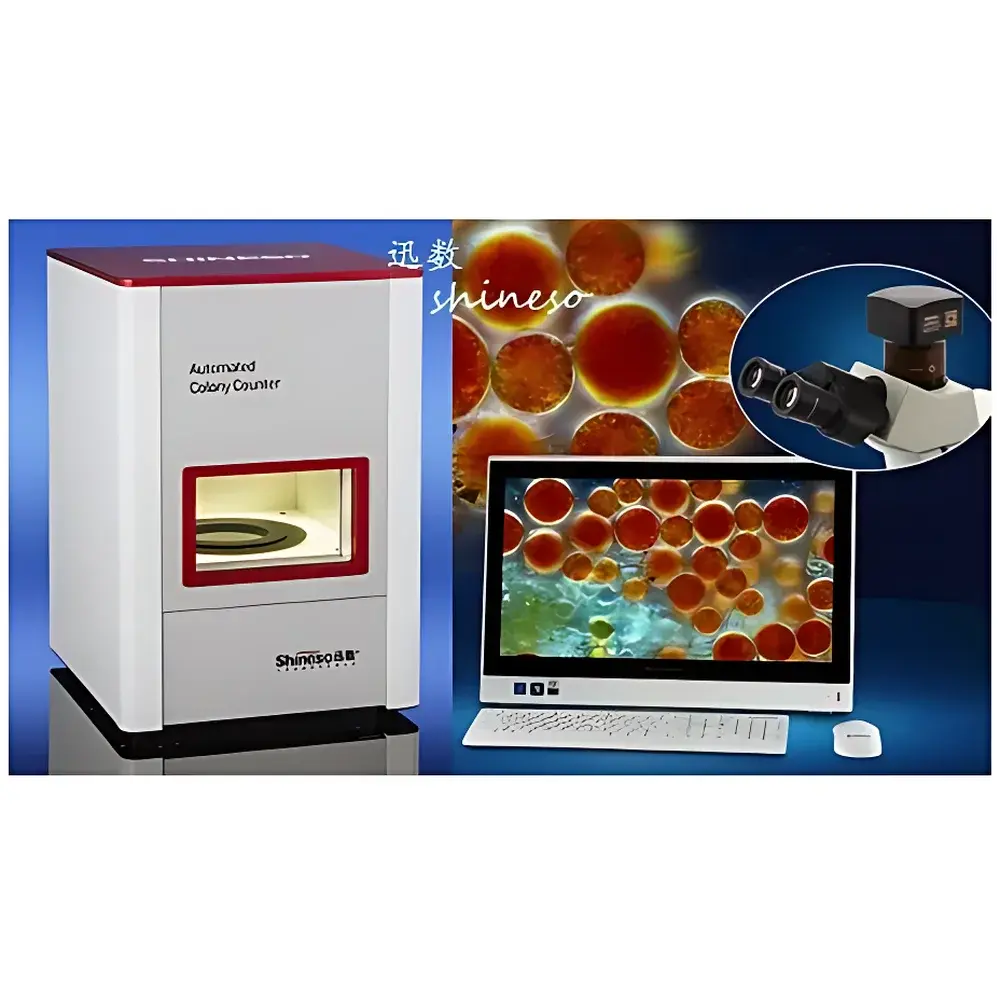
Xunshu M600 Colony Counter & Plankton Analyzer
| Brand | Xunshu |
|---|---|
| Origin | Zhejiang, China |
| Manufacturer Type | OEM Manufacturer |
| Product Category | Domestic |
| Model | M600 |
| Price Range | USD 21,000–28,000 |
| Instrument Type | Algal and Plankton Counter |
| Camera Resolution | 8.5 MP |
| Magnification | 40× |
| Identification Method | Morphological and Taxonomic Analysis |
Overview
The Xunshu M600 Colony Counter & Plankton Analyzer is a dual-function digital imaging platform engineered for high-precision microbiological and aquatic ecological analysis in environmental monitoring laboratories. It integrates three core analytical modalities—automated colony enumeration on solid media, intelligent plankton identification and quantification via brightfield and fluorescence microscopy, and quantitative microalgal cell analysis—within a single, unified hardware-software architecture. The system operates on computer vision–driven image segmentation and deep learning–enhanced pattern recognition, enabling objective, reproducible, and auditable biological assessments without manual bias. Its design adheres to the operational principles of ISO 17994:2020 (microbiological water quality—detection and enumeration of indicator microorganisms) and supports GLP-compliant data handling through role-based access control, electronic audit trails, and exportable metadata-rich reports.
Key Features
- Dual-Mode Illumination System: A fully enclosed, light-tight aluminum alloy imaging chamber (32 × 34 × 46 cm) houses six independently controllable illumination modes: diffuse fog-light reflection (3100–5800 K color temperature, 50–7000 lux), suspended dark-field (white/blue LED hybrid backlight), translucent white trans-illumination, UV sterilization (254 nm), and two customizable colored background options—all adjustable via a concealed pop-up controller with 4-channel dimming and dual-channel color temperature tuning.
- High-Fidelity Imaging Hardware: Equipped with an 8.5 MP CMOS sensor (3328 × 2548 pixels, 1.67 µm pixel pitch) paired with an industrial-grade fixed-focus lens (8 mm, f/1.4–f/32, <1% distortion). Two optional high-sensitivity cameras are available: a 20 MP SONY 1-inch sensor for wide-field brightfield imaging and an 8.3 MP SONY 1/1.2″ sensor optimized for low-light fluorescence detection of Giardia cysts and Cryptosporidium oocysts.
- Adaptive Image Segmentation Engine: Implements seven algorithmic variants—including level-set multi-model, dynamic thresholding, and morphology-aware clustering—to resolve complex colony topologies (e.g., overlapping colonies, pigment diffusion, low-contrast colonies on nutrient agar or VRBA), filter membrane grids, and 3M Petrifilm™ substrates with minimal user intervention.
- Plankton-Specific Deep Learning Module (“XunSao”): Leverages convolutional neural networks (CNNs) for real-time morphological feature extraction from unknown algal cells. Delivers ranked similarity matches against a curated database of >20,000 reference images within 3–5 seconds, prioritizing taxonomically common species per regional waterbody context (e.g., Taihu Lake, Bohai Sea).
- Comprehensive Quantitative Output: Generates standardized ecological metrics including cell density (cells/mL), biovolume (µm³/mL), Shannon–Wiener diversity index (H′), Pielou’s evenness (J′), dominance index (Y), carbon/nitrogen biomass estimates, and functional group proportions—calculated per ISO 14442:2022 and ASTM D5905–18 guidelines.
Sample Compatibility & Compliance
The M600 accommodates standard microbiological and limnological sample formats: pour plates, spread plates, membrane filters (0.45 µm), 3M Petrifilm™ test films, and Utermöhl sedimentation chambers. It supports morphological identification of freshwater and marine phytoplankton (Chlorophyta, Bacillariophyta, Dinophyta, Cyanobacteria, etc.) and zooplankton (Ciliophora, Rotifera, Cladocera, Copepoda), with bilingual (Latin/Chinese) taxonomic descriptors aligned to the World Register of Marine Species (WoRMS) and the Chinese Freshwater Algal Flora. Software workflows comply with FDA 21 CFR Part 11 requirements for electronic records and signatures, including full audit trail logging, user authentication, and immutable PDF report generation.
Software & Data Management
The integrated software suite comprises four independent modules—Colony Analysis, Algal Analysis, MIC Analysis, and Zooplankton Analysis—running on Windows 10. All modules enforce a three-tier permission model (Administrator, Analyst, Reviewer) with encrypted local database storage. Every image acquisition includes embedded EXIF metadata: timestamp, magnification, illumination mode, camera settings, and operator ID. Statistical outputs—including raw counts, size-class distributions, corrected CFU/mL values, and biodiversity indices—are exportable to Excel (.xlsx) or PDF with customizable templates. Batch processing supports up to 200 contiguous microscopic fields per sample, with auto-cumulative species tallies and hierarchical sorting by abundance or taxonomic rank.
Applications
The M600 serves as a primary analytical instrument in municipal drinking water utilities, environmental protection agencies, aquaculture QA labs, and academic limnology departments. Typical use cases include routine compliance testing for total coliforms and E. coli per EPA Method 1603; cyanobacterial bloom surveillance in reservoirs and lakes; phytoplankton community structure assessment under EU Water Framework Directive (WFD) criteria; and activated sludge biota evaluation in wastewater treatment plants. Its fluorescence capability enables regulatory screening for protozoan pathogens in reclaimed water per USEPA Guidance Manual for Validation of Analytical Methods.
FAQ
Does the M600 support automated identification of filamentous cyanobacteria such as Microcystis and Anabaena?
Yes—the “colony grouping” module detects mucilaginous sheaths and cellular arrangement patterns to distinguish colonial forms and estimate intra-colony cell counts.
Can the system validate results against ISO/IEC 17025 accreditation requirements?
Yes—full traceability is maintained via instrument calibration logs, user-defined SOP templates, and version-controlled software updates with documented change history.
Is remote operation supported for multi-site laboratory networks?
The software allows networked deployment with centralized database hosting; however, real-time remote microscope control requires optional third-party VNC licensing.
What is the minimum detectable cell size under 40× magnification?
Under optimal contrast conditions, individual algal cells ≥3 µm in diameter are reliably segmented and classified.
Are software updates included in the initial purchase price?
One year of maintenance and minor version updates is included; extended support contracts are available post-warranty.
Related Products







