
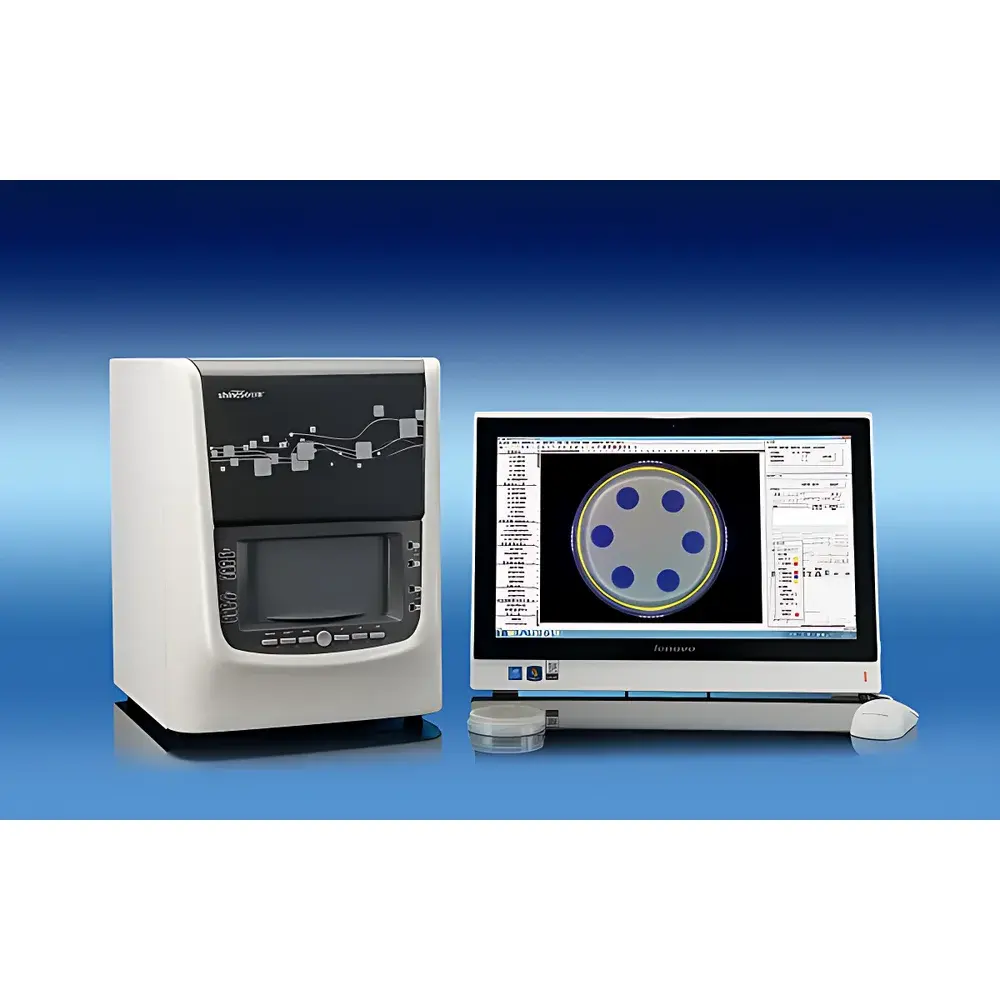
Xunshu Supcre G9 Integrated Colony Counter, Antimicrobial Zone Analyzer & Strain Screening System
| Brand | Xunshu |
|---|---|
| Origin | Zhejiang, China |
| Manufacturer Type | OEM Manufacturer |
| Country of Origin | China |
| Model | Supcre G9 |
| Price Range | USD 11,200 – 14,000 |
| Instrument Type | Fully Automated Microbial Colony Analysis System |
Overview
The Xunshu Supcre G9 is a high-end, research-grade integrated imaging platform engineered for precise, reproducible, and regulatory-compliant microbial analysis. It combines three core analytical functions—colony enumeration, antimicrobial zone (e.g., inhibition zone, hydrolysis halo, clearance zone) measurement, and strain screening—within a single optical and software architecture. The system operates on the principle of high-resolution digital image acquisition followed by algorithm-driven morphometric segmentation and quantitative feature extraction. Its optical design leverages dual-illumination geometry—360° flexible top lighting for chromatic fidelity and texture enhancement, and crystal-sharp suspended dark-field bottom illumination for superior edge contrast—enabling reliable detection of sub-millimeter colonies, phage plaques, and faint inhibition zones on heterogeneous agar backgrounds. Designed for GLP/GMP-aligned laboratories, the Supcre G9 meets functional requirements specified in ISO 7218, USP /, FDA 21 CFR Part 11, and China’s NMPA guidelines for computerized microbiological testing systems.
Key Features
- 16 MP color CMOS sensor with 4/3″ optical format and 16 mm f/1.4 fixed-focus lens delivering >150 lp/mm resolution and exceptional depth-of-field uniformity across Petri dish surfaces
- Dual-illumination system: adjustable-color-temperature (3500–8500 K) top LED array + suspended dark-field bottom illumination; optional 254 nm UV source for chamber sterilization and mutagenesis
- 28 embedded image processing algorithms—including level-set active contour modeling, multi-threshold adaptive segmentation, morphological reconstruction, and Sobel/Laplacian edge detection—optimized for complex colony morphology, high-adhesion clusters, and low-contrast plaques
- Automated dual-zone analysis module for quantitative ratio-based screening (e.g., halo-to-colony diameter ratio, area ratio), supporting enzyme producer, biosurfactant, pesticide-degrading, and antibiotic-resistant strain identification
- Multi-parameter classification engine enabling simultaneous discrimination of colonies by hue, saturation, size distribution, perimeter irregularity, and texture gradient—validated for chromogenic media (e.g., CHROMagar™), mixed-culture plates, and recombinant blue-white screening
- One-click measurement tools for mycelial growth rate (cross-method), OPKA/SBA multi-well assays, and membrane filter grids (including 3M Petrifilm™ series)
Sample Compatibility & Compliance
The Supcre G9 supports all standard microbiological sample formats: pour plates, spread plates, membrane filters (black grid or white), spiral plating (FDA-compliant modes), multi-well plates, Petrifilm™ tests (Total Aerobic Count, E. coli/Coliform, S. aureus), and agar diffusion assay plates (Kirby-Bauer, well-diffusion, cup-plate). Its image segmentation pipeline is validated per SN/T 2098–2008 (China Entry-Exit Inspection), USP , EP 2.6.12, and ISO 4833-1:2013. The system conforms to data integrity requirements under FDA 21 CFR Part 11 through role-based access control, electronic signatures, immutable audit trails, and automatic timestamping of every user action—including image capture, parameter selection, manual correction, and report generation.
Software & Data Management
The proprietary analysis suite implements a four-tier permission architecture: System Administrator (account provisioning), Data Manager (database backup, archival, and export), Operator (image acquisition, analysis, draft reporting), and Reviewer (independent verification and final approval). All operations are logged in an encrypted relational database with full traceability: original image, dilution factor, plate dimensions, selected algorithm, correction history, and final counts. Watermarked PDF reports embed operator/reviewer e-signatures and auto-generated “Approved” seals. Audit-trail replay functionality enables Reviewers to reconstruct the exact analytical environment—including lighting configuration, ROI selection, and threshold settings—for any pending record. Data export supports CSV, Excel, and PDF formats compliant with internal QA review and external regulatory submission.
Applications
The Supcre G9 serves diverse applications across pharmaceutical QC, food safety labs, academic microbiology, and biotech R&D. It performs rapid enumeration of aerobic mesophiles, coliforms, yeasts/molds, and pathogen indicators (e.g., S. aureus, E. coli O157:H7) per ISO 4833, ISO 6579, and AOAC methods. Its dual-zone analytics support antibiotic potency determination (USP , ChP 2015), β-lactamase inhibitor validation (e.g., sulbactam sensitivity), antifungal susceptibility, and enzymatic activity screening (e.g., amylase, lipase, cellulase via halo assays). Additional use cases include phage plaque quantification, probiotic strain characterization, antimicrobial coating efficacy testing, and microbial limit testing per pharmacopoeial monographs.
FAQ
Does the Supcre G9 comply with FDA 21 CFR Part 11 requirements?
Yes—the system enforces electronic signature authentication, role-based permissions, immutable audit logs, and automated time/date stamping for all analytical steps.
Can it analyze irregular or fragmented inhibition zones from Kirby-Bauer assays?
Yes—its hybrid measurement engine applies circular approximation, three-point circle fitting, and edge-detection-based contour tracing to accommodate non-ideal zone morphologies.
Is the software capable of distinguishing colonies on chromogenic media with overlapping colors?
Yes—multi-color clustering with adjustable hue tolerance enables autonomous separation of up to 24 distinct spectral classes without manual intervention.
How does the system handle highly confluent or filamentous growth?
It employs adaptive watershed segmentation, texture-aware erosion/dilation, and user-guided interactive splitting—validated for Streptomyces, Aspergillus, and Bacillus subtilis biofilms.
What validation documentation is provided for regulatory submissions?
Xunshu supplies IQ/OQ protocols, algorithm verification reports, and traceable calibration certificates aligned with ISO/IEC 17025 laboratory accreditation standards.



