
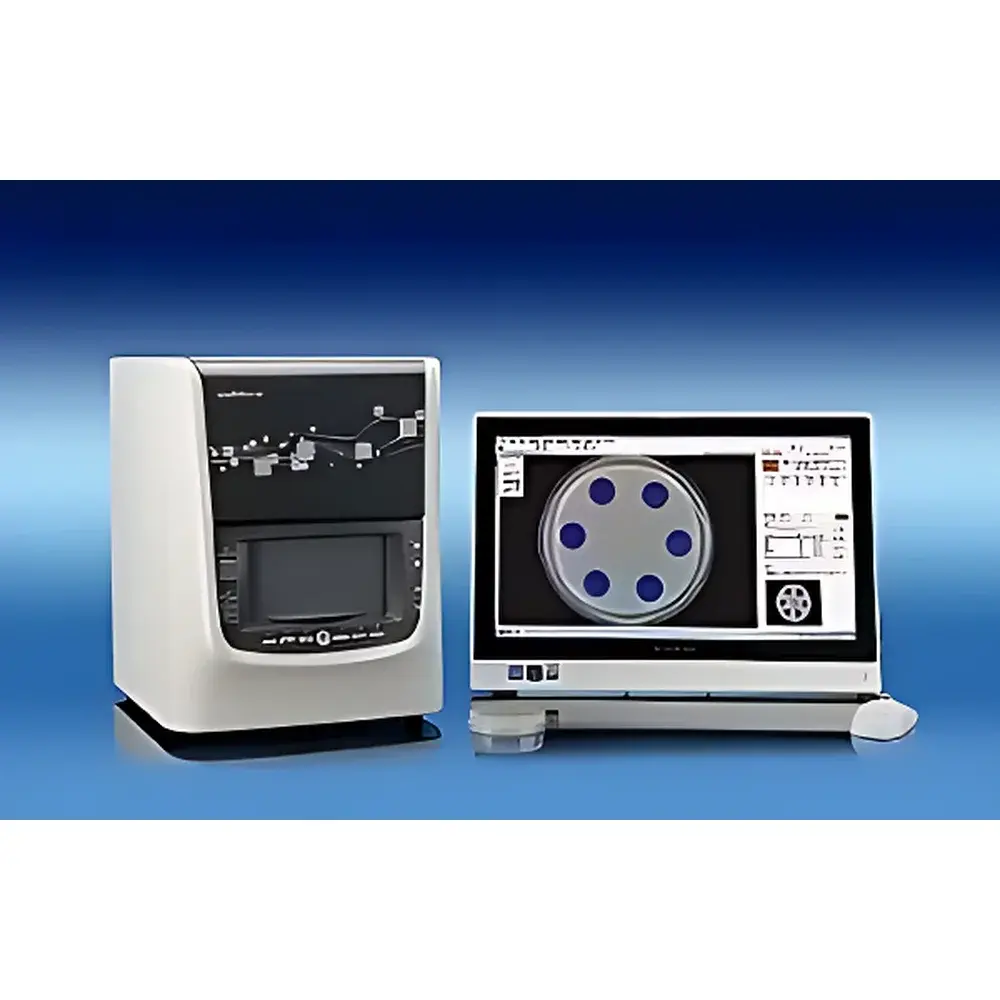
Xunshu Z9 / Z9 Plus Zone of Inhibition (Antibiotic Potency) Measurement System
| Brand | Xunshu |
|---|---|
| Origin | Zhejiang, China |
| Manufacturer Type | Original Equipment Manufacturer (OEM) |
| Country of Origin | China |
| Model | Xunshu Z9 / Z9 Plus |
| Price Range | USD 7,000 – 11,200 |
Overview
The Xunshu Z9 / Z9 Plus Zone of Inhibition (ZOI) Measurement System is a regulated, computerized microbiological assay platform engineered for precise, auditable quantification of antibiotic potency and antimicrobial activity in pharmaceutical quality control, R&D, and regulatory compliance laboratories. It operates on the fundamental principle of digital image metrology applied to agar diffusion assays—specifically the Kirby-Bauer disk diffusion method and related pharmacopoeial bioassays. By capturing high-fidelity grayscale or inverted images of microbial inhibition zones under controlled optical conditions, the system converts biological response (zone diameter) into traceable, quantitative digital data. Designed in full alignment with China’s NMPA “Computerized Systems in Pharmaceutical Production” requirements (2020 Guideline), as well as foundational expectations of USP , EP 5.1.3, and FDA 21 CFR Part 11, the Z9 series supports validated, GxP-compliant workflows for antibiotic potency determination, antimicrobial susceptibility testing (AST), and immunodiffusion analysis.
Key Features
- Patented Crystal-Rad Suspension Dark-Field Illumination: A fully enclosed, side-incident LED array (rated >100,000 h lifetime) generates high-contrast illumination that renders transparent inhibition zones against a dark background—enhancing edge definition between clear zones and turbid bacterial lawns without overexposure or glare.
- High-Fidelity Imaging Architecture: The Z9 Plus integrates a 4/3-inch large-format CMOS industrial camera (16 MP, USB 3.0 interface) coupled with a 16 mm large-target, distortion-free fixed-focus lens (optical resolution ≥150 lp/mm). The base Z9 model employs a 1/2-inch 16 MP CMOS sensor with a 500-line-resolution lens—both calibrated for sub-pixel spatial accuracy.
- Szone Multi-Mode Edge Detection Algorithm Suite: Three complementary measurement modes adapt to biological variability: (1) Automatic contour detection for sharp, circular zones; (2) Circle-fitting approximation for irregular or fragmented edges (e.g., swab-inoculated plates); (3) Manual three-point circle definition for diffuse or overlapping zones.
- Pharmacopoeia-Compliant Potency Calculation Engine: Supports USP monograph-compliant one-dose assay and Chinese Pharmacopoeia 2020 Edition–validated two-dose and three-dose parallel-line bioassays—including combined calculation, slope-ratio validation, and validity criteria assessment per ICH Q5C.
- Regulatory-Grade Data Integrity Framework: Implements a tri-level user architecture (System Administrator → Operator → Reviewer), automatic timestamping, immutable audit trails, and intelligent test environment reconstruction—ensuring full traceability from raw image capture to final potency report.
Sample Compatibility & Compliance
The system accommodates standard 90 mm and 150 mm Petri dishes containing Mueller-Hinton agar, nutrient agar, or customized immunodiffusion gels. It supports paper disk diffusion (CLSI M02/M100), Oxford cup, well diffusion, agar plug, and single radial immunodiffusion (SRID) assays. All measurement outputs comply with CLSI document M02-A12 (Performance Standards for Antimicrobial Disk Susceptibility Tests) and M100-ED33 (Clinical and Laboratory Standards Institute), enabling automated zone diameter interpretation against species-specific interpretive criteria. For β-lactamase detection in dairy matrices, the optional Sulbactam Sensitivity Module follows ISO 13843:2020 principles for qualitative enzyme activity confirmation via water control and parallel sample comparison.
Software & Data Management
The bundled software suite includes two core modules: ZOIMeasure (for zone geometry quantification) and AntibioticPotency (for statistical bioassay evaluation). Both operate under Windows 10/11 (64-bit) and support PDF and Excel export of raw images, annotated measurement overlays, calibration logs, and full audit trails—including operator ID, timestamp, parameter settings, and revision history. All electronic records are stored in an encrypted local SQL Server database with write-once-read-many (WORM) protection. The system enforces 21 CFR Part 11–aligned controls: electronic signatures, role-based access, automatic session timeout, and tamper-evident logging. Audit trail reports include full reconstruction capability—allowing reviewers to re-open original image contexts, reapply measurement tools, and verify analytical decisions without altering source data.
Applications
- Quantitative antibiotic potency testing per USP , ChP 2020 Vol IV, and EP 2.6.12
- Automated antimicrobial susceptibility testing (AST) for clinical and environmental isolates
- β-lactamase screening in milk and dairy products (optional module)
- Single radial immunodiffusion (SRID) for antigen quantification in vaccine development
- High-throughput screening of novel antimicrobial compounds or probiotic strains
- Validation of sterilization efficacy and disinfectant residual activity
- GLP/GMP-compliant stability studies requiring reproducible microbiological endpoints
FAQ
Does the Z9 Plus support FDA 21 CFR Part 11 compliance?
Yes—the system implements electronic signature enforcement, audit trail generation, role-based permissions, and immutable data storage aligned with Part 11 Subpart B requirements for closed systems.
What pharmacopoeial standards does the potency calculation module validate against?
The two-dose and three-dose methods conform to Chinese Pharmacopoeia 2020 Edition, while the one-dose method satisfies USP and EP 2.6.12 bioassay validation criteria.
Can the system measure overlapping or fused inhibition zones?
Yes—via manual three-point circle definition or advanced morphological segmentation using Sobel/Laplace edge operators and adaptive thresholding.
Is calibration traceable to national metrological standards?
Each instrument ships with a factory-applied NIST-traceable calibration slide; users may perform routine verification using certified stage micrometers per ISO/IEC 17025 guidelines.
What level of measurement repeatability is documented?
Instrument repeatability: ≤0.002 mm absolute error; intra-assay relative error ≤0.01%; inter-instrument variation ≤0.2% across identical test conditions.







