
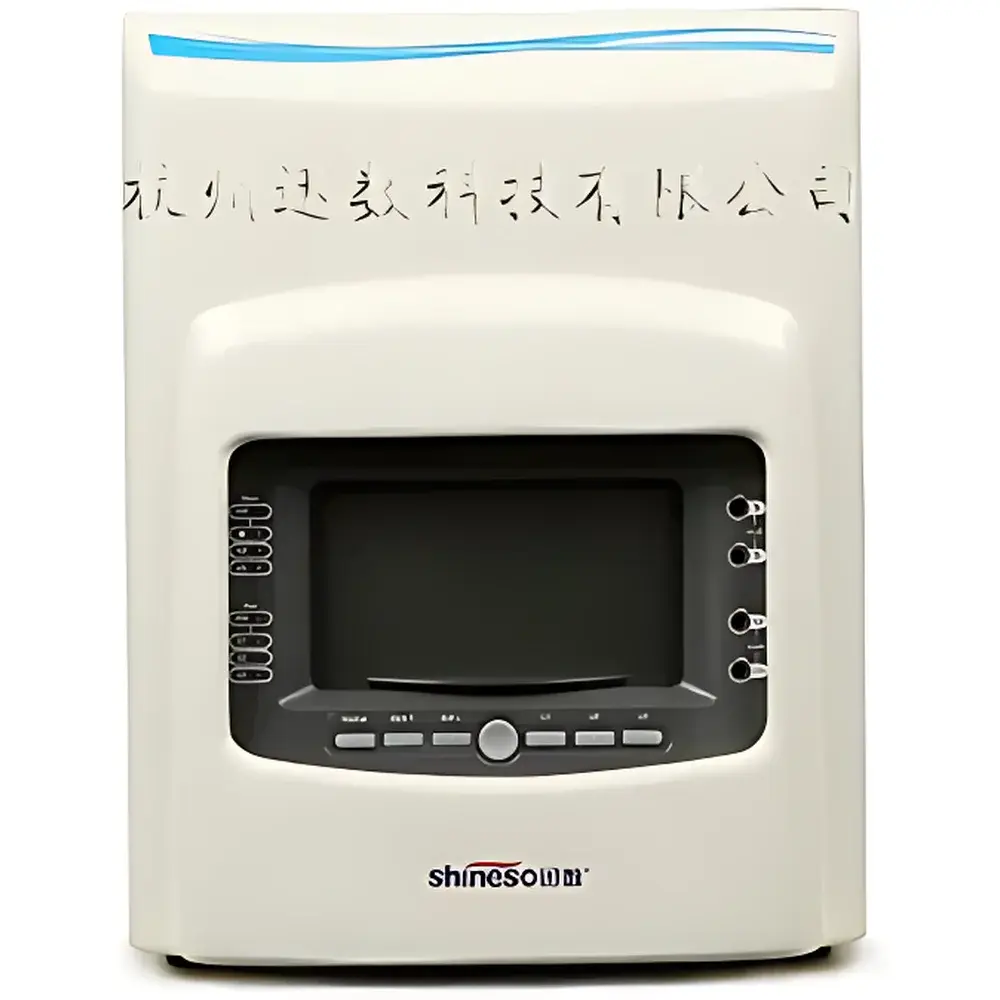
Xunsu iCount10 Fully Automated Colony Counter
| Brand | Xunsu |
|---|---|
| Origin | Zhejiang, China |
| Manufacturer Type | Direct Manufacturer |
| Product Category | Domestic |
| Model | iCount10 |
| Price Range | USD 4,200 – 7,000 (FOB) |
| Instrument Type | Fully Automated Colony Counter |
| Counting Speed | <1 second for up to 500 colonies |
Overview
The Xunsu iCount10 Fully Automated Colony Counter is a fourth-generation intelligent microbiological imaging system engineered for precision, reproducibility, and workflow efficiency in routine and regulated microbial enumeration. It employs high-resolution digital image acquisition coupled with adaptive computer vision algorithms grounded in morphological segmentation, watershed transform, and randomized Hough circle detection—principles widely adopted in ISO 4833-1:2013 and FDA BAM Chapter 3-compliant colony analysis. Designed as an entry-level yet fully functional platform within the iCount series, the iCount10 delivers laboratory-grade accuracy for pour plate, spread plate, and membrane filtration assays without requiring advanced operator training. Its optical architecture integrates dual-illumination pathways—top-mounted 360° diffuse LED ring lighting and bottom-mounted “CrystalSharp” suspended dark-field illumination—to eliminate specular glare, refractive halo artifacts, and environmental light contamination, thereby ensuring consistent contrast across heterogeneous colony morphologies and sizes down to 0.1 mm diameter.
Key Features
- Fully enclosed optical chamber with ergonomic porthole door design—meets ISO/IEC 17025 environmental control recommendations for photometric stability
- Tri-color mixed LED illumination system (RGB-balanced)—eliminates blue-shift bias common in monochromatic white LEDs, enabling faithful color representation of pigmented colonies (e.g., Micrococcus luteus, Serratia marcescens)
- Multi-mode illumination control: top-only, bottom-only, or simultaneous dual illumination—with independent intensity adjustment for optimal contrast in diverse media (e.g., TSA, PCA, VRBA, mEndo)
- 5-megapixel industrial CMOS sensor with fixed-focus macro lens—optimized for uniform resolution across 90 mm and 150 mm Petri dishes
- Six preconfigured one-click counting modes—automatically adapts segmentation parameters based on plate type (pour, spread, filter), colony density, and background complexity
- Advanced adhesion-splitting algorithm combining randomized Hough circle detection and level-set partitioning—validated against USP reference plates with >95% split accuracy for colonies exhibiting partial fusion
- Interactive region-of-interest (ROI) selection: freehand polygon, rectangle, or circle—adjustable via mouse drag or calibrated slider for repeatable sub-area quantification
Sample Compatibility & Compliance
The iCount10 supports standard microbiological culture formats including 90 mm and 150 mm Petri dishes, membrane filters (47 mm and 50 mm), and multi-well plates (6–24 wells). It accommodates opaque, translucent, and chromogenic media—validated with ISO 7218:2017 Annex B test protocols for colony morphology discrimination. The system enables manual exclusion of non-biological artifacts (e.g., agar scratches, dust particles, filter mesh interference) through user-defined masking zones. All counting operations are traceable via embedded audit trail metadata—including timestamp, operator ID, illumination mode, ROI coordinates, and post-processing edits—supporting GLP/GMP documentation requirements per FDA 21 CFR Part 11 when deployed with validated software configuration and access controls.
Software & Data Management
The bundled iCount Analysis Software provides an open-reporting framework compliant with laboratory information management system (LIMS) integration standards. Statistical outputs include total colony count, size-class distribution (25 configurable diameter bins), equivalent circular diameter, area, perimeter, and circularity metrics for individual colonies. Results export natively to Microsoft Excel (.xlsx) with preserved formulas and metadata headers, facilitating downstream statistical analysis (e.g., log10 CFU/g conversion, confidence interval calculation). Three-tier password protection governs system access: application launch password, database encryption key, and administrator-level privilege escalation—ensuring data integrity and role-based accountability. Calibration is performed using built-in reference targets or user-supplied stage micrometers, with optional linear correction mapping for edge distortion compensation.
Applications
The iCount10 serves core QC/QA functions across food safety (ISO 4833-1, AOAC 977.27), pharmaceutical microbiology (USP , EP 2.6.12), water quality testing (ISO 9308-1), and clinical environmental monitoring. It is routinely deployed for aerobic plate counts, coliform enumeration, yeast and mold quantification, and antimicrobial efficacy testing (ISO 11133, CLSI M07-A10). Its rapid throughput (<1 s per plate at ≤500 CFU) and low inter-operator variability make it suitable for high-volume contract laboratories, university teaching labs, and production facility QC departments requiring ALAC or ISO/IEC 17025 accreditation.
FAQ
Does the iCount10 support regulatory submissions under FDA 21 CFR Part 11?
Yes—when configured with enabled audit trails, electronic signatures, and password-protected user roles, the system meets foundational technical controls for electronic records. Full compliance requires site-specific validation per your SOPs.
Can the software distinguish between viable colonies and debris on chromogenic agar?
It uses color-space thresholding and texture filtering optimized for common chromogenic substrates (e.g., CHROMagar, Oxoid Brilliance), though final verification of presumptive positives remains operator-dependent per ISO 7218.
Is calibration traceable to NIST standards?
The system accepts user-provided NIST-traceable stage micrometers for spatial calibration; certificate of conformance is provided upon request for IQ/OQ documentation.
What operating system versions are supported?
Windows 10 Pro (64-bit) and Windows 11 (64-bit), with .NET Framework 4.8 and DirectX 12 runtime dependencies.
How is data backup and recovery managed?
The database uses SQLite with automatic daily encrypted backups; users may configure network-attached storage (NAS) or cloud-synced folders via Windows File History or third-party tools.




