
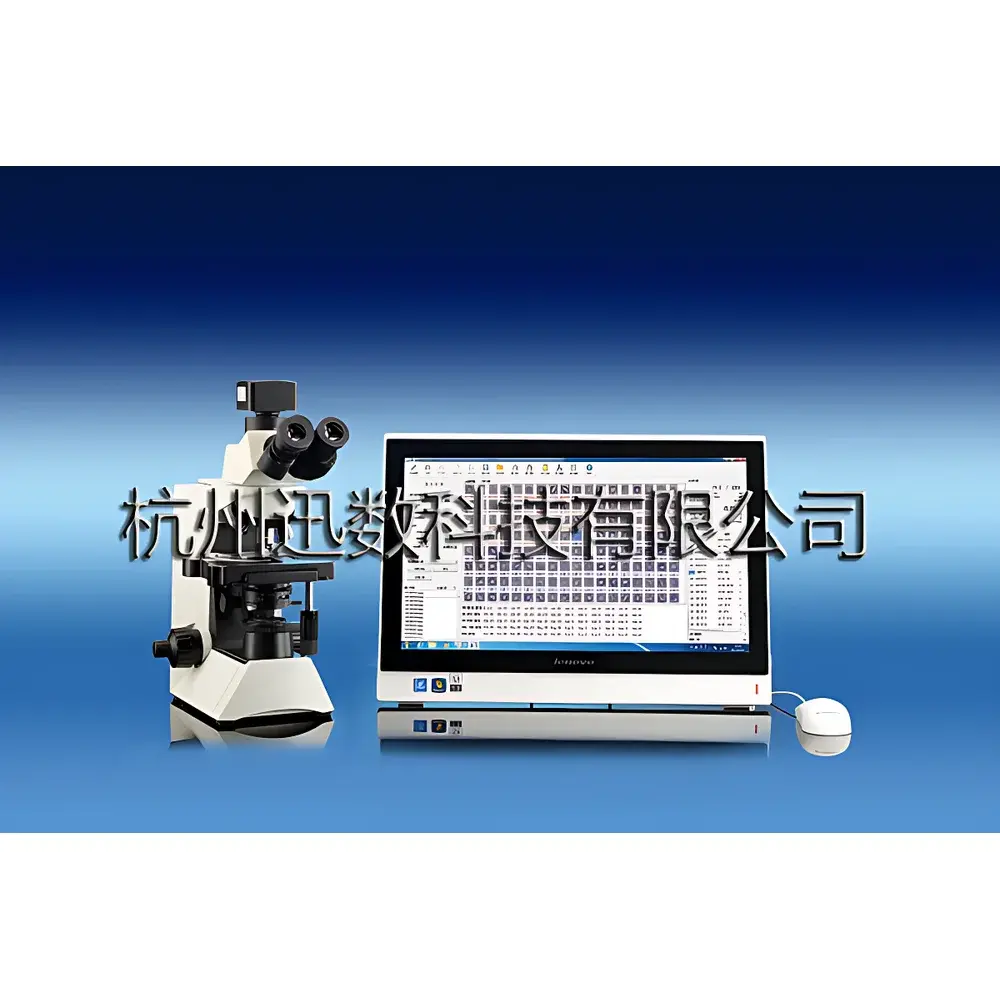
Xunsu MCN S3 Intelligent Micronucleus Analysis System for Erythrocytes
| Brand | Xunsu |
|---|---|
| Origin | Zhejiang, China |
| Manufacturer Type | Direct Manufacturer |
| Region of Origin | Domestic (China) |
| Model | MCN S3 |
| Pricing | Upon Request |
Overview
The Xunsu MCN S3 Intelligent Micronucleus Analysis System for Erythrocytes is a fully integrated digital microscopy platform engineered for standardized, high-throughput micronucleus (MN) assays in mammalian erythrocytes—primarily applied in genetic toxicology screening per OECD Test Guideline 474 and ISO 10993-3. The system combines an Olympus CX-31 upright microscope with UIS2 infinity-corrected optics, a scientific-grade Sony ExView HAD CCD camera (ICX285AQ, 2/3″ sensor), and two proprietary software modules: the MCN S3 Micronucleus Analysis Software and the MIC Image Analysis Suite. It implements a dual-stage computational workflow: first, classification of polychromatic erythrocytes (PCE) versus normochromatic erythrocytes (NCE) via deep learning–enhanced feature extraction; second, micronucleus detection within PCEs using adaptive stochastic resonance (ASR) coupled with mutual information entropy optimization. This architecture ensures robust discrimination of faintly stained micronuclei against heterogeneous background staining and confounding cell types (e.g., lymphocytes, granulocytes), fulfilling the morphological specificity requirements defined in ICH S2(R2) and USP .
Key Features
- Automated PCE/NCE classification: Achieves >98% concordance with expert manual scoring; completes PCE percentage calculation in ≤20 seconds per sample.
- High-fidelity micronucleus detection: Processes up to 200 microscope fields (100× oil immersion) and identifies ≥2,000 PCEs within 60 seconds, reporting micronucleated PCE frequency with traceable cell coordinates.
- Adaptive Stochastic Resonance (ASR) engine: Enhances weak chromatin signal-to-noise ratio without amplifying background artifacts; optimized via bistable system modeling and mutual information entropy thresholding.
- Full audit trail compliance: Records operator identity, timestamp, image acquisition parameters, analysis settings, result modifications, and data deletion events—aligned with FDA 21 CFR Part 11 and GLP/GMP documentation standards.
- Multi-level user management: Administrator-defined role-based access control (RBAC) for account creation, password policy enforcement, and session lockdown.
- Digital calibration & metrology: Integrated micrometric scale with real-time calibration support for linear, angular, and area measurements (µm, deg, µm²); supports ISO/IEC 17025 traceability workflows.
Sample Compatibility & Compliance
The MCN S3 system is validated for bone marrow or peripheral blood smears from rodent models (typically CD-1 mice or Sprague-Dawley rats), prepared using Giemsa or acridine orange staining protocols. It accommodates standard 24 × 50 mm glass slides with coverslips and supports both single- and multi-dose experimental designs—including negative (vehicle), positive (e.g., cyclophosphamide), and three-tier dose groups as required by OECD 474. All software operations conform to ALCOA+ principles (Attributable, Legible, Contemporaneous, Original, Accurate, Complete, Consistent, Enduring, Available). Data integrity is preserved through immutable electronic records stored in encrypted SQLite databases with SHA-256 checksum validation. The system meets essential hardware requirements for ISO/IEC 17025-accredited laboratories performing regulatory submissions to EMA, PMDA, and NMPA.
Software & Data Management
The MCN S3 software suite comprises two interoperable modules. The MCN S3 Analysis Module handles assay-specific logic: batch image ingestion, PCE/NCE training via interactive cell selection, ASR parameter tuning (resonance intensity, chromatin diffusion, MN sensitivity), and automated report generation in PDF or Excel formats—with strict one-to-one correspondence between exported results and raw electronic records. The MIC Image Analysis Module provides comprehensive image enhancement tools: 27 algorithmic filters (Gaussian, median, morphological erosion/dilation), adaptive contrast enhancement, background flattening, edge sharpening, and RGB channel balancing. Both modules support DICOM-compatible metadata embedding, DICOM-SR structured reporting, and CSV export for LIMS integration. Audit logs are retained for ≥10 years and exportable as signed PDF archives compliant with EU Annex 11 and WHO TRS 996.
Applications
The system is deployed in pharmaceutical preclinical safety assessment, chemical hazard characterization, nanomaterial genotoxicity evaluation, and academic research on DNA damage response mechanisms. Typical use cases include: (1) regulatory submission packages for new active pharmaceutical ingredients (APIs); (2) follow-up testing of Ames-positive compounds; (3) tiered screening of industrial chemicals under REACH; (4) validation of CRISPR/Cas9 off-target effects in hematopoietic lineages; and (5) longitudinal monitoring of radiation-induced chromosomal instability. Its reproducibility profile supports inter-laboratory comparison studies under ISO 5725-2, and its throughput enables statistical power ≥0.9 at α = 0.05 for detecting ≥1.5-fold increases in MN frequency across five-dose experimental designs.
FAQ
Does the MCN S3 system comply with FDA 21 CFR Part 11?
Yes—the system implements electronic signatures, role-based authentication, immutable audit trails, and data encryption aligned with Part 11 Subpart B requirements.
Can the software distinguish micronuclei from nuclear buds or apoptotic bodies?
Yes—using morphology-driven classifiers trained on validated reference datasets, it applies size (0.2–0.5× main nucleus diameter), staining intensity, and spatial separation criteria per OECD 474 guidance.
Is the Olympus CX-31 microscope included with full service warranty?
The microscope is supplied with OEM factory warranty; extended service plans covering optical alignment, lamp replacement, and mechanical recalibration are available upon request.
What file formats does the system support for image import/export?
Native TIFF and BMP import; export to TIFF, JPEG, PNG, PDF, XLSX, and CSV. All metadata—including magnification, exposure time, and calibration factors—is embedded in EXIF and custom XML headers.
How is measurement accuracy verified during routine operation?
Users perform daily verification using NIST-traceable stage micrometers; software includes built-in calibration validation routines that flag drift exceeding ±0.5% across 10 consecutive measurements.



