
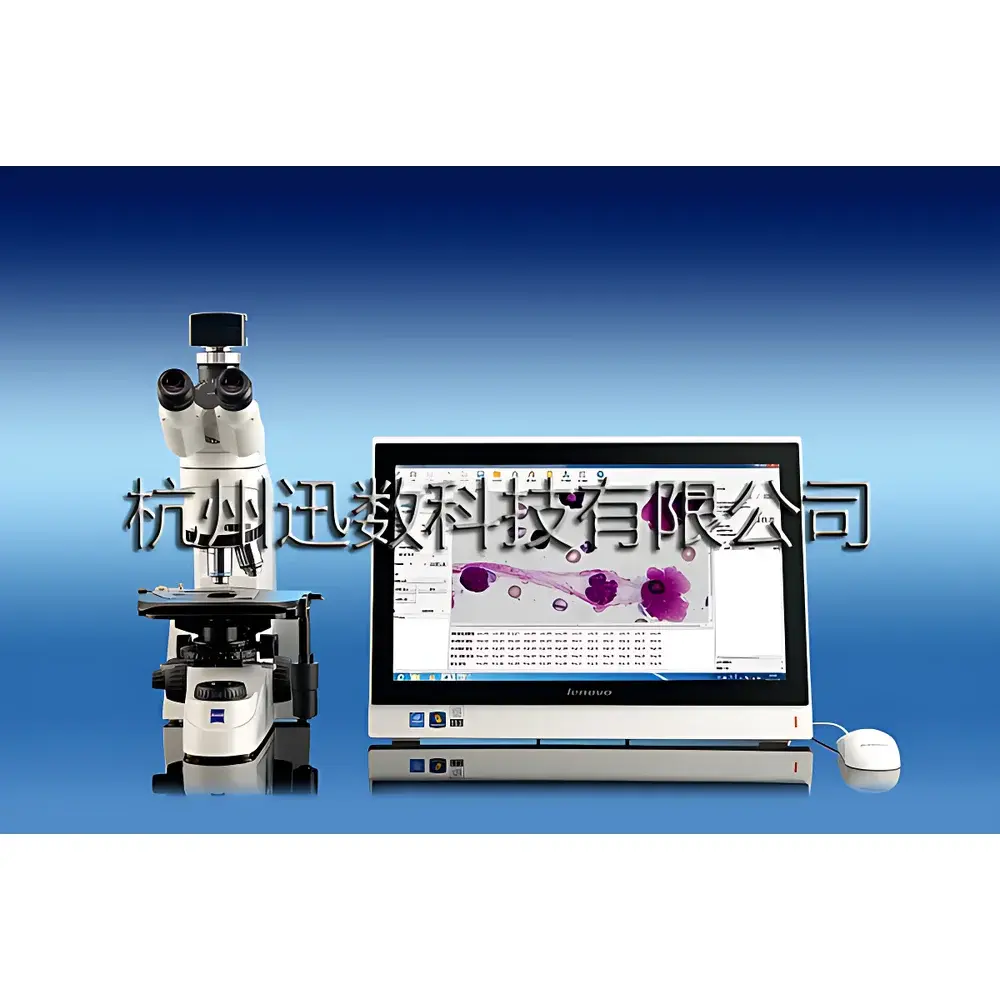
Xunsu MCN S5 Automated Micronucleus Analysis System for Erythrocytes
| Brand | Xunsu |
|---|---|
| Origin | Zhejiang, China |
| Manufacturer Type | Direct Manufacturer |
| Region of Origin | Domestic (China) |
| Model | MCN S5 |
| Pricing | Upon Request |
Overview
The Xunsu MCN S5 Automated Micronucleus Analysis System is a fully integrated digital cytogenetic workstation engineered for high-throughput, regulatory-compliant micronucleus assays in mammalian erythrocytes. It combines a research-grade Zeiss Axio Lab.A1 upright microscope, a 6.0-megapixel Sony ExView HAD CCD camera with 1-inch sensor format, and dual proprietary software modules — the MCN Micronucleus Intelligence Engine and the MIC Microscopic Image Computing platform. The system implements stochastic resonance–enhanced image processing to resolve low-contrast, weakly stained polychromatic erythrocytes (PCEs) and normochromatic erythrocytes (NCEs) in Giemsa-stained bone marrow or peripheral blood smears. Unlike conventional threshold-based segmentation, the MCN S5 applies mutual information entropy analysis within a bistable system framework to amplify sub-threshold chromatic signals, enabling robust identification of micronuclei as small as 1/3 to 1/5 the diameter of the main nucleus — a critical requirement for OECD 474 and ISO 10993-3 compliant genotoxicity testing.
Key Features
- Zeiss Axio Lab.A1 optical platform with IC2S infinity-corrected optics and N-Achroplan Plan Apochromat 100×/1.25 NA oil immersion objective for diffraction-limited resolution and high signal-to-noise ratio imaging
- Sony ICX694AQG(C) ExView HAD CCD sensor (4.54 µm pixel pitch, 1-inch format) delivering high quantum efficiency in the visible spectrum and ultra-low dark current (8 mV @ 1/30 s)
- Stochastic resonance–driven image enhancement engine that selectively amplifies weak chromatic features of PCEs without distorting nuclear morphology or introducing false positives
- Automated PCE/NCE classification and micronucleus detection: processes ≥2,000 PCEs per session in <60 seconds with traceable cell localization via coordinate-mapped digital archiving
- FDA 21 CFR Part 11–ready audit trail system logging operator identity, timestamp, sample ID, parameter adjustments, result modifications, and data deletion events
- Dual-mode measurement: manual digital micrometer (angle, arc length, perimeter, area, diameter) and auto-segmentation mode for dispersed, well-defined cells (processing time <1 second per field)
Sample Compatibility & Compliance
The MCN S5 is validated for use with Giemsa-stained rodent bone marrow smears and human peripheral blood preparations following standard OECD Test Guideline 474, ISO 10993-3 (biological evaluation of medical devices), and ICH S2(R2) recommendations. It supports five experimental groups (high-, mid-, low-dose, positive control, negative control), up to 50 slides per study, and archives ≥10,000 high-resolution fields (2748 × 2200 pixels) with embedded spatial metadata. All image acquisition, classification, and reporting workflows comply with GLP principles, including electronic signature enforcement, role-based access control (administrator/operator tiers), and immutable PDF report generation synchronized with raw electronic records.
Software & Data Management
The MCN S5 runs two co-engineered software suites on Windows 10 Professional: the MCN module handles micronucleus assay execution, while the MIC module provides comprehensive image computing capabilities — including adaptive contrast enhancement, multi-algorithm morphological filtering (Gaussian, median, low-pass), edge-preserving sharpening, background flattening, and 27 configurable preprocessing operations. Both modules support DICOM-compatible metadata embedding, lossless TIFF/PNG export, and batch processing with customizable naming conventions. Data integrity is enforced through encrypted local storage, automatic versioned backups, and tamper-evident audit logs stored in SQLite databases with SHA-256 hash verification. Export formats include ISO/IEC 20227-compliant PDF reports and Excel (.xlsx) datasets with embedded calculation formulas and source-image hyperlinks.
Applications
The system serves core applications in preclinical toxicology, pharmaceutical safety assessment, environmental mutagenicity screening, and academic cytogenetics research. Specific use cases include: automated scoring of micronucleated PCEs in rodent bone marrow for regulatory submission packages; longitudinal monitoring of chromosomal instability in hematopoietic progenitors under chemical or radiation exposure; quantitative morphometric analysis of nuclear anomalies (blebbing, lobulation, fragmentation) in drug-induced genotoxicity studies; and high-content validation of CRISPR/Cas9 editing fidelity in primary erythroid cultures. Its calibrated measurement engine also supports clonogenic assays in multiwell plates and standardized karyotype feature extraction from metaphase spreads.
FAQ
What regulatory standards does the MCN S5 support?
The system meets functional requirements for OECD TG 474, ISO 10993-3, and ICH S2(R2); its audit trail, electronic signature, and data immutability features align with FDA 21 CFR Part 11 and EU Annex 11 expectations.
Can the system distinguish micronuclei from staining artifacts or cytoplasmic granules?
Yes — using stochastic resonance–enhanced contrast and mutual information–guided feature selection, the algorithm discriminates true micronuclei based on size (≥1/5 main nucleus diameter), roundness (>0.7), intensity homogeneity, and spatial separation from the primary nucleus.
Is raw image data preserved alongside processed results?
Absolutely — every analyzed field is archived in original TIFF format with embedded EXIF and custom metadata (slide ID, field coordinates, exposure settings, software version). Processed masks and classification labels are stored separately but cross-referenced via UUID.
Does the system require external calibration for morphometric measurements?
No — the MIC software includes built-in stage micrometer calibration with real-time scaling factor application across all measurement modes, ensuring traceability to NIST-traceable reference standards.
How is user access controlled and audited?
Role-based authentication enforces strict separation between administrator (account creation, privilege assignment, log review) and operator (sample analysis only). All actions are logged with ISO 8601 timestamps, IP address (if networked), and cryptographic checksums to prevent post-hoc tampering.





