
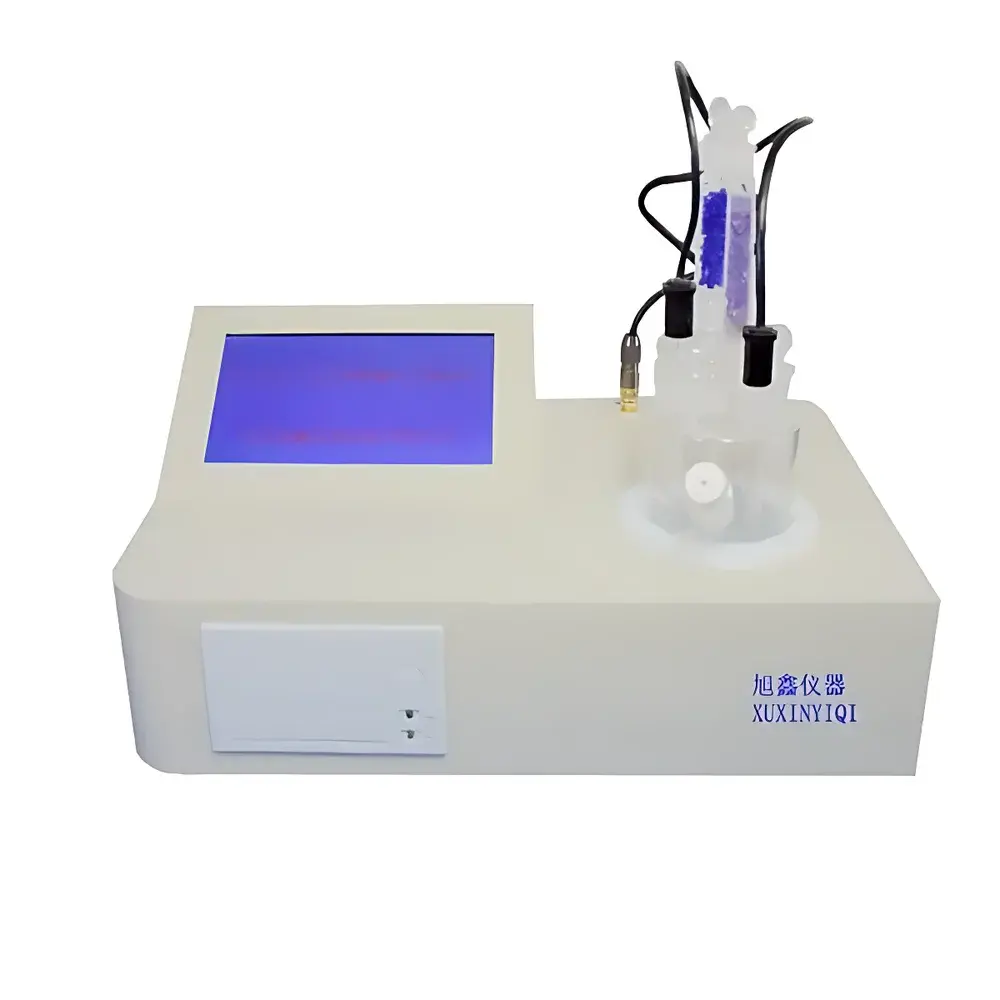
Xuxin Instrument ST-1513 Coulometric Karl Fischer Moisture Titrator
| Brand | Xuxin Instrument |
|---|---|
| Origin | Beijing, China |
| Manufacturer Type | Direct Manufacturer |
| Country of Origin | China |
| Model | ST-1513 |
| Pricing | Upon Request |
| Measurement Range | 1 µg – 200 mg H₂O |
| Accuracy | ±3 µg (for 5–1000 µg), ±0.3% (for >1000 µg) |
| Resolution | 0.1 µg |
| Power Consumption | ≤60 W |
| Electrolysis Current | 0–400 mA (auto-controlled) |
| Maximum Electrolysis Rate | 2.2 mg/min (0–37 µg/s, auto-controlled) |
| Operating Temperature | 5–40 °C |
| Relative Humidity | 10–80 % RH |
| Power Supply | 220 V ±10%, 50 Hz |
| Dimensions (L×W×H) | 326 × 246 × 180 mm |
| Weight | 4.14 kg |
| Display | Color LCD touchscreen |
| Language Options | Switchable Chinese/English UI |
| Compensation Features | Blank current compensation, drift correction, endpoint delay, electrolysis delay |
| Titration Mode | Dual-circuit balanced coulometric titration |
| Units Supported | µg, mg/L, ppm, % (user-selectable & memory-retained) |
| Reagent Status Monitoring | Integrated reagent depletion alert |
| Compliance | Designed to support GLP-compliant workflows |
Overview
The Xuxin Instrument ST-1513 Coulometric Karl Fischer Moisture Titrator is a precision-engineered analytical system designed for trace-level water quantification in diverse sample matrices using the coulometric Karl Fischer (KF) principle. Unlike volumetric KF methods, coulometric titration generates iodine electrochemically at the anode in real time, enabling ultra-sensitive detection down to 0.1 µg of water—ideal for low-moisture samples such as pharmaceutical active ingredients, lithium battery electrolytes, high-purity solvents, and polymer precursors. The instrument operates on the stoichiometric reaction between iodine, sulfur dioxide, water, and a base in methanol-based KF reagents, where each coulomb of charge corresponds to a fixed mass of water (10.72 µg/C). This fundamental electrochemical relationship underpins the ST-1513’s high reproducibility and inherent calibration stability—eliminating the need for frequent standardization with external water standards.
Key Features
- Color LCD touchscreen interface with intuitive navigation and dual-language support (English/Chinese), enabling seamless operation across international laboratories.
- Dual-circuit balanced coulometric titration architecture minimizes electrical interference and improves signal-to-noise ratio—delivering enhanced sensitivity and reduced measurement variance.
- Integrated blank current compensation and drift correction algorithms actively monitor and subtract background electrolysis contributions, ensuring accuracy even during extended analysis sessions or in variable ambient conditions.
- Waterproof sealed electrolytic cell design reduces equilibrium time by up to 40% and extends reagent service life—critical for high-throughput QC environments.
- Configurable electrolysis delay and endpoint hold functions accommodate challenging samples with slow water release kinetics (e.g., hygroscopic solids, viscous oils, or thermally labile APIs).
- Eight pre-programmed calculation formulas and four selectable units (µg, mg/L, ppm, %) are stored per method—supporting multi-product labs without manual recalculations.
- Real-time reagent exhaustion monitoring provides audible and visual alerts prior to performance degradation—reducing risk of false negatives and non-conforming results.
Sample Compatibility & Compliance
The ST-1513 accommodates solid, liquid, and gaseous samples via optional accessories—including oven samplers (for volatilization-based moisture extraction), gas diffusion cells, and solid-sample adapters. It has been validated for use with alcohols, hydrocarbons, esters, ethers, organic acids, amines, pesticides, pharmaceutical intermediates, and silicone-based fluids. All operational parameters and audit trails comply with core regulatory expectations for analytical instrumentation: data integrity safeguards align with FDA 21 CFR Part 11 principles (when paired with compliant LIMS or ELN systems), and measurement protocols conform to ASTM E203 (Standard Test Method for Water in Organic Liquids by Coulometric Karl Fischer Titration), ISO 760 (Determination of Water—Coulometric Titration Method), and USP <921> “Water Determination.” The instrument’s mechanical and electrical design meets IEC 61010-1 safety standards for laboratory equipment.
Software & Data Management
While the ST-1513 operates autonomously via its embedded firmware, it supports RS-232 and USB-B connectivity for raw data export (CSV format) and remote parameter configuration. Each analysis record includes timestamp, sample ID, operator ID (if entered), method name, water mass, unit, relative standard deviation (RSD) of replicate injections (if applicable), and reagent status flags. Audit trail functionality logs all critical events—including method changes, calibration resets, and user logins—enabling retrospective review during internal audits or regulatory inspections. For laboratories implementing paperless workflows, the device integrates natively with third-party laboratory information management systems (LIMS) and electronic lab notebooks (ELN) that accept ASCII-based instrument data streams.
Applications
This coulometric titrator serves as a primary moisture verification tool in quality control laboratories across multiple regulated industries. In pharmaceutical manufacturing, it verifies water content in lyophilized powders, excipients, and final dosage forms—ensuring compliance with ICH Q5C stability guidelines. In petrochemical QA, it quantifies trace water in jet fuel (ASTM D6304), transformer oil (IEC 60814), and lubricants—preventing corrosion and dielectric failure. Battery material producers rely on it to validate moisture thresholds in cathode precursors (<20 ppm) prior to cell assembly. Academic research groups apply it to study hydration states in metal–organic frameworks (MOFs), catalyst deactivation mechanisms, and polymerization inhibitor efficacy—all requiring sub-10 µg detection capability and metrological traceability.
FAQ
What types of KF reagents are compatible with the ST-1513?
The instrument is optimized for single-component coulometric reagents (e.g., Hydranal-Coulomat AG, Aquastar-Coulomat AG) containing iodide, sulfur dioxide, and base in methanol or chlorinated solvent systems. Non-methanolic reagents require validation of endpoint detection stability.
Can the ST-1513 be used for Karl Fischer titration of samples containing ketones or aldehydes?
Yes—provided a ketone-compatible reagent (e.g., Hydranal-Ketone) is selected and the instrument’s endpoint detection algorithm is configured for slower reaction kinetics; method development is recommended for new matrix–reagent combinations.
Is GLP-compliant data archiving supported out-of-the-box?
Raw data export and event logging meet foundational GLP documentation requirements; however, full audit trail enforcement (e.g., electronic signatures, role-based access) requires integration with validated LIMS or ELN software.
How often does the electrolytic cell require maintenance?
Under typical usage (≤10 samples/day), the cell should be cleaned weekly with dry methanol and inspected for electrode passivation; membrane replacement is recommended every 6–12 months depending on reagent purity and sample load.
Does the ST-1513 support automatic sample changers?
It does not include built-in autosampling, but its serial communication protocol enables integration with third-party XYZ autosamplers via custom scripting or OEM SDK support upon request.




