
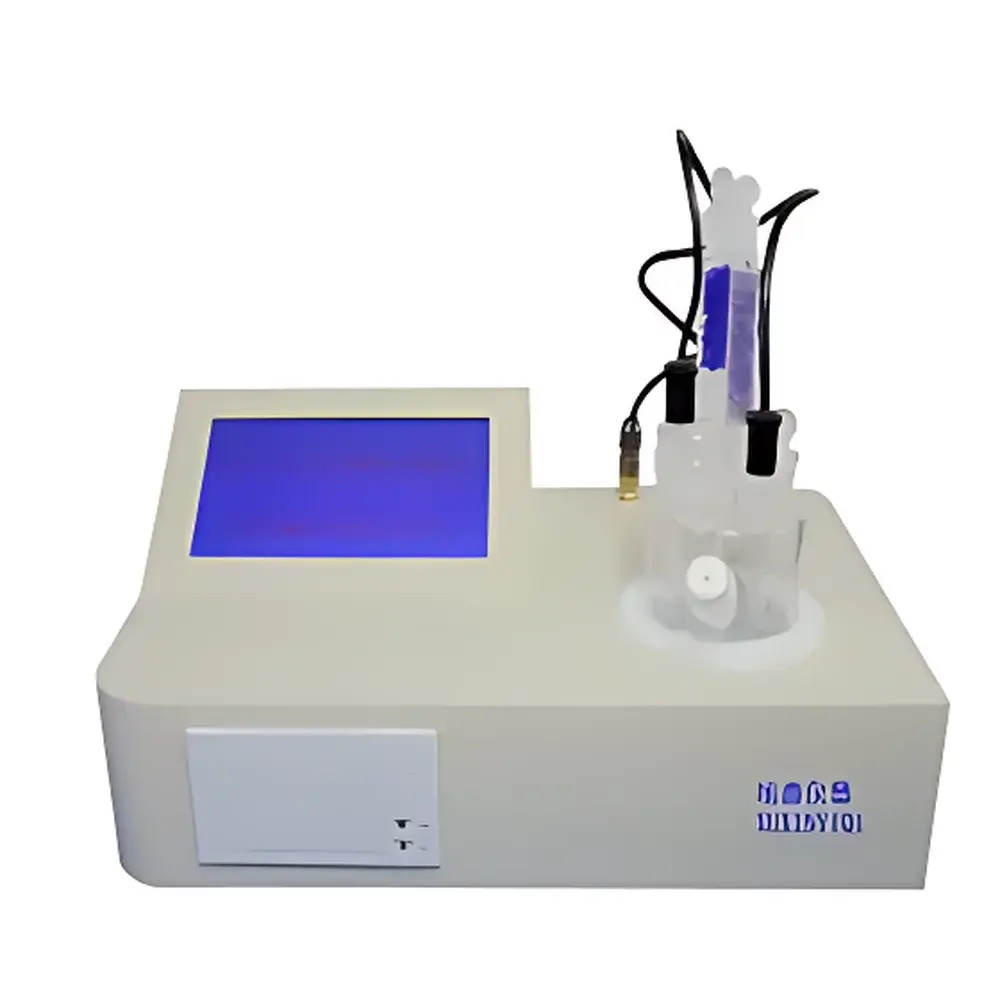
Xuxin Instrument ST-1513A Automatic Coulometric Karl Fischer Moisture Titrator
| Brand | Xuxin Instrument |
|---|---|
| Origin | Beijing, China |
| Manufacturer Type | OEM Manufacturer |
| Country of Origin | China |
| Model | ST-1513A |
| Price Range | USD 1,400 – 7,000 |
Overview
The Xuxin Instrument ST-1513A Automatic Coulometric Karl Fischer Moisture Titrator is a precision analytical instrument engineered for trace water quantification in solid, liquid, and gaseous samples using the coulometric Karl Fischer titration principle. Unlike volumetric KF methods, this system generates iodine electrochemically at the anode via controlled current (0–400 mA), enabling direct, stoichiometric determination of water content with high sensitivity and minimal reagent consumption. The method relies on the quantitative reaction: H₂O + I₂ + SO₂ + 3RN + CH₃OH → 2RN·HI + RN·HSO₄CH₃, where water is the sole limiting reactant. Designed for laboratories requiring compliance with stringent regulatory and quality control protocols, the ST-1513A delivers reproducible results across demanding industrial sectors—including petrochemical refining, pharmaceutical excipient release testing, polymer synthesis monitoring, and transformer oil condition assessment.
Key Features
- Coulometric detection with automatic current regulation (0–400 mA) and real-time electrolysis speed control (up to 37 µg/s), ensuring optimal response for ultra-trace (1 µg–200 mg H₂O) and high-moisture samples
- Dual-circuit balanced titration architecture minimizes baseline drift and improves measurement repeatability
- Waterproof sealed electrolytic cell with rapid equilibrium stabilization (<60 s typical) and extended electrolyte service life (≥1,000 tests per fill under standard conditions)
- Intelligent endpoint recognition with dual delay functions: electrolysis delay (for slow-reacting matrices) and endpoint hold delay (to confirm stable endpoint in low-water or volatile samples)
- 7-inch or optional 8-inch high-resolution capacitive touch LCD interface supporting both full English and full Chinese language modes
- Three calculation formula options (µg H₂O, ppm, % w/w) with automatic unit conversion and user-selectable display resolution (0.01 µg minimum)
- Integrated electromagnetic stirrer with continuously adjustable speed (100–1,200 rpm) for homogeneous sample dissolution and consistent mass transfer
- Onboard data storage for up to 1,000 complete test records—including date/time stamp, sample ID, method parameters, raw current curves, and final result—accessible via USB export
Sample Compatibility & Compliance
The ST-1513A accommodates diverse sample types without modification: low-viscosity organics (e.g., methanol, acetone, THF), viscous oils (transformer oil, lubricants, biodiesel), hygroscopic solids (APIs, catalysts, desiccants), and compressed gases (natural gas, SF₆, fluorocarbons). Its design conforms to internationally recognized standards for moisture analysis, including ASTM E1064 (organic liquids), ASTM D4928 (crude oil), ASTM D6304 (petroleum products), ISO 10337 (crude oil), and multiple GB/T standards (e.g., GB/T 6283, GB/T 7600, GB/T 11133). The instrument supports GLP-compliant operation through audit-trail-capable data logging, user-access-level management (admin/operator), and optional NIM (National Institute of Metrology, China) calibration certification—meeting traceability requirements for ISO/IEC 17025-accredited labs.
Software & Data Management
Data integrity is maintained via built-in timestamped storage and non-volatile memory. All measurements include raw coulometric current vs. time profiles, endpoint detection logic flags, and environmental metadata (ambient temperature/humidity). Results export in CSV format via USB port for integration into LIMS or statistical process control (SPC) platforms. The firmware implements automatic blank current compensation and drift correction algorithms based on real-time background current monitoring—critical for maintaining accuracy during long-duration batch analyses. While native software does not support FDA 21 CFR Part 11 electronic signature functionality, the system’s deterministic measurement architecture and immutable record structure facilitate validation under GMP and ISO 9001 frameworks.
Applications
- Petrochemical QA/QC: Water quantification in crude oil, jet fuel (ASTM D6304), transformer oil (GB/T 7600), and refrigerants (GB/T 7376)
- Pharmaceutical manufacturing: Moisture verification of active pharmaceutical ingredients (APIs), excipients, and lyophilized products per USP & EP guidelines
- Chemical R&D: Reaction monitoring in esterification, amidation, and hydrolysis processes where residual water impacts yield or stability
- Electronics materials: Moisture screening of solvents used in semiconductor cleaning (e.g., IPA, PGMEA) to prevent device corrosion
- Academic research: Teaching and method development in analytical chemistry laboratories focused on redox titrimetry and electroanalytical fundamentals
FAQ
What is the detection limit and measurement range of the ST-1513A?
The instrument detects water from 1 µg to 200 mg, corresponding to concentration ranges of 0.0001% (1 ppm) to 100% w/w.
Does the system require manual calibration before each analysis?
No. The coulometric principle is inherently absolute—no external standardization is needed. Only periodic verification with certified water standards (e.g., 1.00 mg/g Hydranal® Standard) is recommended for routine performance checks.
Can the ST-1513A analyze samples containing ketones or aldehydes?
Yes, but only when using aldehyde/ketone-compatible KF reagents (e.g., two-component systems with imidazole-based buffers) and appropriate sample preparation protocols to suppress side reactions.
Is the electrolyte cell compatible with automated sample changers?
The ST-1513A is designed for manual sample introduction. It does not natively support robotic autosamplers; however, its RS-232 interface allows integration with third-party automation controllers upon custom firmware configuration.
What maintenance is required for long-term operational reliability?
Routine maintenance includes daily drying tube inspection, monthly catholyte replacement, biannual anolyte renewal, and annual verification of stirrer motor torque and electrode contact resistance.



