
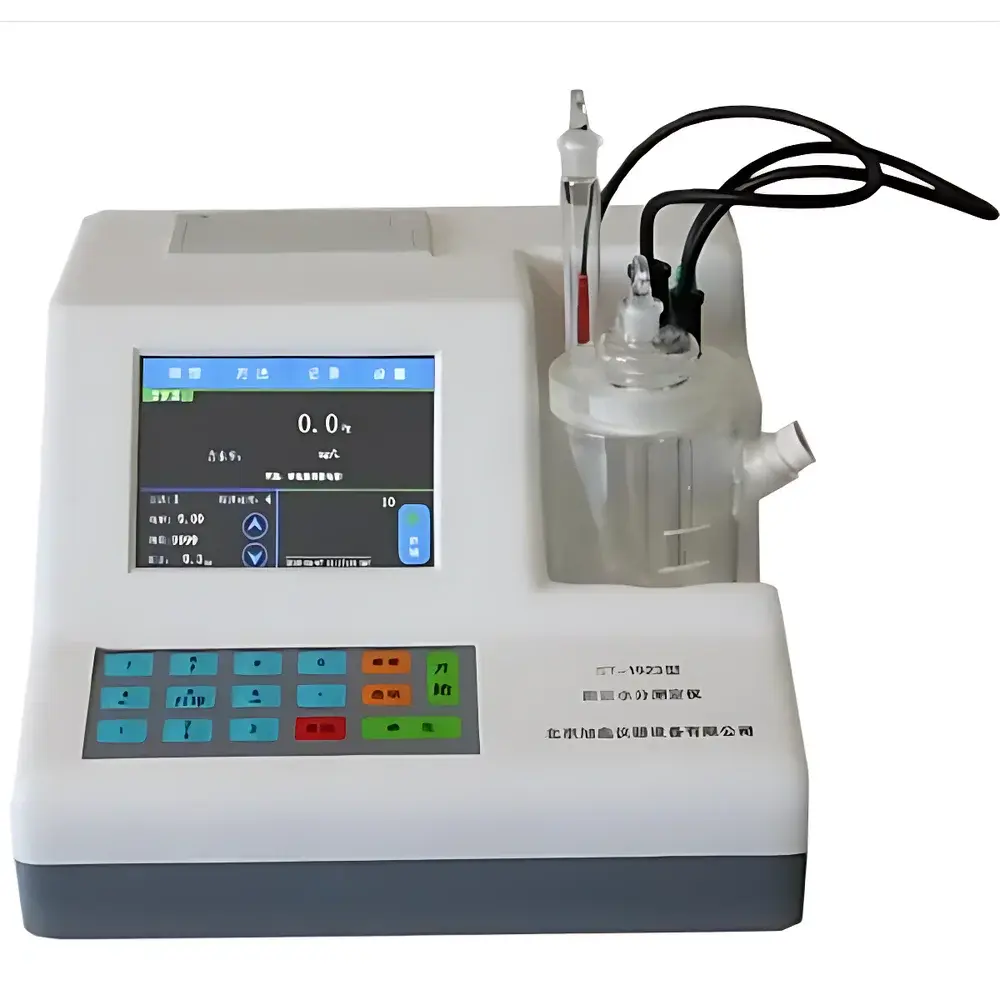
Xuxin Instrument ST-1523 Fully Automated Coulometric Karl Fischer Moisture Analyzer
| Brand | Xuxin Instrument |
|---|---|
| Origin | Beijing, China |
| Manufacturer Type | OEM Manufacturer |
| Model | ST-1523 |
| Titration Mode | Fully Automated Coulometric Titration |
| Instrument Type | Coulometric Karl Fischer Moisture Analyzer |
| Water Content Range | 1 µg to 200 mg |
| Resolution | 0.1 µg |
| Accuracy | ±3 µg for 5–1000 µg |
Overview
The Xuxin Instrument ST-1523 Fully Automated Coulometric Karl Fischer Moisture Analyzer is engineered for high-precision, trace-level water quantification in solid, liquid, and gaseous samples using the coulometric Karl Fischer (KF) principle. Unlike volumetric KF systems, this analyzer generates iodine electrochemically at the anode via controlled current—enabling direct, stoichiometric measurement of water content without manual reagent standardization. The method adheres strictly to Faraday’s law, where 1 mole of iodine corresponds to 1 mole of water (10.721 mC per µg H₂O), ensuring inherent accuracy and long-term reproducibility. Designed for laboratories requiring compliance with pharmacopeial and industrial standards—including USP <921>, EP 2.5.12, and ASTM E1064—the ST-1523 delivers robust performance in regulated environments such as pharmaceutical QC, petrochemical refining, polymer synthesis, and battery electrolyte analysis.
Key Features
- Fully automated coulometric titration with real-time current control (0–400 mA) and adaptive electrolysis speed (up to 2.2 mg H₂O/min), enabling rapid stabilization and minimal drift.
- Dual-circuit balanced titration architecture minimizes interference from background current and improves signal-to-noise ratio—critical for low-moisture matrices (<10 ppm).
- Hermetically sealed, moisture-resistant electrolytic cell with optimized electrode geometry reduces equilibration time and extends reagent lifetime by up to 40% compared to conventional designs.
- 32-bit embedded microprocessor running a deterministic real-time OS ensures deterministic response latency, consistent timing control, and immunity to system-level software interrupts.
- High-resolution 7-inch color TFT touchscreen paired with tactile physical keys supports glove-compatible operation and dual-input redundancy—essential for ISO/IEC 17025-accredited labs.
- Integrated automatic reagent dispensing and waste evacuation eliminates manual handling, reducing operator exposure and cross-contamination risk in GMP-compliant workflows.
- Onboard thermal printer (fast-dry, 58 mm) and 16 GB internal flash storage support GLP-compliant audit trails, including timestamped raw curves, method parameters, and operator ID logs.
Sample Compatibility & Compliance
The ST-1523 accommodates diverse sample types—including hygroscopic solids (e.g., APIs, excipients), viscous liquids (lubricants, silicone oils), volatile organics (ethers, ketones), and pressurized gases (natural gas, SF₆)—via optional vapor-phase or oven-based sampling modules. Its coulometric design avoids solvent volume limitations, making it ideal for samples with <0.1% water content where volumetric methods suffer from poor precision. The instrument meets or exceeds requirements of multiple international standards: ASTM E1064 (organic liquids), ASTM D4928 (crude oil), ISO 10337 (crude oil water content), GB/T 7600 (in-service transformer oil), GB/T 18826 (HFC-134a), and SH/T 0246 (light petroleum products). All firmware and calibration protocols are designed to support 21 CFR Part 11-compliant electronic records when connected to validated LIMS or ELN platforms.
Software & Data Management
The ST-1523 operates with a dual-language UI (English/Chinese selectable at boot) and supports six preconfigured calculation algorithms—including absolute mass (µg), concentration (mg/L, ppm), and relative moisture (% w/w)—with unit switching performed dynamically during measurement. Raw electrolysis current vs. time curves are displayed in real time, allowing immediate visual assessment of endpoint sharpness and reagent exhaustion. Data export is supported via USB 2.0 and RS-232 interfaces; ASCII-formatted CSV files include full metadata (date/time, method ID, sample ID, ambient T/RH, electrode potential). When interfaced with certified analytical balances (METTLER TOLEDO, SARTORIUS), the system auto-imports sample weight with 0.01 mg resolution and applies gravimetric normalization without user intervention. Audit trail functionality records all parameter changes, calibration events, and user logins—fully traceable for FDA inspection readiness.
Applications
- Pharmaceutical: Quantification of residual moisture in lyophilized biologics, active pharmaceutical ingredients (APIs), and polymer-based drug delivery systems per ICH Q5C guidelines.
- Petrochemical: Trace water analysis in hydrocarbon streams, lubricants, biodiesel, and LNG feedstocks to prevent corrosion, freezing, and catalyst deactivation.
- Electronics: Moisture verification in lithium-ion battery electrolytes (LiPF₆ solutions), conformal coatings, and semiconductor packaging resins—where sub-10 ppm levels directly impact device reliability.
- Polymers & Plastics: Monitoring moisture in polyamide (nylon), polycarbonate, and PET prior to extrusion or injection molding to avoid hydrolytic degradation.
- Food & Flavor: Determination of bound water in powdered dairy, spices, and encapsulated flavors—critical for shelf-life prediction and Maillard reaction control.
FAQ
What is the minimum detectable water mass, and how is detection limit verified?
The instrument achieves a theoretical detection limit of 0.1 µg based on electrochemical resolution and noise floor characterization per ISO 11843-1. Verification is performed using certified anhydrous methanol spiked with NIST-traceable water standards (e.g., 10 µg/mL ±0.5%).
Does the system support external balance integration with automatic tare and weight import?
Yes—RS-232 and USB-HID protocols are implemented for seamless bidirectional communication with Class I and II analytical balances meeting OIML R76 requirements.
Can the electrolytic cell be cleaned and reused, and what is its typical service life?
The platinum electrodes and glass frit are field-replaceable; under normal use (≤500 assays/month), the cell maintains stable baseline and endpoint reproducibility for ≥18 months. Cleaning follows ASTM D6304 Annex A3 procedures using dry nitrogen purge and acetone rinse.
Is firmware validation documentation available for regulated users?
Xuxin provides IQ/OQ protocol templates, test scripts, and raw validation data packages upon request—compatible with Annex 11 and GAMP 5 frameworks.
How does the instrument handle samples that release water slowly (e.g., crystalline hydrates)?
The built-in “slow-release mode” extends electrolysis duration while applying dynamic current ramping and adaptive endpoint detection—validated per USP <921> Method II for hydrated salts.






