
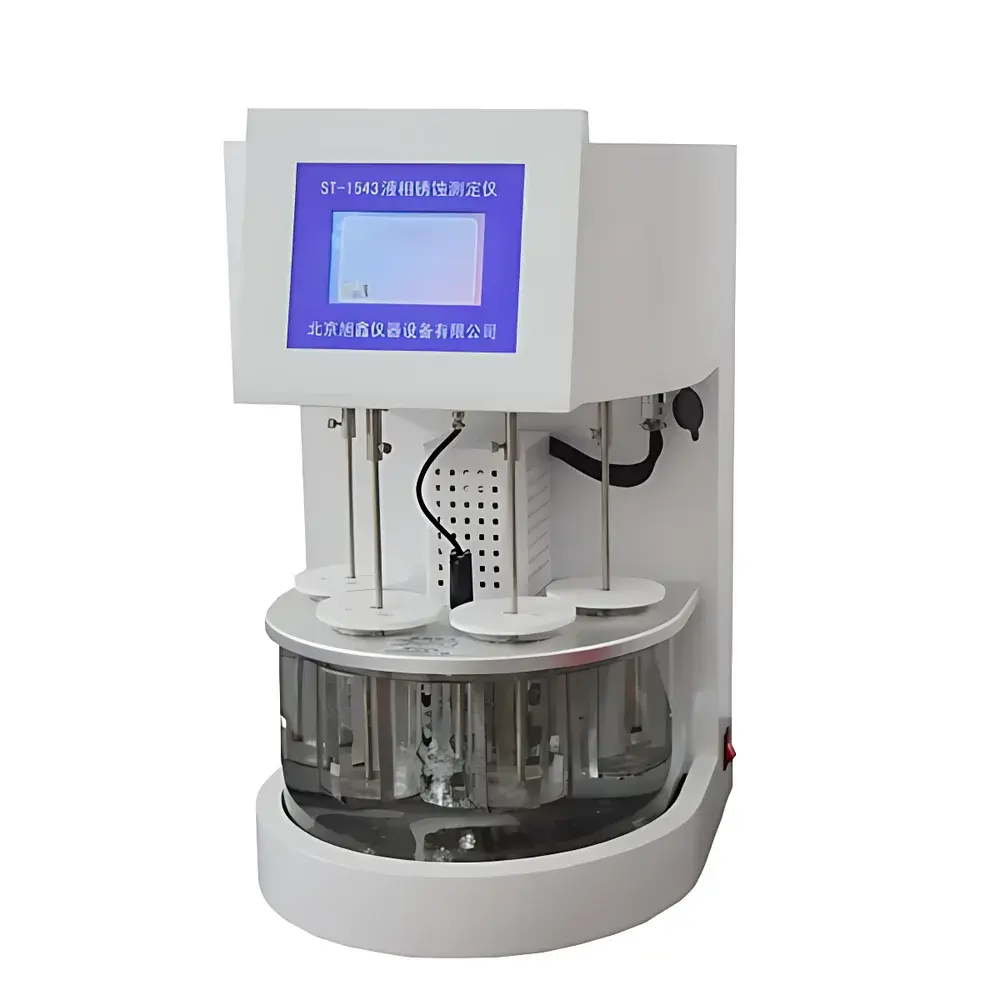
Xuxin Instrument ST-1543 Fully Automated Liquid-Phase Rust Corrosion Tester
| Brand | Xuxin Instrument |
|---|---|
| Origin | Beijing, China |
| Manufacturer Type | Direct Manufacturer |
| Country of Origin | China |
| Model | ST-1543 |
| Price Range | USD 1,400 – 4,200 |
| Applicable Standards | GB/T 11143, ASTM D665 |
| Temperature Control Range | Ambient to 100 °C |
| Temperature Accuracy | ±0.1 °C |
| Temperature Resolution | 0.1 °C |
| Test Channels | 4 independent stations |
| Stirring Speed | 1000 ± 20 rpm |
| Water Bath Capacity | 25 L (stainless steel inner bath) |
| Display | LCD with bilingual (Chinese/English) interface option |
| Power Consumption | ≤2500 W |
| Dimensions (W×D×H) | 510 × 330 × 750 mm |
| Weight | 25 kg |
| Operating Environment | 5–45 °C, 10–80% RH |
| Power Supply | 220 V ±10%, 50 Hz |
Overview
The Xuxin Instrument ST-1543 Fully Automated Liquid-Phase Rust Corrosion Tester is an engineered solution for evaluating the corrosive tendency of petroleum-based lubricants—including turbine oils, hydraulic fluids, and engine oils—when exposed to water under controlled thermal and mechanical conditions. Designed in strict compliance with GB/T 11143 (China National Standard) and ASTM D665 (Standard Test Method for Rust-Preventing Characteristics of Inhibited Mineral Oil in the Presence of Water), this instrument quantifies the ability of lubricant formulations to inhibit rust formation on polished steel test specimens immersed in a water-contaminated oil medium. The test principle relies on standardized immersion, constant-temperature water-bath conditioning, and uniform mechanical agitation to accelerate corrosion kinetics while maintaining reproducible boundary conditions. Its primary output is a qualitative rust rating (e.g., “non-rusting”, “slight rust”, “moderate rust”, or “heavy rust”) assigned after visual inspection per ASTM D665 Annex A1, supporting formulation development, quality control, and regulatory conformance in refinery, power generation, and OEM lubricant supply chains.
Key Features
- Four independent test channels enable parallel evaluation of up to four samples with individually programmable parameters—ideal for comparative studies, batch release testing, or additive screening.
- PID auto-tuning temperature control with high-stability platinum resistance thermometers (Pt100) ensures thermal uniformity across the 25 L stainless-steel water bath, achieving ±0.1 °C accuracy over the full 0–100 °C operating range.
- Imported precision DC stirring motors deliver consistent 1000 ± 20 rpm rotation to each test rod, minimizing shear-induced artifacts and ensuring standardized oxygen transfer and interfacial dynamics at the metal–oil–water interface.
- Intuitive LCD interface supports dual-language operation (English/Chinese), real-time display of bath temperature and elapsed time, and user-configurable test duration from 0 to 99 hours in 1-minute increments.
- Robust architecture includes IP54-rated enclosure, corrosion-resistant internal components, and fail-safe thermal cutoffs—engineered for unattended operation in industrial QC labs and long-term academic research environments.
Sample Compatibility & Compliance
The ST-1543 accommodates standard ASTM D665 test specimens: polished, degreased, and weighed 1018 carbon steel rods (76.2 mm × 12.7 mm × 3.2 mm), immersed in 300 mL of test oil pre-saturated with 0.5 vol% distilled water. It supports all common petroleum base stocks (mineral, PAO, ester) and additive-treated formulations, including rust inhibitors (e.g., amine carboxylates, succinimides) and multifunctional additives. The system meets essential requirements for GLP-compliant testing environments: audit-ready parameter logging, non-volatile memory retention of setpoints and runtime data, and traceable calibration paths for temperature and rotational speed sensors. While not inherently 21 CFR Part 11 compliant, its data export capability (via RS232 or optional USB) enables integration into validated LIMS or ELN platforms where electronic signatures and audit trails are managed externally.
Software & Data Management
The ST-1543 operates as a standalone hardware platform with embedded firmware; no external PC is required for basic operation. All test configurations—including target temperature, duration, and channel activation—are stored in non-volatile memory and persist through power cycles. Time-stamped temperature logs (recorded every 30 seconds) and final status flags (e.g., “completed”, “aborted”, “over-temperature”) are viewable on-screen and exportable via serial interface for post-test analysis. Optional software packages (available separately) provide CSV-formatted reports, trend visualization of bath stability, and automated pass/fail classification based on user-defined rust severity thresholds. Data files conform to ISO/IEC 17025 documentation best practices and support third-party validation protocols used in ISO 17025-accredited laboratories.
Applications
- Quality assurance of new lubricant batches prior to shipment to power plants and industrial facilities.
- Development and benchmarking of rust-inhibiting additive packages in R&D laboratories.
- Root-cause analysis of field failures linked to water ingress and corrosion in steam turbines or hydraulic systems.
- Contract testing services for third-party certification bodies verifying conformity to API RP 505, ISO 8502-3, or IEC 60296 specifications.
- Educational use in university tribology and petroleum engineering courses to demonstrate corrosion mechanisms in multiphase lubricant systems.
FAQ
What standards does the ST-1543 fully support?
It is designed and verified for direct implementation of GB/T 11143 and ASTM D665, including specimen preparation, water saturation, agitation profile, and endpoint evaluation criteria.
Can the instrument operate unattended overnight?
Yes—its thermal safety cutoffs, stable PID control, and non-volatile timer allow secure 99-hour continuous operation without supervision.
Is calibration documentation provided with the unit?
Each ST-1543 ships with a factory calibration certificate for the Pt100 sensor and stirring motor encoder, traceable to CNAS-accredited reference standards.
Does it support ASTM D665 Method B (distilled water) and Method C (synthetic seawater)?
Yes—the four-channel design permits simultaneous execution of different water matrices across individual stations, enabling side-by-side comparison per Method B and C protocols.
What maintenance is required for long-term reliability?
Routine tasks include periodic cleaning of the stainless-steel bath, verification of stir rod alignment, and annual recalibration of temperature sensors using a NIST-traceable dry-block calibrator.





