
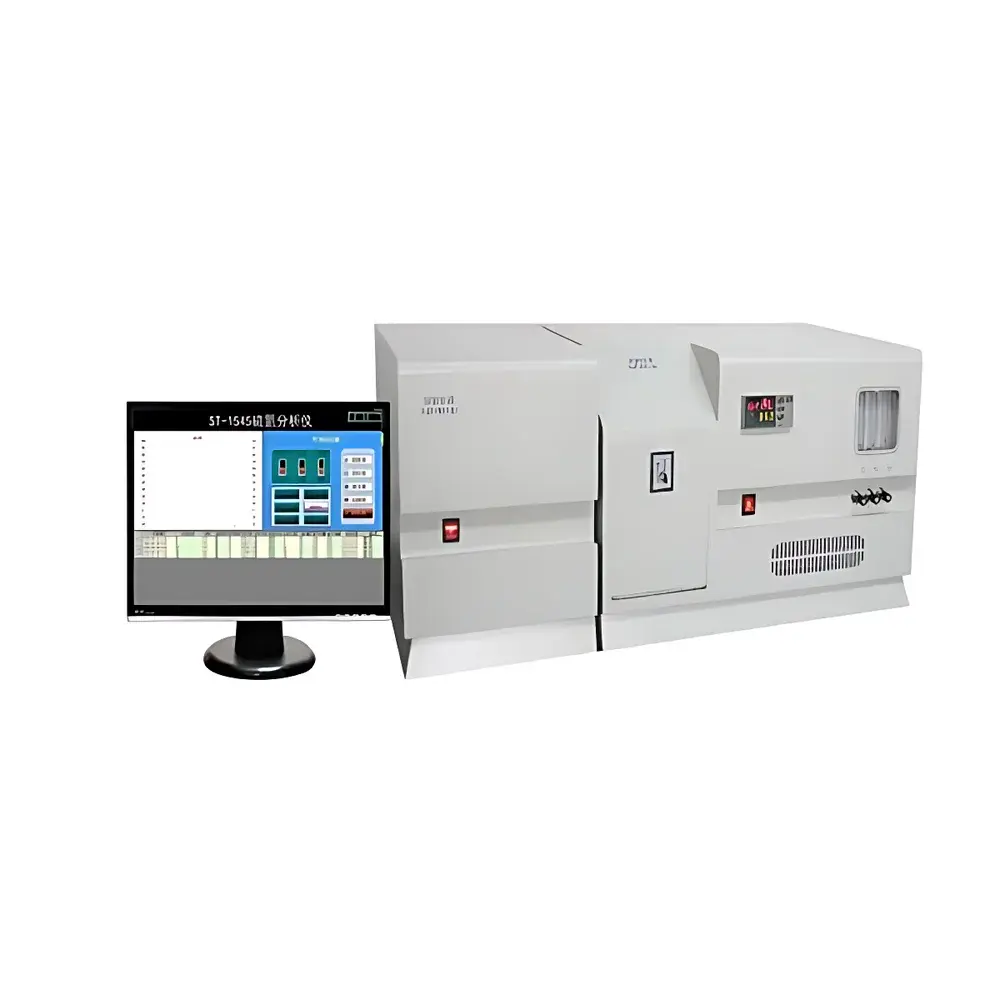
Xuxin Instrument ST-1545 Total Sulfur and Nitrogen Analyzer
| Brand | Xuxin Instrument |
|---|---|
| Origin | Beijing, China |
| Manufacturer Type | Manufacturer |
| Country of Origin | China |
| Model | Xuxin ST-1545 |
| Price Range | USD 7,000 – 14,000 (FOB) |
| Analyte Types | Total Sulfur (S) and Total Nitrogen (N) |
| Detection Principles | UV Fluorescence (S), Chemiluminescence (N) |
| Compliant Standards | SH/T 0657, SH/T 0689, ASTM D4629, ASTM D5453 |
| Sample Forms | Liquids, Solids, Gases (with optional injectors) |
| S Detection Range | 0.2–10,000 mg/L (ppm to wt%) |
| N Detection Range | 0.1–10,000 mg/L (ppm to wt%) |
| S LOD | 0.2 mg/L |
| N LOD | 0.1 mg/L |
| Furnace Temp Range | Ambient to 1300 °C |
| Temp Control Accuracy | ±1 °C |
| Gas Requirements | High-purity Ar (≥99.99%), O₂ (≥99.99%) |
| Flow Control Options | Electronic Mass Flow Controllers or Rotameters |
| Data Acquisition | 24-bit USB interface, signal resolution <1 µV |
| Power | 220 V ±10%, 50 Hz, ≤2500 W |
| Operating Environment | 5–45 °C, 10–80% RH |
| Precision (RSD) | 2–5% across 0.2–5000 ppm range depending on injection volume (5–20 µL liquid) |
Overview
The Xuxin Instrument ST-1545 Total Sulfur and Nitrogen Analyzer is a dual-detection, high-sensitivity laboratory instrument engineered for precise quantification of total sulfur (S) and total nitrogen (N) in petroleum products, lubricants, fuels, and related hydrocarbon matrices. It integrates two orthogonal detection methodologies—ultraviolet fluorescence (UVF) for sulfur and chemiluminescence (CLD) for nitrogen—within a single, thermally controlled combustion system. Samples are introduced into a high-temperature quartz furnace (up to 1300 °C) under controlled oxidizing conditions, where organic S and N compounds are completely converted to SO₂ and NO, respectively. The SO₂ is then carried into a UV fluorescence cell, where excitation at 190–230 nm induces characteristic emission; the NO reacts with ozone in the CLD chamber to generate light proportional to nitrogen concentration. This orthogonal architecture eliminates cross-interference between S and N signals and significantly improves robustness against matrix impurities compared to coulometric or microcoulometric alternatives.
Key Features
- Dual-method platform: UV fluorescence detection for sulfur (per ASTM D5453/SH/T 0689) and chemiluminescent detection for nitrogen (per ASTM D4629/SH/T 0657), enabling simultaneous or independent analysis.
- High-stability optical subsystem: Imported UV lamp, interference filter, photomultiplier tube (PMT), and desiccant dryer ensure long-term baseline stability and sub-ppm sensitivity.
- Precise thermal management: Programmable furnace with ±1 °C temperature control over ambient to 1300 °C, optimized for complete sample oxidation without charring or incomplete conversion.
- Flexible gas flow architecture: Dual configuration support—electronic mass flow controllers (MFCs) for fully automated, PC-regulated gas delivery, or calibrated rotameters for manual operation.
- Low-noise data acquisition: 24-bit USB-based analog-to-digital conversion with signal resolution below 1 µV, supporting high-fidelity peak integration and reproducible quantitation.
- Configurable PMT voltage: Adjustable high-voltage supply allows optimization of detector gain across wide dynamic ranges (0.1–10,000 mg/L).
- Multi-point calibration capability: Supports both single-point linearization and multi-point non-linear curve fitting using certified reference standards (e.g., dibenzothiophene, methyl nitrate).
Sample Compatibility & Compliance
The ST-1545 accommodates liquid (5–20 µL via syringe or autosampler), solid (1–20 mg via boat injector), and gaseous (1–5 mL via gas-tight loop) samples. Optional accessories include a high-temperature ceramic boat for solids, a pressurized gas sampling valve, and a cryogenic trap for volatile light ends. All operational protocols align with internationally recognized regulatory frameworks: ASTM D5453 (UVF sulfur in light hydrocarbons), ASTM D4629 (CLD nitrogen in middle distillates), SH/T 0689 (Chinese standard for sulfur in gasoline/diesel), and SH/T 0657 (nitrogen in crude oil and fractions). The system supports audit-ready data handling compliant with GLP and GMP requirements, including electronic signature support, user-access logging, and full audit trail generation when integrated with validated LIMS environments.
Software & Data Management
The instrument is operated via Windows-based software featuring bilingual UI (English/Chinese toggle), real-time chromatogram display, automatic peak detection, and integrated calibration management. All raw signals, processed results, calibration curves, and method parameters are stored in encrypted binary files with timestamped metadata. Data export options include CSV, PDF reports, and XML for LIMS interoperability. The software enforces 21 CFR Part 11–compatible workflows—including role-based user permissions, electronic signatures, and immutable audit logs—when deployed in regulated laboratories. Backup and restore functions operate at the project level, ensuring zero data loss during power interruption or system restart.
Applications
The ST-1545 serves as a primary analytical tool in refinery QC labs, petrochemical R&D centers, third-party testing facilities, and academic research groups focused on fuel specification compliance (e.g., Euro 6, Tier 3, IMO 2020 sulfur cap), catalyst deactivation studies, feedstock characterization, and environmental emissions monitoring. Typical use cases include sulfur speciation screening in jet fuel per ASTM D3227, nitrogen quantification in naphtha reformer feeds, trace sulfur analysis in biofuels per EN 14214, and regulatory reporting for EPA Method 1664 and ISO 8754. Its low detection limits and broad linear dynamic range make it suitable for both routine compliance testing and method development for ultra-low-sulfur diesel (ULSD) and renewable diesel blends.
FAQ
What detection principles does the ST-1545 employ for sulfur and nitrogen?
It uses ultraviolet fluorescence (UVF) for sulfur and chemiluminescence (CLD) for nitrogen—two physically distinct, non-interfering detection mechanisms.
Which international standards does this analyzer support?
ASTM D5453, ASTM D4629, SH/T 0689, and SH/T 0657—covering sulfur and nitrogen measurement in liquid fuels, crude oils, and distillates.
Can the ST-1545 analyze solid or gaseous samples?
Yes—solid samples require a ceramic boat injector; gaseous samples require a dedicated gas loop and pressure regulator (both optional accessories).
Is the instrument compatible with 21 CFR Part 11 requirements?
When configured with user authentication, electronic signatures, and audit trail logging, the software meets core elements of FDA 21 CFR Part 11 for regulated environments.
What gas purity is required for optimal performance?
High-purity argon (≥99.99%) as carrier gas and high-purity oxygen (≥99.99%) as combustion gas are mandatory to prevent background noise and detector contamination.







