
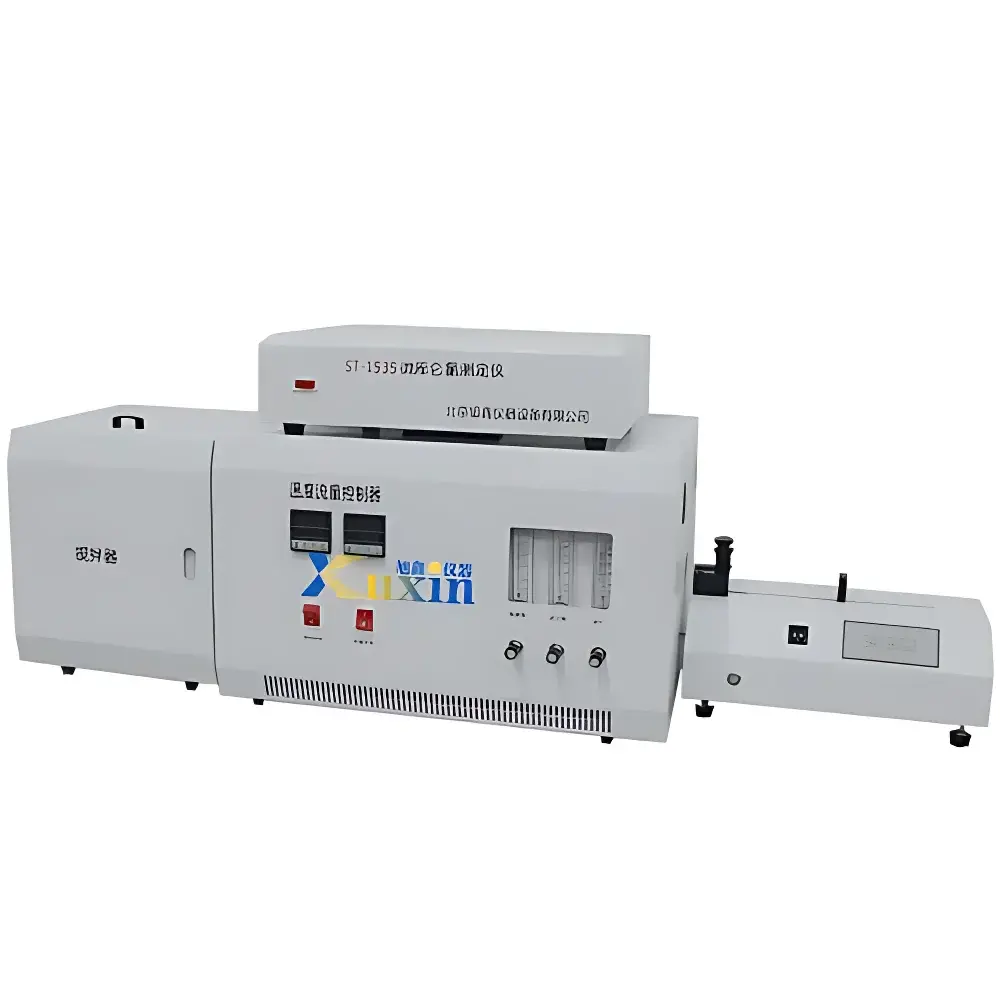
Xuxin ST-1535C Microcoulometric Organic Chlorine Analyzer
| Brand | Xuxin Instrument |
|---|---|
| Origin | Beijing, China |
| Manufacturer Type | Manufacturer |
| Country of Origin | Domestic (China) |
| Model | ST-1535C |
| Price Range | USD 700 – 7,000 |
| Principle | Microcoulometric Titration |
| Standards Compliance | GB/T 18612-2011, GB/T 22904, SY/T 7329-2016, Q/SH1020 2093-2016 |
| Bias Voltage Range | 0–500 mV (continuously adjustable) |
| Detection Method | Coulometric |
| Measurement Range | 0.1–10,000 mg/L Cl (dilutable for high concentration |
| Detection Limit | 0.1 mg/L (as Cl) |
| Sample Types | Liquid, solid, and gaseous (with compatible autosamplers) |
| Temperature Control Range | Ambient to 1100 °C |
| Temperature Control Accuracy | ±1 °C |
| Carrier Gases | Industrial-grade N₂ and O₂ |
| Operating Environment | 5–45 °C, 10–80% RH |
| Power Supply | 220 V ±10%, 50 Hz |
| Power Consumption | 2500 W |
| Precision (RSD) | ≤2% (at 100 mg/L, 5 µL injection), ≤3% (at 10 mg/L), ≤8% (at 1 mg/L), ≤20% (at 0.1 mg/L) |
Overview
The Xuxin ST-1535C Microcoulometric Organic Chlorine Analyzer is a dedicated laboratory instrument engineered for the quantitative determination of total organic chlorine in diverse sample matrices—including crude oil, petroleum products, drilling fluids, pulp and paper, and chemical additives—using standardized microcoulometric titration. Based on ASTM D5808 and ISO 14902 principles, the system thermally cracks samples at programmable high temperatures (up to 1100 °C) in an oxygen-enriched quartz furnace, converting organically bound chlorine into hydrogen chloride (HCl) gas. The HCl is then carried by purified carrier gas into a silver coulometric titration cell, where electrochemical quantification occurs via controlled electrolysis of Ag⁺ ions. The charge consumed (in coulombs) is directly proportional to chlorine mass according to Faraday’s law, enabling trace-level quantification with inherent stoichiometric accuracy. Unlike spectrometric or chromatographic alternatives, microcoulometry offers direct elemental selectivity without calibration drift from matrix interferences—making it the reference method for regulatory compliance in refining, upstream chemistry, and quality assurance laboratories.
Key Features
- Integrated microcoulometric detection system with real-time charge integration and auto-zeroing circuitry for baseline stability
- Programmable high-temperature pyrolysis furnace (ambient to 1100 °C, ±1 °C control accuracy) with dual-zone heating and active cooling fan management (auto-activated at ≥80 °C)
- Dual gas flow architecture: optional electronic mass flow controllers (MFCs) for precise, computer-regulated carrier and oxygen flow (eliminating manual float-meter variability); standard configuration includes calibrated rotameters
- Modular hardware design—separate analyzer mainframe, temperature/flow controller, electrolytic cell assembly, magnetic stirrer, and liquid/solid/gas-compatible autosampler interface
- Full Windows-based control software with dual-language UI (English/Chinese toggle), real-time parameter monitoring (bias voltage, cell current, temperature profile, gas flow rates), and automatic result calculation per ASTM/GB methodology
- Adjustable bias voltage range (0–500 mV) optimized for signal-to-noise ratio across wide concentration spans—from 0.1 mg/L to 10,000 mg/L Cl
Sample Compatibility & Compliance
The ST-1535C supports liquid (e.g., hydrocarbon solvents, distillates, wastewater extracts), solid (e.g., filter papers, polymer pellets, catalyst residues), and gaseous (e.g., refinery off-gas, vapor-phase emissions) samples—each requiring application-specific inlet modules and combustion aids. All operational protocols adhere to internationally recognized standards including GB/T 18612-2011 (crude oil organic chlorine), GB/T 22904 (pulp/paper total and organic chlorine), SY/T 7329-2016 (oilfield chemical agents), and Q/SH1020 2093-2016 (Method A/B). The instrument architecture supports GLP-compliant data integrity: audit trails, user access levels, electronic signatures, and raw signal archiving meet FDA 21 CFR Part 11 requirements when deployed with validated software configurations. Optional NIM (National Institute of Metrology, China) calibration certification is available upon request for metrological traceability.
Software & Data Management
Control and analysis are executed via Xuxin’s proprietary Windows application, which provides full sequence programming (injection volume, ramp rate, hold time, gas flow setpoints), live graphical display of titration curves and thermal profiles, and automated report generation in PDF/CSV formats. Raw coulombic integrals, background correction values, and system diagnostic logs are stored in encrypted binary files with timestamped metadata. Data export supports LIMS integration via ODBC drivers. Software validation documentation (IQ/OQ protocols) and electronic record retention policies align with ISO/IEC 17025 and CNAS-CL01 requirements. Remote diagnostics and firmware updates are supported over secure LAN connections.
Applications
- Monitoring organic chloride contamination in crude oil feedstocks to prevent catalyst poisoning in hydrotreaters and FCC units
- Quality control of drilling mud additives, corrosion inhibitors, and scale inhibitors per SY/T 7329-2016
- Regulatory testing of pulp bleaching effluents and recycled paper products for adsorbable organic halides (AOX)
- Trace chlorine speciation in pharmaceutical excipients and polymer stabilizers where residual halogen affects thermal stability
- Environmental screening of landfill leachates and incineration flue gases (with gas sampling module and dilution calibration)
FAQ
What sample types can be analyzed without modification?
Liquid samples (e.g., diesel, kerosene, chlorinated solvents) are directly injectable using the standard syringe autosampler. Solid and gaseous samples require optional accessories: a boat-type solid sampler with ceramic crucibles or a gas-tight loop injector with pressure regulator.
Is the instrument compliant with US EPA or ASTM methods?
While primarily aligned with Chinese national standards (GB/T, SY/T), the underlying microcoulometric principle conforms to ASTM D5808 (Standard Test Method for Organic Chloride in Crude Oil) and ASTM D3229 (for distillate fuels), enabling cross-method validation in multinational labs.
Can the system quantify total sulfur simultaneously?
No—the ST-1535C is optimized exclusively for chlorine detection. Xuxin offers parallel models (e.g., ST-1535S) for sulfur analysis; however, chlorine- and sulfur-specific cells, electrodes, and furnace parameters are not interchangeable.
What maintenance intervals are recommended for routine operation?
Electrolyte replacement every 72 hours during continuous use; quartz pyrolysis tube cleaning weekly; MFC calibration quarterly; full system performance verification using certified reference materials (e.g., DBT in xylene) before each analytical batch.
Does the software support multi-user environments with role-based permissions?
Yes—administrator, analyst, and reviewer roles are configurable, with password-protected method editing, result approval workflows, and immutable audit logs meeting GLP/GMP documentation requirements.




