
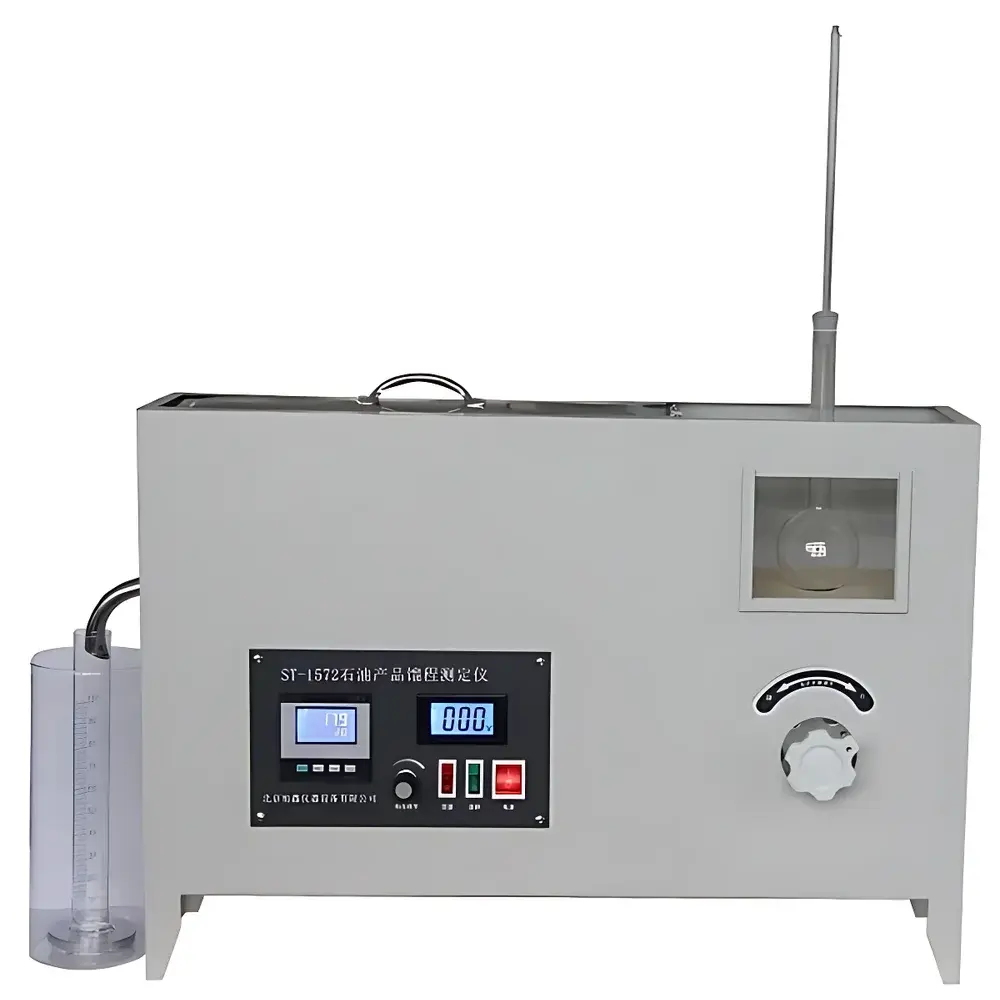
Xuxin ST-1572 Petroleum Distillation Apparatus for ASTM D86 / GB/T 255 / SH/T 0121 Compliance
| Brand | Xuxin Instrument |
|---|---|
| Origin | Beijing, China |
| Manufacturer | Yes |
| Type | Domestic |
| Model | ST-1572 |
| Price Range | USD 1,400–4,200 (FOB) |
| Temperature Range | Ambient to 400 °C |
| Temperature Accuracy | ±0.5 °C |
| Condenser Bath Temperature Range | Ambient to 60 °C |
| Distillation Rate | 1–5 mL/min |
| Volume Measurement Range | 0–125 mL |
| Volume Resolution | 0.1 mL |
| Heating Power | 1000 W (continuously adjustable) |
| Total Power Consumption | ≤1700 W |
| Condenser Material | Stainless Steel |
| Distillation Flask | 125 mL borosilicate glass (≥500 °C thermal resistance) |
| Graduated Cylinder Options | 10 mL and 100 mL |
| Cooling Method | Water-cooled |
| Input Voltage | AC 220 V ±10%, 50 Hz ±10% |
| Operating Environment | 5–45 °C, 10–80% RH |
Overview
The Xuxin ST-1572 Petroleum Distillation Apparatus is a precision-engineered, fully integrated distillation system designed to determine the boiling point distribution of volatile petroleum products in strict accordance with standardized test methods—including ASTM D86, ISO 3405, GB/T 255, and SH/T 0121. It operates on the principle of atmospheric pressure batch distillation, where a representative sample is heated under controlled conditions, and the sequential vaporization, condensation, and volumetric collection of distillate fractions are monitored in real time. The apparatus delivers high reproducibility for key parameters such as initial boiling point (IBP), 10%, 50%, 90%, and final boiling point (FBP), enabling accurate characterization of fuel volatility, refining efficiency, and product specification compliance. Its modular architecture supports routine quality control in refinery laboratories, third-party testing facilities, and regulatory compliance units operating under ISO/IEC 17025 or GLP frameworks.
Key Features
- Intelligent all-in-one design with integrated temperature control, distillation timing, and volume tracking—minimizing operator intervention and inter-laboratory variability.
- Motorized vertical lift mechanism for precise, repeatable positioning of the heating mantle relative to the distillation flask—ensuring consistent heat transfer and reducing thermal gradient effects.
- Stainless steel condenser bath with PID-controlled refrigeration and ambient-to-60 °C range; maintains stable coolant temperature within ±0.5 °C across extended runs.
- Continuously adjustable 1000 W heating element with analog power regulation—enabling fine-tuned ramp rates to meet method-specified distillation rates (e.g., 4–5 mL/min for light distillates per ASTM D86).
- Dual graduated cylinder support (10 mL and 100 mL) with 0.1 mL resolution, calibrated per ISO 4787 and traceable to NIST standards.
- Borosilicate glass distillation flask (125 mL capacity, thermal shock resistant up to 500 °C) compliant with ASTM E202 and ISO 1773 specifications.
- Water-cooled condensation system with flow monitoring and overheat protection—ensuring consistent condensate recovery and preventing vapor bypass.
Sample Compatibility & Compliance
The ST-1572 is validated for use with gasoline, naphtha, kerosene, diesel fuel, jet fuel (Jet A-1), solvent blends, and other light to mid-range hydrocarbon mixtures with initial boiling points above 30 °C and final boiling points below 400 °C. It meets mechanical and procedural requirements outlined in ASTM D86 (Standard Test Method for Distillation of Petroleum Products at Atmospheric Pressure), GB/T 255 (Petroleum Products—Determination of Distillation Range), and SH/T 0121 (Petroleum Products—Distillation Test Method for Solvent Oils). All temperature sensors are calibrated against certified reference thermometers traceable to national metrology institutes. The unit’s thermal stability and volume measurement repeatability support audit readiness for ISO/IEC 17025 accreditation and internal QA/QC documentation under GMP or refinery-specific quality management systems.
Software & Data Management
While the ST-1572 operates as a standalone benchtop instrument with analog controls and manual data recording, its design incorporates digital-ready interfaces for optional integration with laboratory information management systems (LIMS). Temperature and volume readings can be logged externally via RS-232 or USB output (with optional data acquisition module). All recorded distillation curves—including IBP, 10%, 50%, 90%, and FBP values—are exportable in CSV format for statistical process control (SPC), trend analysis, and reporting aligned with ASTM D6792 (Standard Practice for Statistical Analysis of Distillation Data). Audit trails for calibration events, maintenance logs, and operator entries are maintained manually per GLP requirements; electronic record functionality complies with FDA 21 CFR Part 11 when paired with validated third-party software.
Applications
- Refinery QC labs: Monitoring fractional composition of straight-run naphtha, reformate, and hydrotreated feedstocks prior to blending.
- Fuel certification: Verifying conformance of commercial gasoline and aviation turbine fuel to ASTM D4814 and D1655 specifications.
- Research & development: Evaluating volatility shifts during catalyst testing, additive formulation, or bio-blendstock compatibility studies.
- Regulatory inspection: Supporting customs clearance and import verification by national petroleum quality supervision centers (e.g., CNAS-accredited labs in China).
- Academic instruction: Teaching fundamental distillation principles, phase equilibrium behavior, and standard method execution in chemical engineering and petroleum technology curricula.
FAQ
What standards does the ST-1572 comply with?
It is engineered to meet ASTM D86, ISO 3405, GB/T 255, and SH/T 0121 for atmospheric distillation of petroleum products.
Can the instrument be used for vacuum distillation?
No—the ST-1572 is configured exclusively for atmospheric-pressure operation. Vacuum-capable variants require separate hardware and are not covered under this model designation.
Is the temperature sensor calibrated before shipment?
Yes—each unit ships with a factory calibration certificate referencing traceable standards; users are advised to perform periodic verification using certified reference thermometers per ISO/IEC 17025 Clause 6.5.
What maintenance is required for long-term reliability?
Routine cleaning of the condenser bath and flask holder, annual verification of heating element output, and biannual inspection of water-cooling connections and seals are recommended.
Does the system support automated data export?
Standard configuration includes manual recording; optional RS-232/USB interface modules enable direct data logging and LIMS integration upon request.




