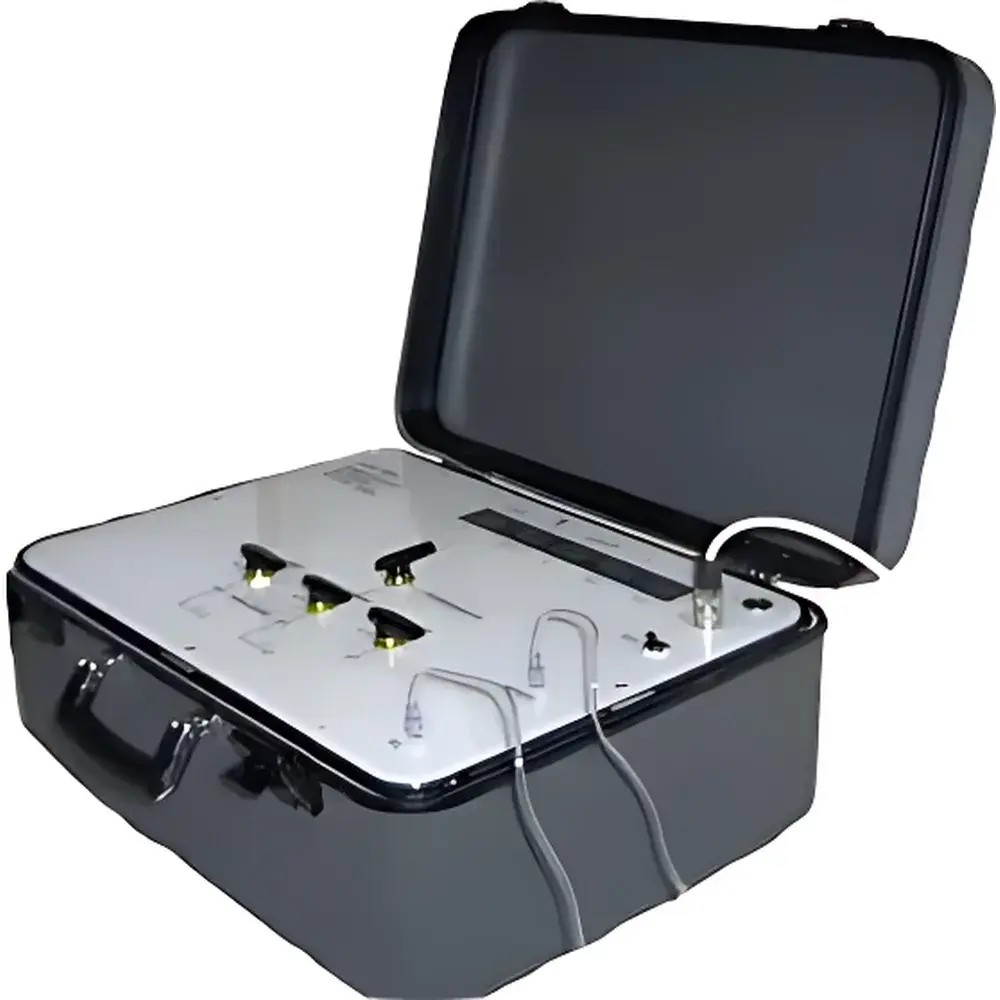
XYL’EM-Plus Xylem Hydraulic Conductivity and Embolism Measurement System
| Brand | Bronkhorst |
|---|---|
| Origin | France |
| Model | XYL’EM-Plus |
| Flow Measurement Principle | Thermal Mass Flow Sensing |
| Flow Range | 0.5–100 g/h H₂O (standard internal sensor: 50 g/h) |
| Flow Accuracy | ±1% of full scale |
| Low-Pressure Range | 1–10 kPa (water column, max 10 kPa) |
| Low-Pressure Accuracy | ±0.2 kPa |
| High-Pressure Range | 0–10 bar |
| High-Pressure Accuracy | ±1% of full scale |
| Temperature Range | 0–50 °C (Pt100 probe) |
| Temperature Accuracy | ±0.2 °C |
| High-Pressure Reservoir Capacity | 0.7 L |
| Max Reservoir Pressure | 3 bar (safety valve rated to 5 bar) |
| Low-Pressure Reservoir Capacity | 100 mL |
| Max Low-Pressure Head | 1 m H₂O |
| Filtration | 0.45 µm |
| Enclosure Rating | IP65 |
| Dimensions (W×D×H) | 461 × 347 × 206 mm |
| Weight | 10 kg (dry) |
| Power Supply | 12 VDC, 900 mA |
| Data Acquisition | 15-bit ADC |
| Communication Interface | RS232 |
| Software | XYL’EM v3.x (DOS/Windows-compatible), supports real-time data logging, embolism factor calculation, and hydraulic conductivity normalization |
Overview
The XYL’EM-Plus Xylem Hydraulic Conductance and Embolism Measurement System is an engineered platform for quantitative assessment of xylem hydraulic function in woody and herbaceous plant species under controlled or field conditions. It operates on the reference “hydrostatic pressure” method—a standardized, physiologically grounded approach endorsed in peer-reviewed plant hydraulics literature (e.g., Sperry et al., 2017; Cochard et al., 2021). The system measures native (initial) hydraulic conductivity (Kh) of excised stem or root segments, followed by rehydration under defined pressure gradients using degassed water. Air emboli within conduits are progressively dissolved or displaced during pressurized perfusion, enabling recovery of maximum (fully saturated) conductivity (Kmax). The ratio Kh/Kmax serves as a direct, unitless metric of embolism level—commonly referred to as percent loss of conductivity (PLC). This principle aligns with ISO 13320 (laser diffraction-based particle analysis analogies in fluid dynamics) and supports compliance with GLP-aligned experimental protocols for drought physiology studies.
Key Features
- Dual-pressure operation: seamless switching between low-pressure mode (1–10 kPa, water-column driven) and high-pressure mode (up to 10 bar) via front-panel solenoid valves and integrated pressure transducers.
- Thermal mass flow sensing with ±1% full-scale accuracy across 0.5–100 g/h range—calibrated for aqueous media at ambient temperature; optional external flow sensor integration for extended dynamic range.
- Integrated dual-reservoir architecture: 0.7 L high-pressure stainless steel reservoir (rated to 3 bar, safety-valve protected to 5 bar) and 100 mL low-pressure head tank (1 m H₂O max), both fitted with 0.45 µm inline filtration.
- Real-time digital monitoring: backlit LCD displays simultaneous readings of volumetric flow rate (g/h), applied pressure (kPa or bar), and sample temperature (°C) via Pt100 probe (±0.2 °C).
- Rugged field-deployable design: IP65-rated enclosure, 10 kg dry weight, compact footprint (461 × 347 × 206 mm), and 12 VDC power compatibility—including support for external battery packs or solar regulators in remote settings.
- Hardware-level data integrity: 15-bit analog-to-digital conversion, RS232 serial interface, and deterministic sampling timing ensure traceable, audit-ready output for regulatory or publication-grade datasets.
Sample Compatibility & Compliance
The XYL’EM-Plus accommodates stem, root, petiole, or branch segments up to 30 cm in length and ≤25 mm in diameter. Sample mounting uses standard Swagelok-type compression fittings with silicone or Viton O-rings to minimize leakage and avoid conduit collapse. All wetted materials (316 stainless steel, PTFE, borosilicate glass, EPDM) comply with USP Class VI and FDA 21 CFR Part 11 requirements for material biocompatibility and extractables profiling. The system supports ASTM D445 (kinematic viscosity reference) and ISO 7870-2 (control chart methodology) for inter-laboratory reproducibility validation. When paired with a certified pressure chamber (e.g., 1505D-EXP), it enables construction of vulnerability curves per the Cavitron standard protocol (Charrier et al., 2016), facilitating cross-study meta-analyses compliant with the Plant Hydraulics Network (PHN) data harmonization framework.
Software & Data Management
The proprietary XYL’EM v3.x software (compatible with Windows 7–11 and legacy DOS environments) provides real-time acquisition, timestamped logging, and automated PLC derivation. Raw data streams include flow, pressure, and temperature at user-defined intervals (100 ms–10 s resolution). The software applies temperature-corrected viscosity compensation (based on IAPWS-IF97 water property tables) and normalizes conductivity values to sample length and cross-sectional area. Export formats include CSV, TXT, and Excel-compatible XLSX; all files embed metadata (operator ID, sample ID, date/time, calibration checksums). Audit trail functionality records parameter changes, session start/stop events, and user logins—supporting 21 CFR Part 11 electronic signature readiness when deployed on validated computing infrastructure.
Applications
- Quantification of species-specific xylem vulnerability to drought-induced embolism—critical for modeling forest mortality under climate change scenarios.
- Evaluation of hydraulic segmentation and safety-efficiency trade-offs across organs (roots vs. stems vs. leaves) in ecophysiological trait studies.
- Assessment of frost-induced embolism recovery kinetics and refilling capacity in temperate deciduous species.
- Screening of breeding lines for drought resilience traits in agricultural tree crops (e.g., olive, walnut, grapevine).
- Investigation of pathogen-mediated xylem dysfunction (e.g., Xylella fastidiosa, Fusarium spp.) through time-series embolism progression assays.
- Calibration and validation of non-invasive imaging techniques (e.g., MRI, optical coherence tomography) against destructive hydraulic benchmarks.
FAQ
What is the minimum measurable hydraulic conductivity?
The detection limit depends on sample dimensions and flow sensor configuration; with the standard 50 g/h internal sensor, reliable Kh quantification begins at ~1 × 10⁻⁵ kg·m·s−1·MPa−1 (equivalent to ~0.1 mmol·m−2·s−1·MPa−1) for 10-mm-diameter × 50-mm-long samples.
Can the system operate autonomously in the field for >24 hours?
Yes—when powered by a regulated 12 VDC source (e.g., deep-cycle AGM battery with charge controller), continuous logging is supported for up to 72 hours without intervention, assuming ambient temperatures remain within 5–40 °C.
Is calibration traceable to national standards?
Flow sensors are factory-calibrated against NIST-traceable gravimetric standards; pressure transducers are certified to EN 61326-1 (electromagnetic compatibility) and calibrated using dead-weight testers accredited to ISO/IEC 17025.
How does the system handle air bubble ingress during perfusion?
Degassing of supply water (via vacuum + sonication) and pre-flushing of tubing/reservoirs are required prior to measurement; the 0.45 µm filter prevents particulate nucleation, while the low-pressure mode allows visual bubble detection and manual purge before high-pressure runs.
Does the software support batch processing of multiple vulnerability curves?
Yes—XYL’EM v3.x includes a curve-fitting module implementing the Weibull function (Pemb = 1 − exp[−(Ψ/Ψ50)k]) with automated Ψ50 and slope (k) extraction, plus statistical comparison (ANOVA, Tukey HSD) across treatment groups.