
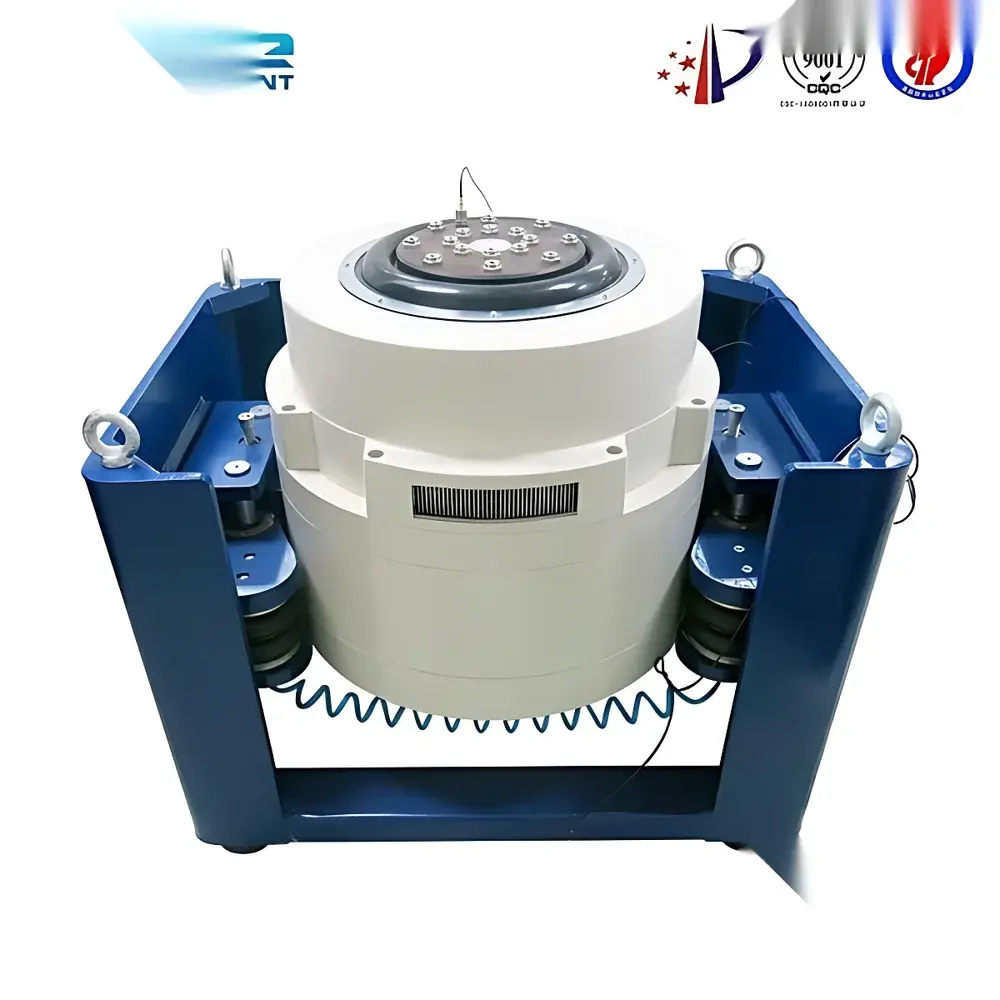
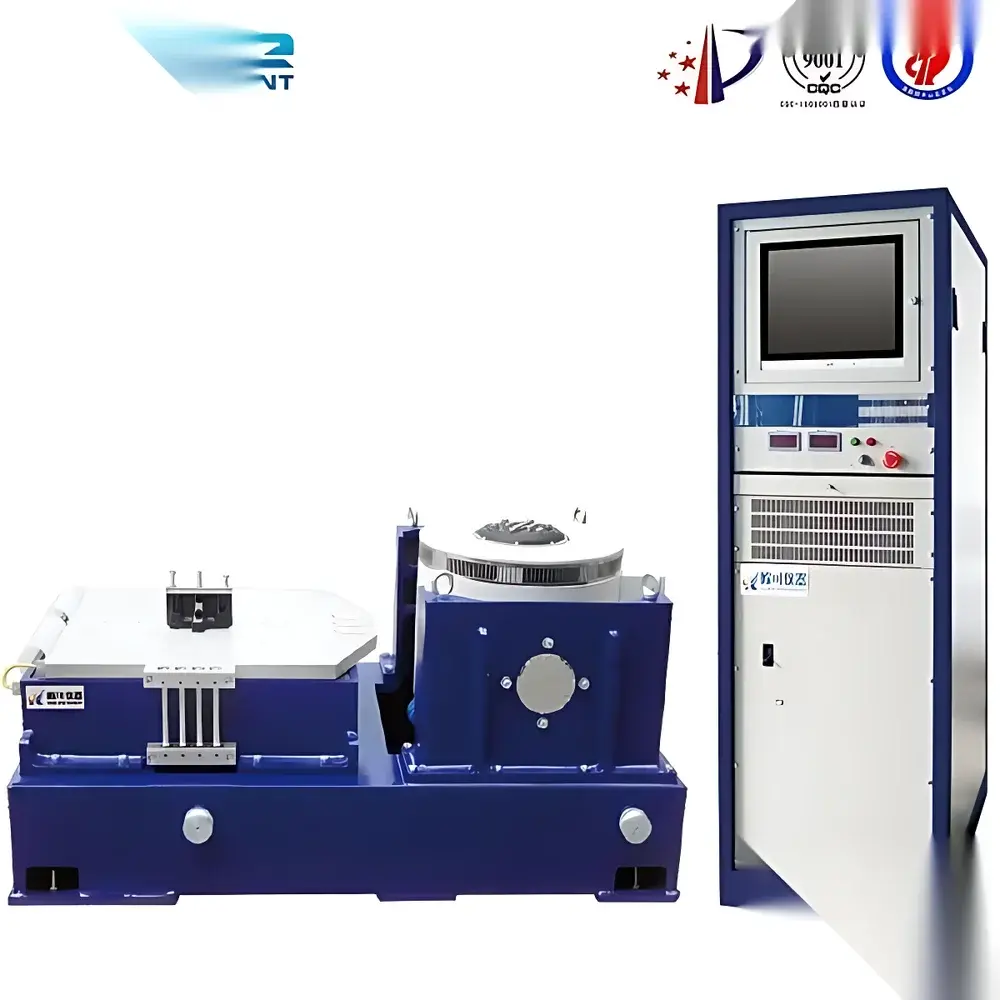
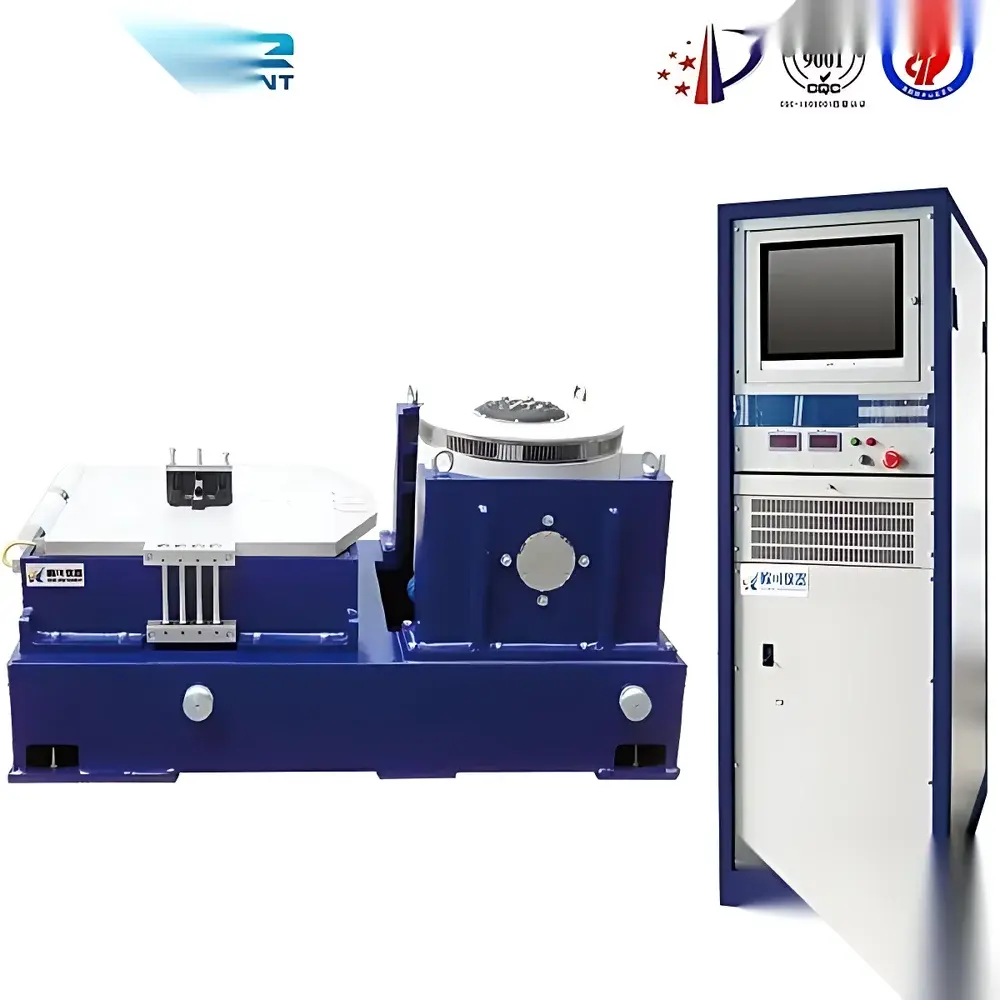
XYZ Electromagnetic Triaxial Vibration Test System
| Brand | Other Brands |
|---|---|
| Origin | Imported |
| Manufacturer Type | Authorized Distributor |
| Temperature Range | -20 °C to 130 °C |
| Humidity Range | 40–98% RH |
| Temperature Uniformity | ±2 °C (unloaded) |
| Temperature Fluctuation | ±0.5 °C (unloaded) |
| Humidity Fluctuation | ±2% RH |
| Chamber Models | OK-ZTH-408 (60×85×80 cm), OK-ZTH-800 (100×100×80 cm), OK-ZTH-1000 (100×100×100 cm) |
| Refrigeration | French Tecumseh hermetic compressor |
| Dryer Filter | USA Parker Hannifin (AEGO) |
| Oil Separator | China Guanya |
| Solenoid Valve | Italy Castel |
| Vibration Exciter | Japan ThreeBand coil bonding adhesive, IMV temperature sensors, Tohbu stainless mesh diaphragm |
| Power Amplifier | Siemens switches/contactors, Sanyo power modules, Motorola output devices, Fuji protective fuses |
| Cabinet Construction | A3 steel exterior with powder coating, SUS304 stainless steel interior, ultra-fine glass wool insulation |
Overview
The XYZ Electromagnetic Triaxial Vibration Test System is an integrated environmental stress screening (ESS) platform engineered for simultaneous multi-axis vibration excitation and precise climatic conditioning. Unlike conventional single-axis shakers or standalone thermal chambers, this system combines electromagnetic inertial excitation in X-, Y-, and Z-orthogonal axes with tightly controlled temperature and humidity profiles—enabling accelerated reliability testing of electronic assemblies, automotive ECUs, aerospace avionics, and medical device enclosures under realistic combined-stress conditions. Its core measurement architecture follows ISO 10816-1 (vibration severity assessment) and IEC 60068-2-64 (random vibration testing), while the environmental chamber complies with IEC 60068-2-1 (cold), IEC 60068-2-2 (dry heat), and IEC 60068-2-78 (damp heat). The triaxial shaker employs force-cooled electromagnetic exciters with high linearity and low harmonic distortion (<3% THD at rated force), ensuring reproducible spectral energy distribution across 5–2000 Hz.
Key Features
- Triaxial electromagnetic vibration capability: Independent or synchronized excitation in X, Y, and Z directions with programmable phase relationships and real-time cross-axis coupling control.
- Integrated environmental chamber with three standard internal volumes: OK-ZTH-408 (0.408 m³), OK-ZTH-800 (0.800 m³), and OK-ZTH-1000 (1.000 m³), all featuring uniform airflow via multi-wing centrifugal blowers and optimized inlet/outlet duct geometry.
- Climatic performance: Stable operation from –20 °C to +130 °C with ±0.5 °C temperature stability (unloaded) and 40–98% RH humidity control with ±2% RH fluctuation—validated per ASTM E145 Class II requirements.
- Dual-circuit refrigeration architecture: Primary/secondary cascade design using Tecumseh hermetic compressors, Parker Hannifin AEGO dry filters, Guanya oil separators, and Castel solenoid valves for extended service life and reduced maintenance intervals.
- Robust mechanical construction: Powder-coated A3 steel outer frame, mirror-finish SUS304 stainless steel inner chamber, and ultra-fine glass wool insulation (thermal conductivity ≤0.036 W/m·K) ensure structural integrity and thermal efficiency.
- Human-centered interface: Double-layer high-tensile silicone gasket door seal, anti-reflection multi-layer tempered observation window with conductive ITO film, and 50 mm diameter cable port on left side for external signal/power feedthrough.
Sample Compatibility & Compliance
The system accommodates test specimens up to 100 cm × 100 cm × 100 cm (OK-ZTH-1000 model), with payload capacity calibrated per ISO 5344 and verified with reference accelerometers traceable to NIST standards. All chamber models support standardized mounting configurations—including ISO 13373-3 compliant fixture interfaces—and are compatible with MIL-STD-810H Method 514.7 (vibration) and Method 502.7 (temperature/humidity). The integrated control architecture supports audit-ready data logging compliant with FDA 21 CFR Part 11 (electronic records/signatures), including user access levels, change history, and timestamped event logs. Environmental profiles adhere to IEC 60721-3-3 (climate classes) and IPC-9701A (solder joint reliability acceleration factors).
Software & Data Management
Control and analysis are performed via a dedicated Windows-based software suite supporting real-time spectrum monitoring (FFT resolution down to 0.1 Hz), time-history waveform capture at up to 51.2 kHz sampling rate, and closed-loop control using PID + feedforward algorithms. The software includes built-in test templates aligned with ISTA 3A, JEDEC JESD22-B103, and GR-63-CORE vibration profiles. All raw acceleration, temperature, and humidity data are stored in IEEE-compliant .tdms format with embedded metadata (test ID, operator, calibration certificate ID, ambient conditions). Export options include CSV, MATLAB .mat, and PDF reports with configurable cover pages, statistical summaries (RMS, kurtosis, crest factor), and pass/fail flagging per user-defined limits.
Applications
This triaxial vibration and climate system is routinely deployed in product development labs for HALT/HASS protocols, qualification testing of PCBAs subjected to automotive thermal cycling and road-simulation spectra, validation of battery management systems under combined thermal-vibrational loads, and reliability screening of IoT sensor housings exposed to tropical humidity and broadband shock. It serves as a primary tool for R&D teams requiring correlation between field failure modes (e.g., solder fatigue, connector fretting corrosion, polymer creep) and laboratory-accelerated stresses—particularly where uniaxial vibration fails to replicate real-world multi-directional dynamic loading.
FAQ
What standards does the vibration subsystem conform to?
It meets ISO 5344 (shaker performance), ISO 10816-1 (vibration severity evaluation), and IEC 60068-2-64 (random vibration testing), with optional third-party verification available per ANSI/ISO/IEC 17025.
Can the system perform dwell-and-sweep or step-stress profiles?
Yes—the controller supports sequential and nested profile execution, including temperature dwell + random vibration hold, ramp-and-soak cycles, and progressive amplitude/frequency sweeps with user-defined breakpoints.
Is remote monitoring and alarm notification supported?
The system includes Ethernet (TCP/IP) and RS-485 interfaces; optional SNMP integration enables email/SMS alerts for out-of-spec conditions, door open events, or amplifier fault states.
What is the maximum payload mass for each chamber model?
Maximum recommended payload is 75 kg for OK-ZTH-408, 120 kg for OK-ZTH-800, and 150 kg for OK-ZTH-1000—subject to fixture rigidity and center-of-gravity constraints per ISO 13373-3 Annex B.
Does the system support GLP/GMP documentation workflows?
Yes—audit trails, electronic signatures, calibration history tracking, and UDI-compliant report generation are enabled through optional GxP compliance module licensed separately.



