
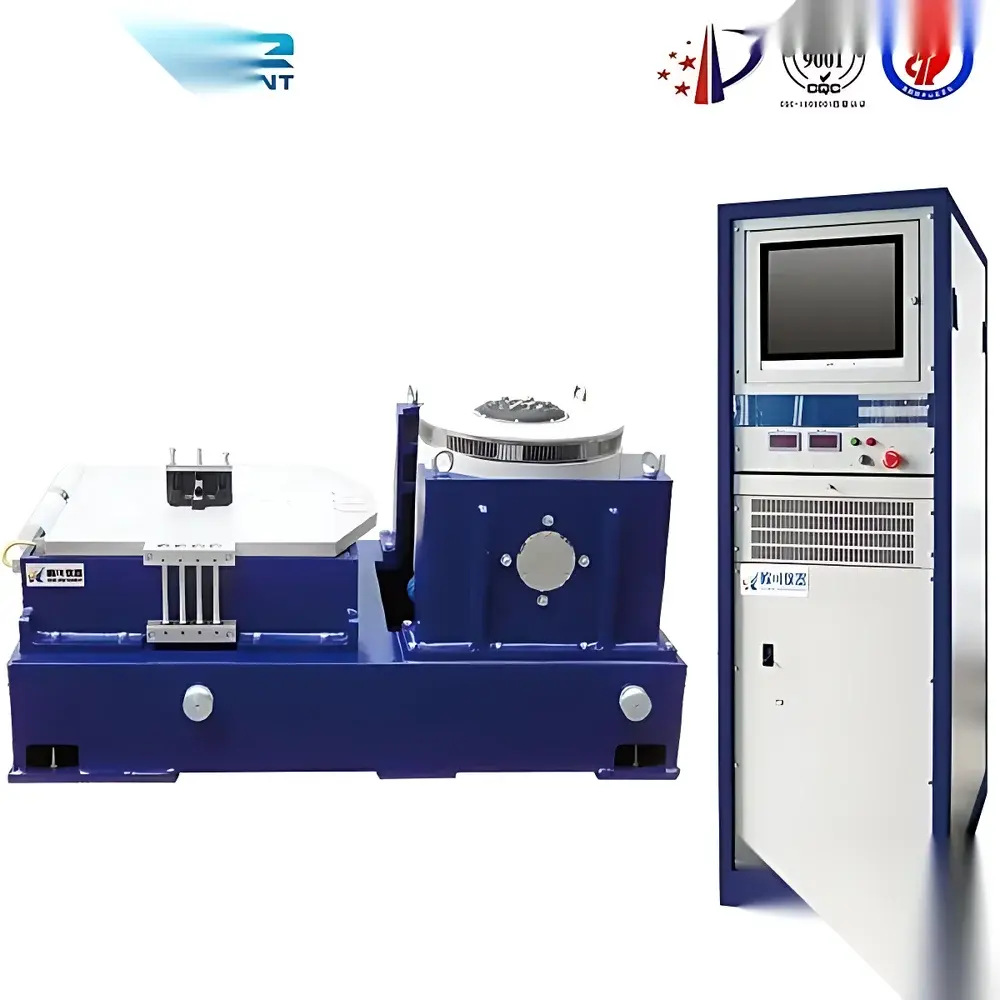
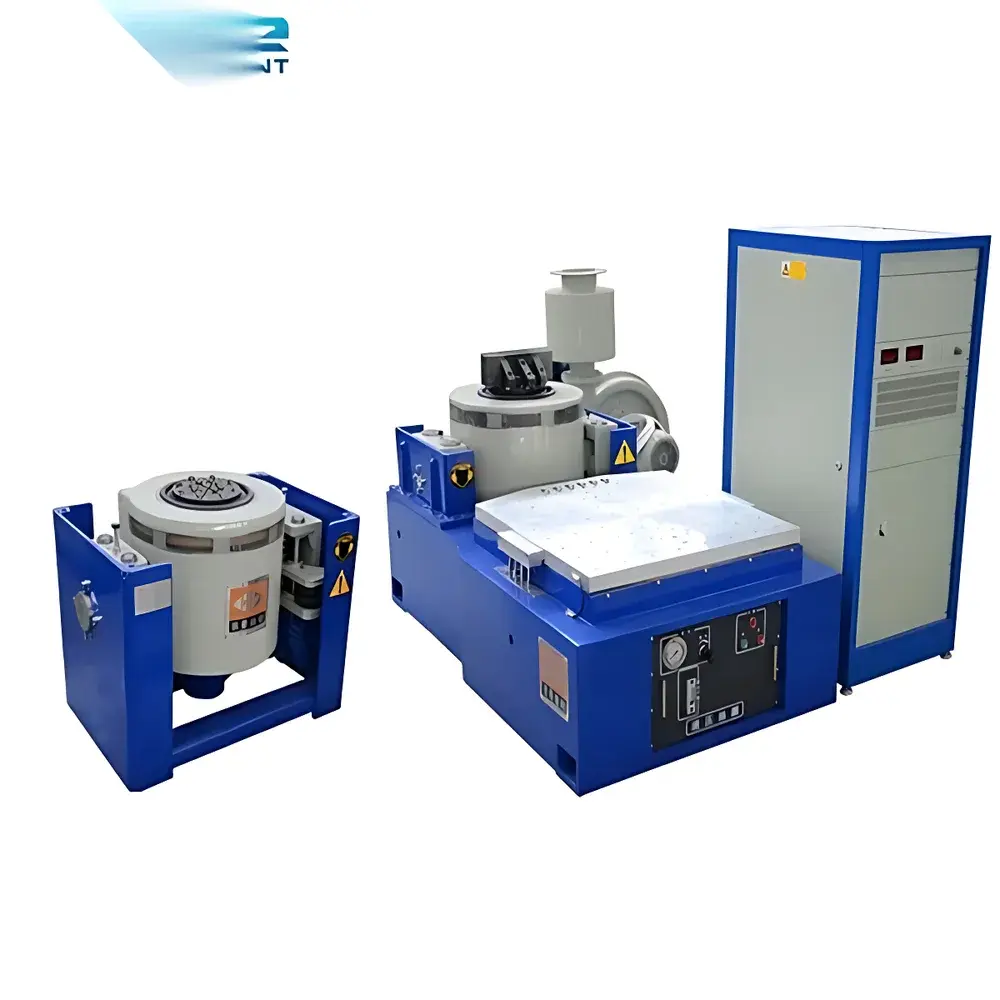
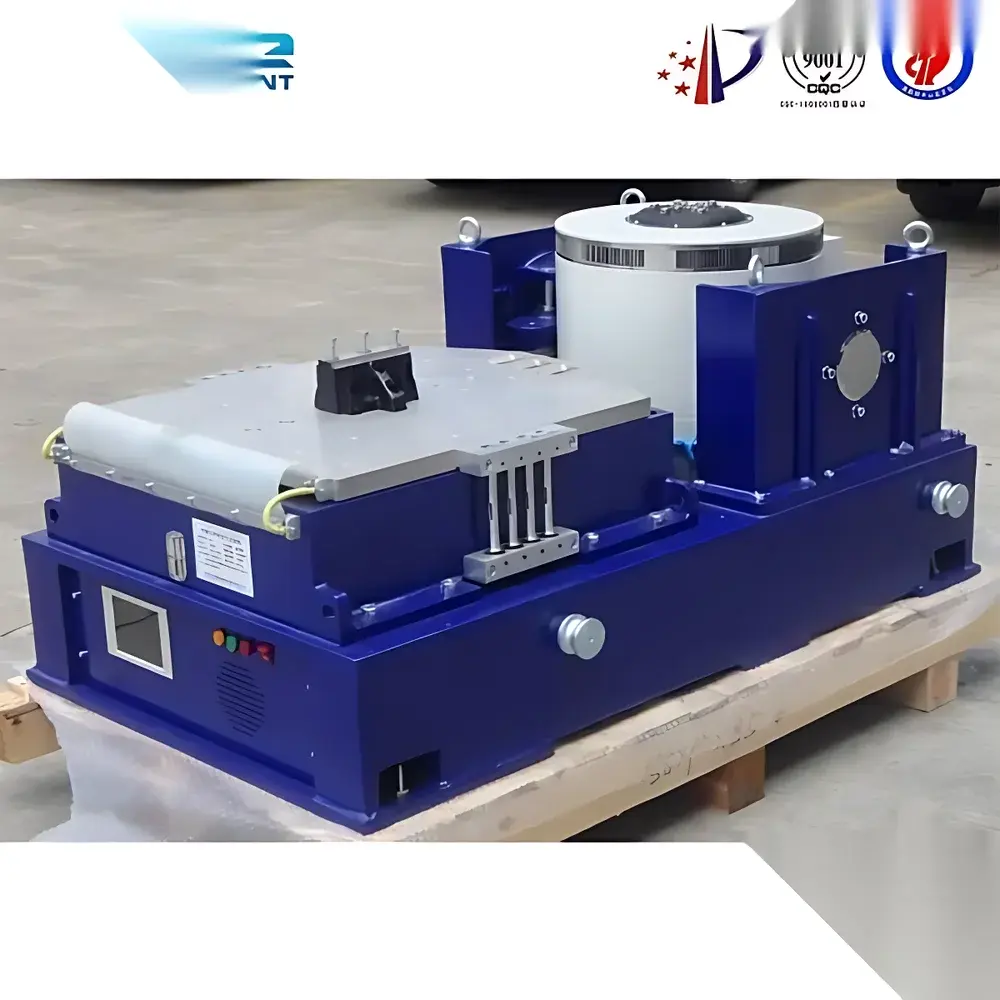
XYZ OK-ES Series Triaxial Electromagnetic Vibration Shaker System
| Key | Brand: Other Brands |
|---|---|
| Origin | Imported |
| Manufacturer Type | Authorized Distributor |
| Price | USD 21,000 (FOB) |
| Compliance | GB/T 2423.5, GJB 150.18–1986 |
| Drive Type | Pneumatic + Electromagnetic Hybrid |
| Max Payload Capacity | Up to 2× Rated Load (Model-Dependent) |
| Platform Material | Monolithic Cast Aluminum Alloy |
| Guidance System | Chrome-Plated Precision Linear Rails |
| Impact Repeatability | ±0.5 mm (via Photoelectric Height Sensing) |
| Built-in Damping Base | High-Mass Isolation Substructure |
| Operating Mode | Sweep, Fixed-Frequency, Shock Pulse, Random Vibration (with Optional Controller) |
Overview
The XYZ OK-ES Series Triaxial Electromagnetic Vibration Shaker System is an engineered solution for rigorous mechanical environmental simulation in laboratory and production-line settings. Designed around a hybrid actuation architecture—integrating high-force pneumatic lift mechanisms with precision electromagnetic shakers—the system delivers controlled, repeatable triaxial excitation across X, Y, and Z orthogonal axes. Its operational principle relies on Lorentz-force-driven coil motion within a high-flux magnetic circuit, coupled with pneumatically assisted vertical impact generation compliant with GB/T 2423.5 (IEC 60068-2-27) and GJB 150.18–1986 shock test protocols. Unlike purely electrodynamic or hydraulic alternatives, this dual-mode design ensures both high-acceleration transient shock capability (up to 1000 g peak, depending on payload and pulse width) and stable sinusoidal/random vibration performance across 5–3000 Hz. The system is not intended for seismic simulation or structural modal analysis but is purpose-built for product-level reliability screening, early-life failure detection, and mechanical robustness verification in electronics, automotive components, avionics modules, and consumer appliances.
Key Features
- Monolithic cast aluminum alloy worktable with integrated stiffening ribs—optimized for modal suppression and minimal resonance coupling below 1.2 kHz.
- Chrome-plated, preloaded linear guide rails providing ≥10⁶ cycles service life under rated load conditions; rail stiffness exceeds 12 kN/mm in all three axes.
- Dual-piston pneumatic lifting system enabling programmable drop-height control from 10 mm to 100 mm with ±0.5 mm repeatability via non-contact photoelectric sensing.
- Self-contained high-mass damping base (≥1200 kg inertial mass) attenuates high-frequency harmonics above 2 kHz, ensuring clean half-sine and trapezoidal shock pulse fidelity.
- Full-pneumatic primary drive architecture eliminates hydraulic fluid contamination risks and reduces maintenance intervals by >60% versus servo-hydraulic equivalents.
- Modular controller interface supporting IEEE 488 (GPIB), Ethernet TCP/IP, and USB 2.0—enabling direct integration with LabVIEW, MATLAB, or custom Python-based test sequencers without proprietary middleware.
- No-load acoustic emission <52 dB(A) at 1 m distance—meets ISO 7779 noise limits for Class A laboratory environments.
Sample Compatibility & Compliance
The OK-ES platform accommodates test specimens ranging from PCB assemblies (<0.5 kg) to full ECUs, instrument clusters, and small powertrain modules (up to 225 kg, depending on model variant). Internal chamber dimensions scale across four standard configurations: OK-ES-225 (500 × 600 × 750 mm), OK-ES-500 (700 × 800 × 900 mm), OK-ES-800 (800 × 1000 × 1000 mm), and OK-ES-1000 (1000 × 1000 × 1000 mm). All models comply with the mechanical and metrological requirements of GB/T 2423.5–2019 (identical to IEC 60068-2-27 Ed. 4.0), including waveform rise time ≤2 ms, pulse duration tolerance ±10%, and peak acceleration linearity ±3% FS. For military-grade validation, the system satisfies GJB 150.18A–2009 shock response spectrum (SRS) envelope criteria when operated with certified charge amplifiers and IEPE accelerometers traceable to NIM (China National Institute of Metrology). Optional third-party calibration certificates per ISO/IEC 17025 are available upon request.
Software & Data Management
The system ships with embedded firmware supporting real-time waveform generation, closed-loop amplitude control, and automated sweep sequencing (logarithmic/linear). Data acquisition operates at 100 kS/s per channel (3-channel synchronized input), with onboard storage for ≥16 GB of raw time-history data. Export formats include CSV, TDMS, and HDF5—fully compatible with post-processing tools such as MATLAB Signal Processing Toolbox, Python SciPy, and DIAdem. Audit trails record operator ID, test parameters, calibration dates, and pass/fail status per test segment, satisfying GLP and internal QA documentation requirements. While FDA 21 CFR Part 11 compliance is not natively enabled, the system supports integration with validated LIMS or ELN platforms via RESTful API endpoints for electronic signature and change-control workflows.
Applications
- Early-life failure screening of surface-mount electronics prior to burn-in and functional testing.
- Structural integrity validation of automotive infotainment housings subjected to road-induced multi-axis vibration.
- Shock survivability assessment of UAV navigation sensors under simulated hard-landing conditions.
- Production-line end-of-line (EOL) vibration verification for household appliance control boards (e.g., washing machine timers, HVAC thermostats).
- Qualification testing of medical device enclosures per IEC 60601-1 mechanical stress clauses.
- Component-level qualification of aerospace connectors and harness assemblies against MIL-STD-810H Method 516.7.
FAQ
What is the maximum allowable payload for the OK-ES-1000 model during shock testing?
The OK-ES-1000 supports up to 225 kg at nominal shock severity; however, overload operation (up to 450 kg) is permitted only for low-g, long-duration pulses (20 ms), subject to prior mechanical review.
Does the system include built-in shock pulse shaping capabilities?
Yes—the controller provides user-selectable half-sine, sawtooth, trapezoidal, and modified sawtooth waveforms with adjustable rise/fall times and flat-top durations.
Is third-party calibration included with purchase?
Factory calibration per ISO 16063-21 is provided; NIST-traceable field calibration services are available as a billable option.
Can the shaker be operated in vacuum or inert atmosphere chambers?
No—the pneumatic subsystem requires ambient air supply; electromagnetic shaker modules may be adapted for vacuum use with custom feedthroughs and cooling provisions (quoted separately).
What safety interlocks are implemented?
Hardware-enforced emergency stop (E-stop) circuitry, door position sensing, overtravel limit switches, and real-time current monitoring prevent uncontrolled motion or thermal runaway.
Related Products



