
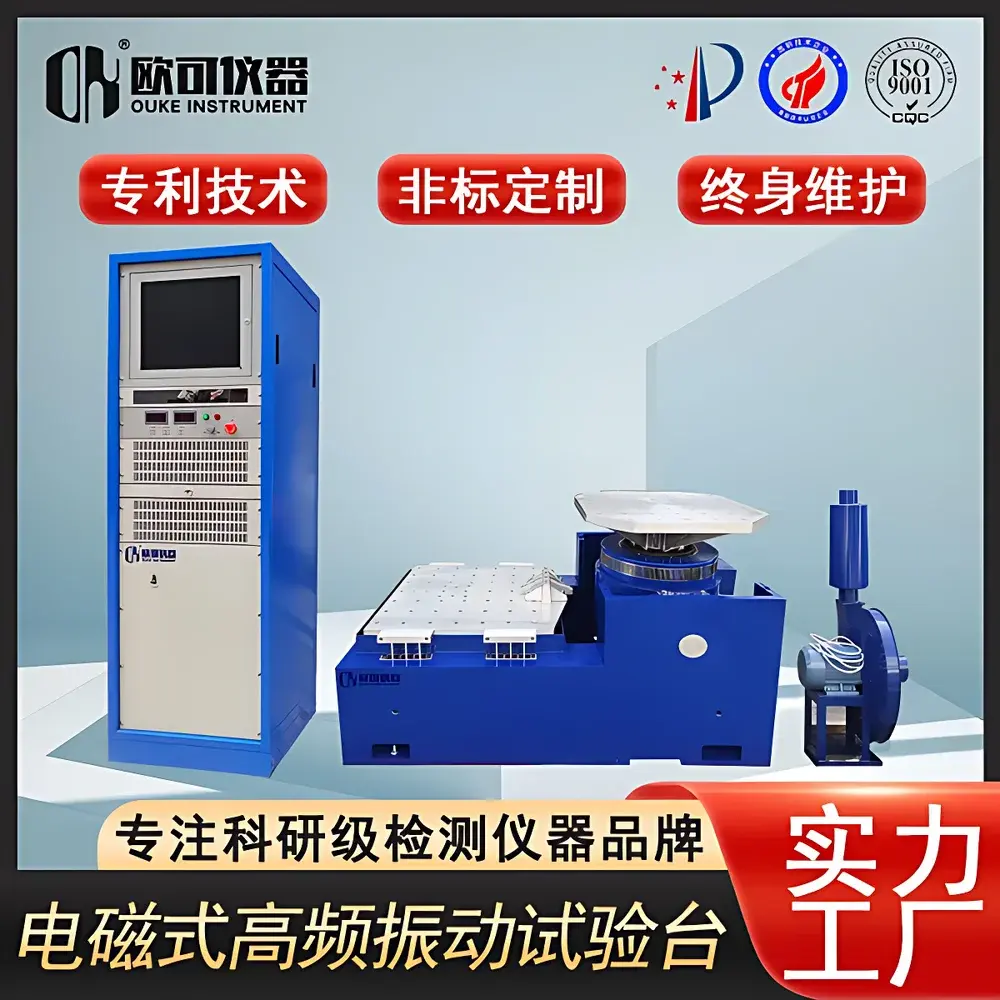
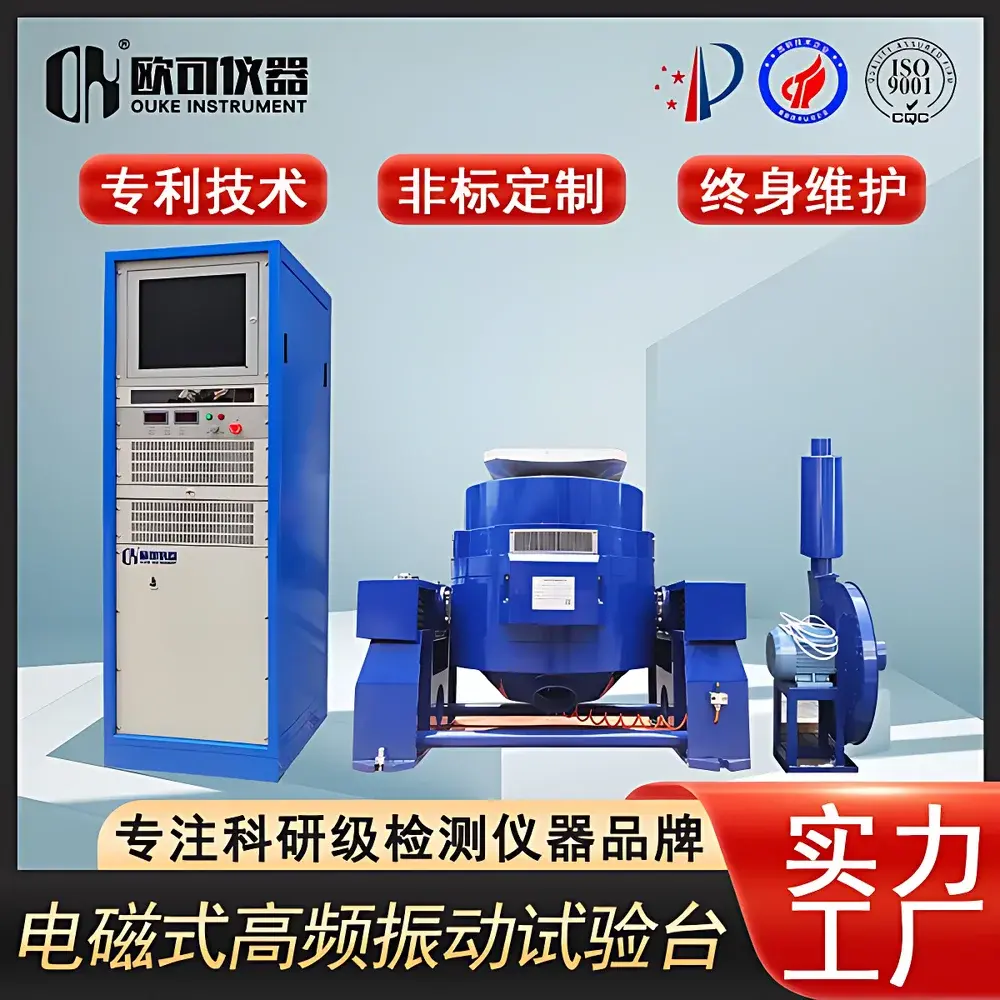
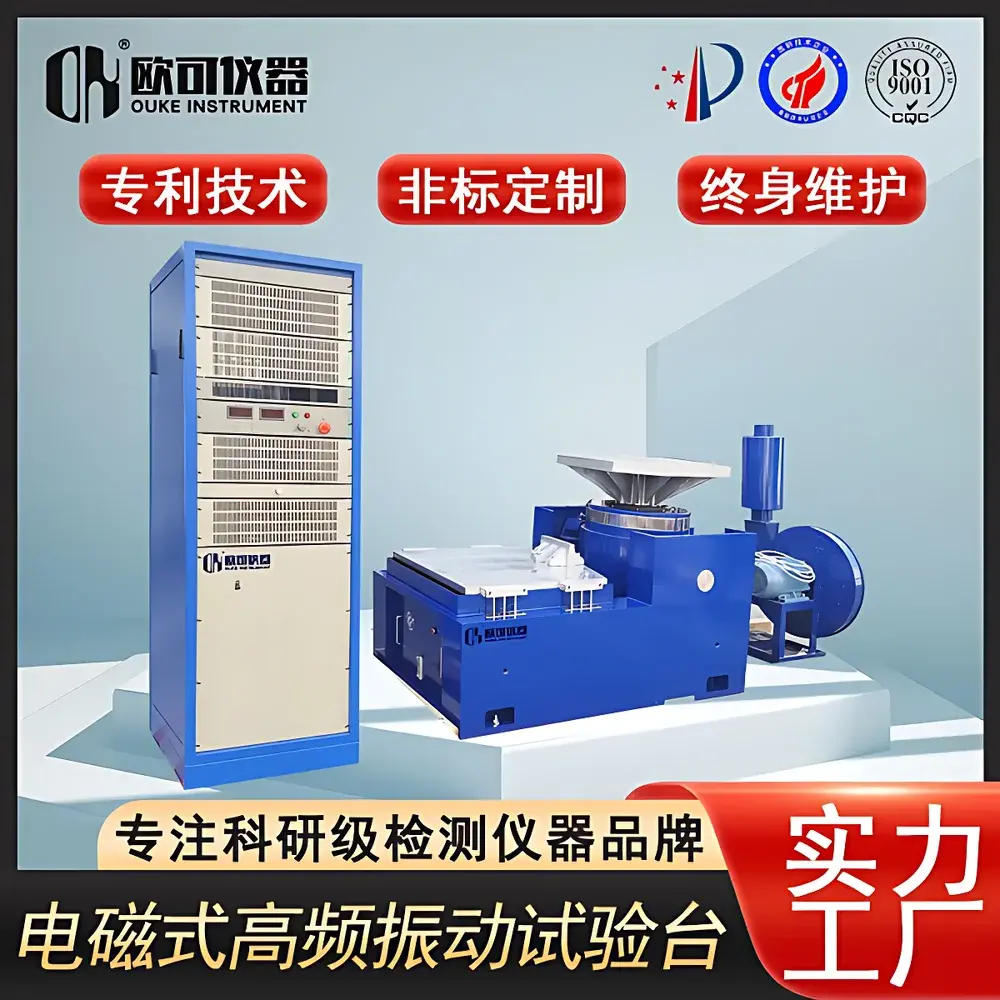
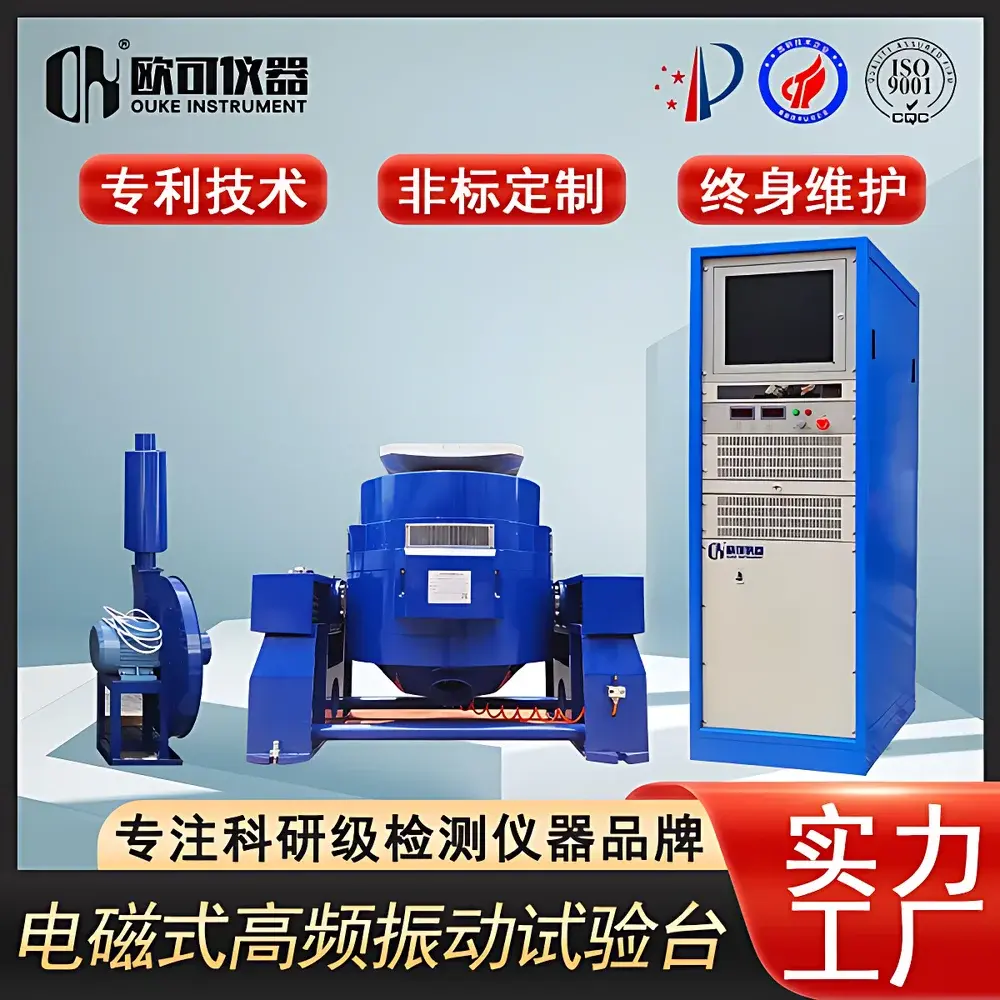
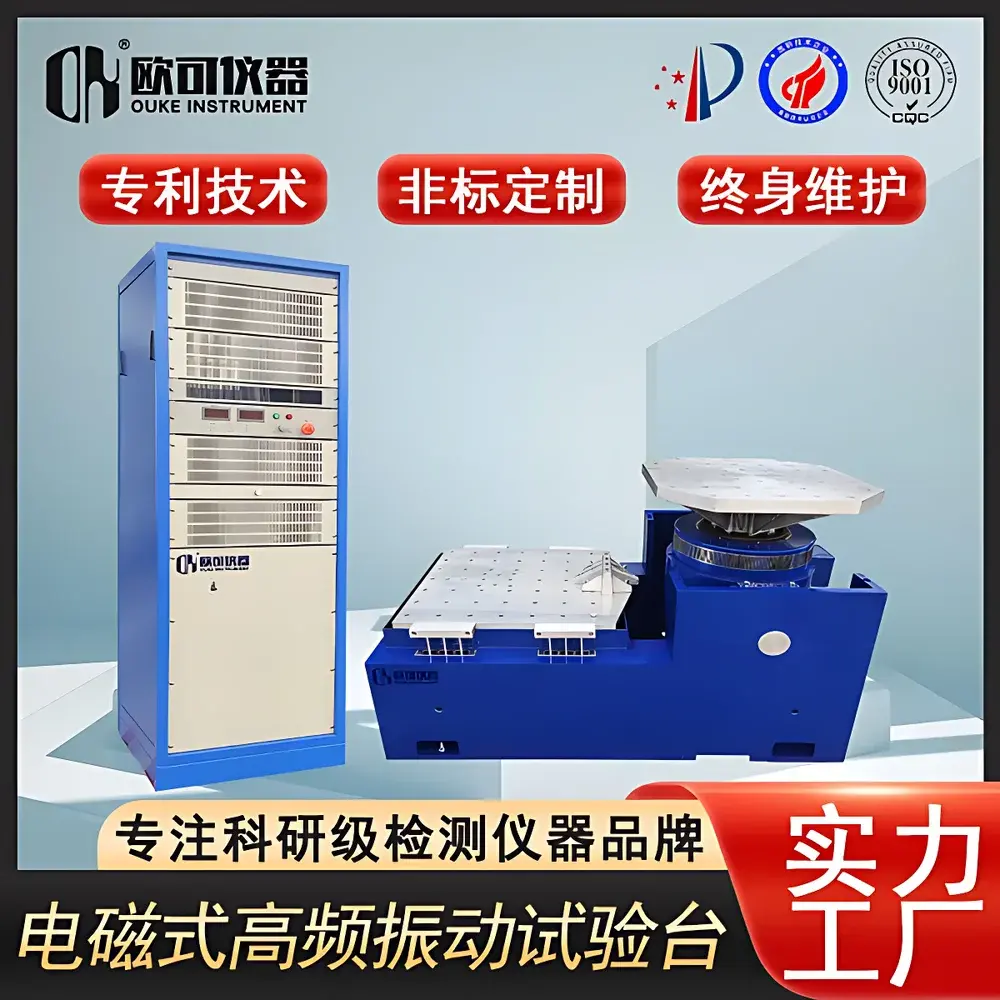
OK XYZ Triaxial Electrodynamic Vibration Shaker
| Brand | OK Instruments |
|---|---|
| Origin | Guangdong, China |
| Manufacturer Type | Direct Manufacturer |
| Instrument Type | Electrodynamic Vibration Shaker |
| Model | OK-ES-6.325 |
| Rated Thrust | 1.98 kN |
| Frequency Range | 5–5000 Hz |
| Maximum Test Load | 70 kg |
| Tabletop Dimensions | 300 × 300 × 30 mm |
| Maximum Acceleration | 10 g |
| Compliance | MIL-STD-810G/H, IEC 60068-2-64, ISTA 3A/3E |
Overview
The OK XYZ Triaxial Electrodynamic Vibration Shaker (Model OK-ES-6.325) is an advanced multi-axis dynamic testing system engineered for high-fidelity simulation of real-world mechanical vibration environments. Unlike conventional uniaxial shakers, this system delivers synchronized, independently controlled sinusoidal, random, and transient vibration profiles simultaneously along three orthogonal axes—X (lateral), Y (longitudinal), and Z (vertical)—enabling true triaxial excitation in accordance with ISO 2041, IEC 60068-2-64, and MIL-STD-810H methodologies. Its electrodynamic actuation architecture employs three coaxially aligned, force-coordinated voice-coil exciters mounted on a rigid, low-inertia moving mass assembly. This design ensures minimal cross-axis coupling while maintaining structural integrity across the full operational bandwidth (5–5000 Hz). The system is fundamentally intended for qualification-level reliability testing where physical fidelity—not just compliance—is paramount: aerospace avionics, automotive ECUs, defense-grade communication modules, and high-value consumer electronics subjected to transport and operational stresses.
Key Features
- Triaxial electrodynamic excitation with real-time MIMO (Multi-Input Multi-Output) control, enabling independent amplitude, phase, and spectral density regulation per axis
- Digital controller with embedded FFT-based feedback loop, supporting pre-defined test standards (e.g., MIL-STD-810H Method 514.8, IEC 60068-2-64 Annex D) and custom waveform synthesis
- Integrated power amplifier subsystem delivering stable, low-distortion drive signals up to 1.98 kN peak thrust per axis
- Rigid 300 × 300 × 30 mm aluminum alloy tabletop with threaded mounting pattern (M6, 25 mm grid) and modal damping treatment to suppress local resonances below 1 kHz
- Onboard triaxial acceleration measurement capability via calibrated IEPE sensors (±500 g range, <2 % amplitude nonlinearity), sampled at 51.2 kS/s per channel
- Thermal management system with forced-air cooling and real-time coil temperature monitoring to sustain continuous operation at rated acceleration (10 g RMS)
Sample Compatibility & Compliance
The OK-ES-6.325 accommodates test specimens up to 70 kg, with mounting flexibility achieved through standardized interface plates and customizable fixture solutions. Fixture design adheres to ASTM D4728 and IEC 60068-2-64 guidelines to ensure transmissibility fidelity and minimize boundary condition artifacts. All control algorithms implement active decoupling compensation to mitigate mechanical crosstalk—verified via modal assurance criterion (MAC) analysis during system commissioning. The shaker meets electromagnetic compatibility (EMC) requirements per EN 61326-1 and is designed for integration into GLP-compliant laboratories. Its data acquisition and control firmware supports audit-trail logging, electronic signatures, and 21 CFR Part 11–ready user access controls when deployed with optional validation packages.
Software & Data Management
The system operates under OK-VibraControl™ v4.x—a deterministic real-time platform built on a Linux RT kernel. It provides native support for test profile import/export in STDF, ASCII, and MATLAB .mat formats. Key software capabilities include: closed-loop random vibration control with PSD convergence tolerance ±0.5 dB; sine-on-random superposition; shock response spectrum (SRS) synthesis; and automated pass/fail evaluation against user-defined acceptance thresholds. All raw and processed data are stored in HDF5 format with embedded metadata (test ID, operator, timestamp, calibration traceability). Export options include PDF reports compliant with ISO/IEC 17025 documentation requirements, as well as CSV-compatible time-history files for third-party post-processing in MATLAB or Python-based analysis workflows.
Applications
- Aerospace: Qualification testing of satellite payloads, inertial measurement units (IMUs), and flight-critical harness assemblies under combined-axis launch vibration spectra
- Automotive: Durability validation of ADAS sensors, battery management systems (BMS), and infotainment modules per ISO 16750-3 and GMW14872
- Electronics Manufacturing: Transport simulation for PCBAs and handheld devices per ISTA 3E (air/ground distribution) and ASTM D4169
- Defense Systems: Environmental stress screening (ESS) of encrypted radios, EO/IR turrets, and missile guidance components per MIL-STD-810H Change 1
- Academic Research: Experimental modal analysis (EMA), nonlinear structural dynamics studies, and vibro-acoustic coupling investigations requiring controlled multi-degree-of-freedom excitation
FAQ
What distinguishes triaxial vibration testing from sequential single-axis testing?
Sequential single-axis tests assume independence between axes and cannot replicate phase relationships or coupled resonance phenomena. Triaxial testing captures true vectorial vibration states—including off-diagonal energy transfer—critical for detecting fretting wear, connector micro-disconnection, and subharmonic structural instabilities.
Is the OK-ES-6.325 suitable for HALT or HASS applications?
While optimized for specification-driven qualification, the system can be configured for accelerated stress profiling with optional thermal chamber integration and extended frequency sweep capability. However, dedicated HALT systems typically prioritize rapid thermal ramp rates over precise triaxial coherence.
How is mechanical crosstalk quantified and mitigated during operation?
Crosstalk is measured during factory calibration using orthogonal impulse response functions and corrected in real time via adaptive inverse MIMO filters updated at 10 kHz. Residual coupling remains below −40 dB across the 20–2000 Hz band.
What maintenance protocols are recommended for long-term performance stability?
Annual recalibration of force transducers and accelerometer channels is advised. Quarterly inspection of suspension flexures, voice-coil alignment, and amplifier cooling ducts ensures sustained thrust linearity and thermal margin.
Can the system be integrated into an existing test lab automation framework?
Yes—the controller features Ethernet/IP and Modbus TCP interfaces, and SDKs for LabVIEW, Python, and C++ enable seamless integration with MES, PLM, and test orchestration platforms such as NI TestStand or Keysight PathWave.



