
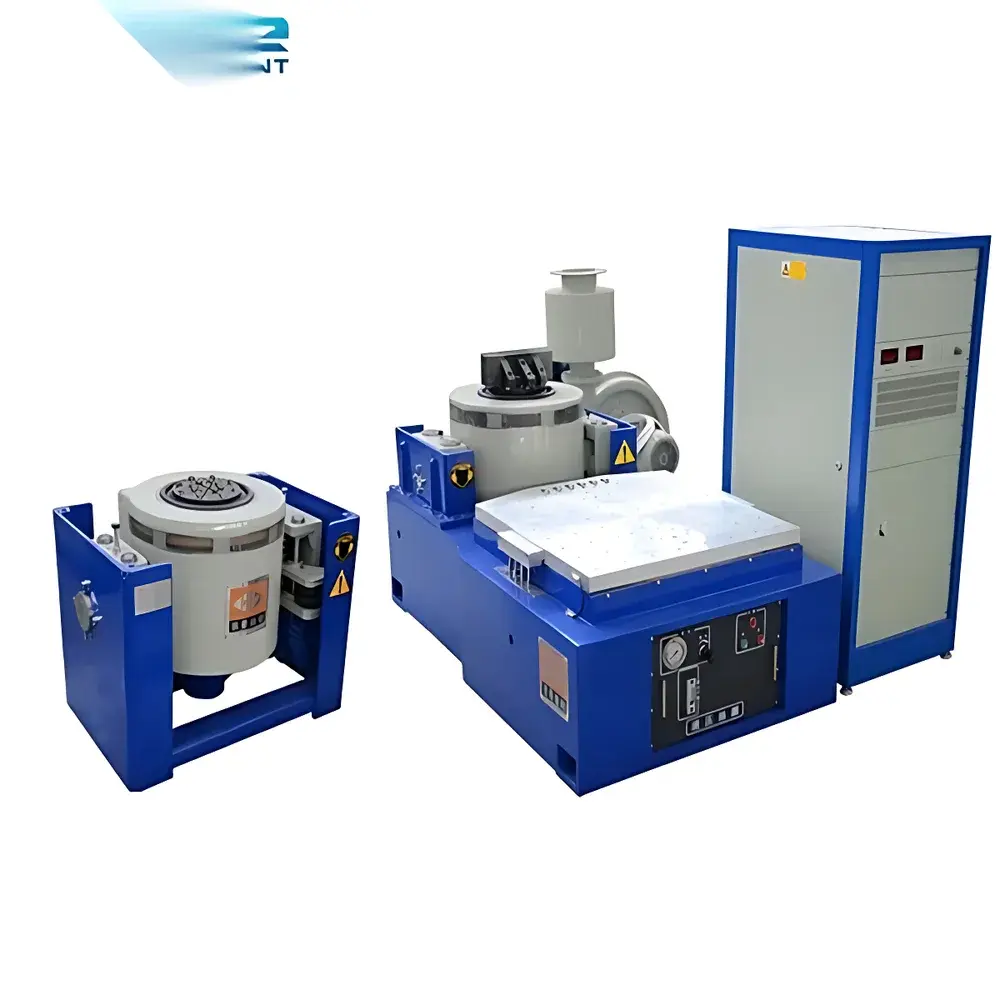
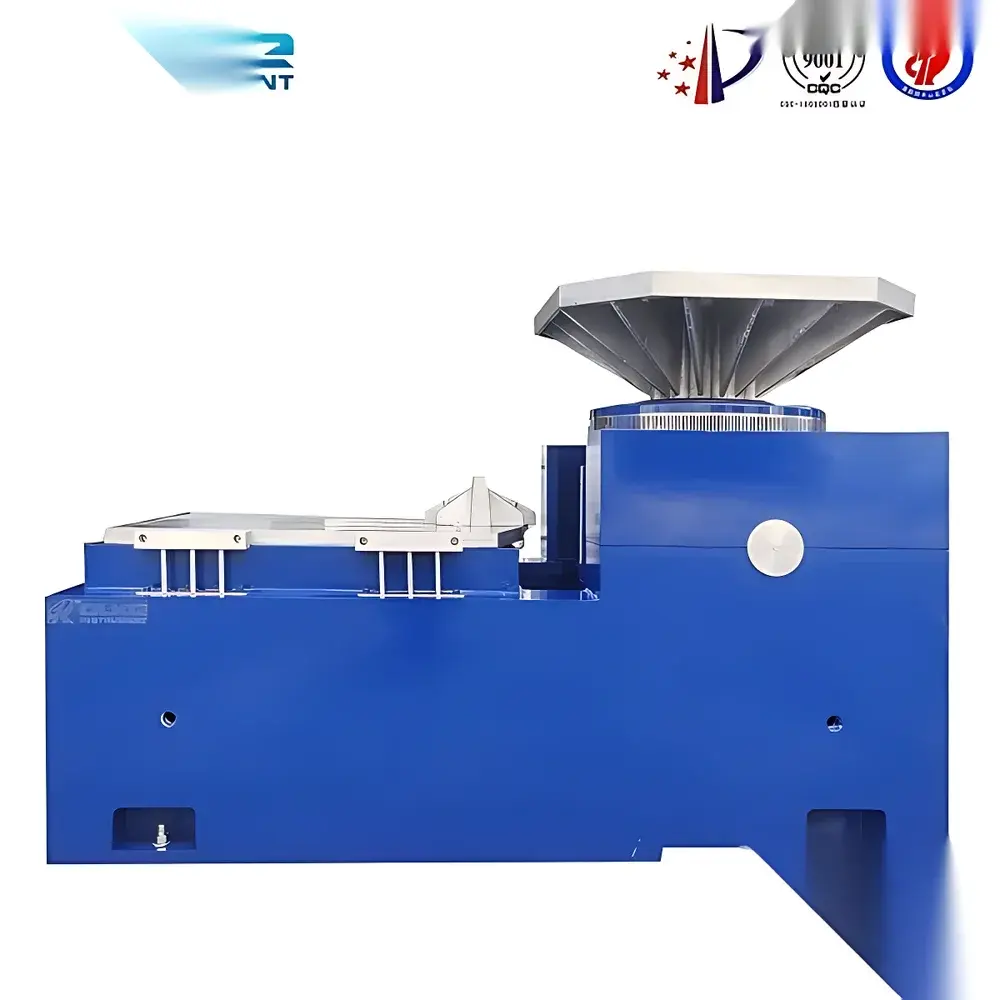
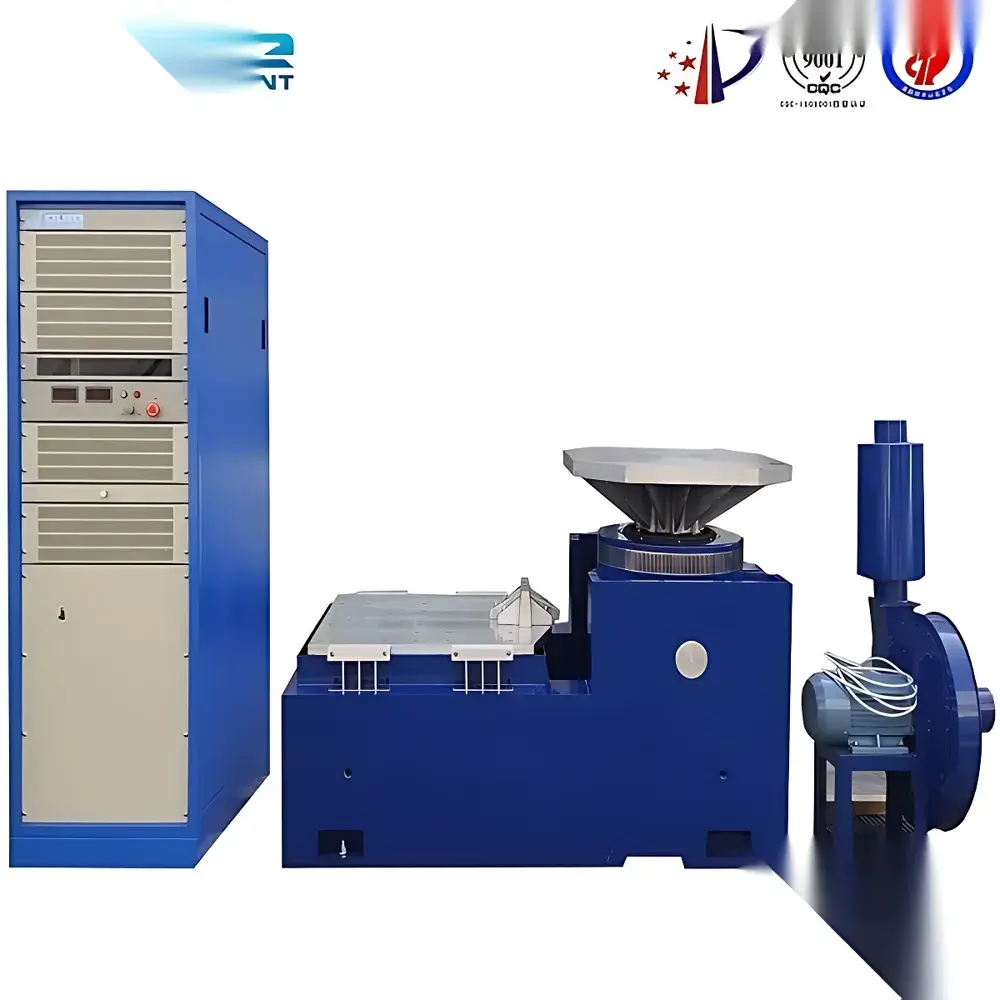
XYZ Triaxial Vibration Test System
| Brand | Other Brands |
|---|---|
| Origin | Imported |
| Manufacturer Type | Authorized Distributor |
| Price | USD 21,500 (FOB) |
| Frequency Range | 1–5000 Hz |
| Max Acceleration | <20 g |
| Max Displacement (p-p) | ≤5 mm |
| Load Capacity | 100 kg |
| Vibration Waveform | Sine (Half/Full Cycle) |
| Axes | Vertical + Horizontal (X/Y/Z orthogonal) |
| Control Modes | Fixed Frequency, Sweep, Programmable (15-segment), Logarithmic, Octave |
| Display Resolution | 0.01 Hz (frequency), ±0.1 Hz accuracy |
| Operating Temperature | 5–40 °C (24-hr avg ≤25 °C) |
| Humidity | ≤85% RH |
| Power Supply | AC 220 V ±10% / 50 Hz or AC 380 V ±10% / 50 Hz |
Overview
The XYZ Triaxial Vibration Test System is an electromechanical shaker platform engineered for rigorous mechanical stress screening of products and components under controlled multi-axis vibratory excitation. Based on electromagnetic force generation and closed-loop inertial mass actuation, the system delivers precise sinusoidal motion across three orthogonal axes (X, Y, Z) to replicate real-world transport, handling, and operational vibration environments. Its core architecture adheres to fundamental vibration dynamics principles—acceleration (a) governed by a = 0.002 × f² × D (where f is frequency in Hz and D is peak-to-peak displacement in mm), with hard limits enforced at 20 g maximum acceleration and 5 mm maximum displacement to ensure structural integrity and test repeatability. Designed for laboratory, QC, and R&D settings, the system supports deterministic vibration profiles required by international reliability standards including IEC 60068-2-6, MIL-STD-810H Method 514.7, and ISO 10326-1.
Key Features
- Triaxial orthogonal excitation capability: independent vertical (Z-axis) and dual horizontal (X/Y-axis) shakers enabling simultaneous or sequential 3D vibration testing.
- High-rigidity aluminum-magnesium alloy casting platform with anodized surface finish for enhanced corrosion resistance, thermal stability, and extended service life.
- Stainless steel or alloy-inserted threaded mounting holes to prevent thread stripping under high-cycle dynamic loading—critical for long-term fixture retention and measurement fidelity.
- Wide frequency coverage: selectable configurations spanning 1–600 Hz, 1–3000 Hz, and 1–5000 Hz bandwidths; fixed-frequency 50 Hz variant available for standardized compliance checks.
- Precision digital control: frequency resolution of 0.01 Hz, accuracy ±0.1 Hz; programmable sweep rates, dwell times, and amplitude ramping per segment.
- Modular operation modes: fixed-frequency, linear/logarithmic sweep, 15-segment programmable sequencing, octave-based frequency stepping, and bidirectional logarithmic cycling.
Sample Compatibility & Compliance
The XYZ system accommodates specimens up to 100 kg mass on a standard 500 × 500 mm active surface (vertical unit: 150 mm height; horizontal unit: 250 mm height). Custom platform dimensions—including non-standard footprints and reinforced load interfaces—are available upon engineering review. Mounting adaptability supports PCB assemblies, automotive ECUs, medical device enclosures, consumer electronics, and aerospace subassemblies. The system complies with environmental conditioning requirements per IEC 60068-1 (operating temperature 5–40 °C, max 24-hr average 25 °C; humidity ≤85% RH). Electrical safety conforms to IEC 61000-4 series EMC immunity standards. While the base unit does not include integrated acceleration/velocity transducers, it is compatible with third-party IEPE sensors and data acquisition systems certified to ISO 18431-1 for traceable metrology.
Software & Data Management
The XYZ system features RS-485 serial interface for external host integration. Optional interface cards and PC-based control software (sold separately) enable full remote operation, real-time parameter logging, waveform visualization, and automated report generation in PDF/CSV formats. Software architecture supports audit-trail functionality compliant with GLP and GMP documentation requirements—including user access logs, parameter change timestamps, and test execution records. Data export adheres to ASTM E2917-21 guidelines for vibration test reporting. All firmware updates are delivered via secure authenticated channels and retain full backward compatibility with legacy test programs.
Applications
This triaxial shaker is routinely deployed in: product qualification for automotive Tier-1 suppliers (e.g., connector fatigue validation per USCAR-2); pre-shipment screening of industrial control modules; durability assessment of handheld diagnostic instruments under simulated field conditions; resonance search and mode shape identification in mechanical design verification; and accelerated life testing of MEMS packaging structures. It is also utilized in academic research on vibration-induced solder joint failure mechanisms and in regulatory testing labs performing IEC 60950-1 clause 4.5.2 mechanical robustness evaluations.
FAQ
Does the system include built-in accelerometers or displacement sensors?
No—the XYZ Triaxial Vibration Test System is a drive-only platform. Real-time acceleration or displacement measurement requires optional external IEPE sensors and a compatible DAQ system.
Can the system perform random vibration testing?
No—this model is configured exclusively for deterministic sinusoidal waveforms (fixed, swept, or programmable sine). Random vibration capability requires a separate controller and power amplifier upgrade path.
What is the maximum allowable specimen center-of-gravity offset?
For optimal dynamic balance and bearing longevity, CG offset must remain within ±15 mm from the platform geometric center along any axis. Larger offsets require custom counterweight calibration.
Is FDA 21 CFR Part 11 compliance supported?
Yes—when used with the optional validated PC control software package, full electronic signature, audit trail, and role-based access controls meet Part 11 requirements for regulated medical device testing.
How is thermal management handled during extended high-frequency operation?
The shaker motors incorporate forced-air cooling with thermostatically monitored exhaust; continuous operation above 3000 Hz is limited to ≤60 minutes per cycle to maintain coil temperature below Class H insulation rating (180 °C).



