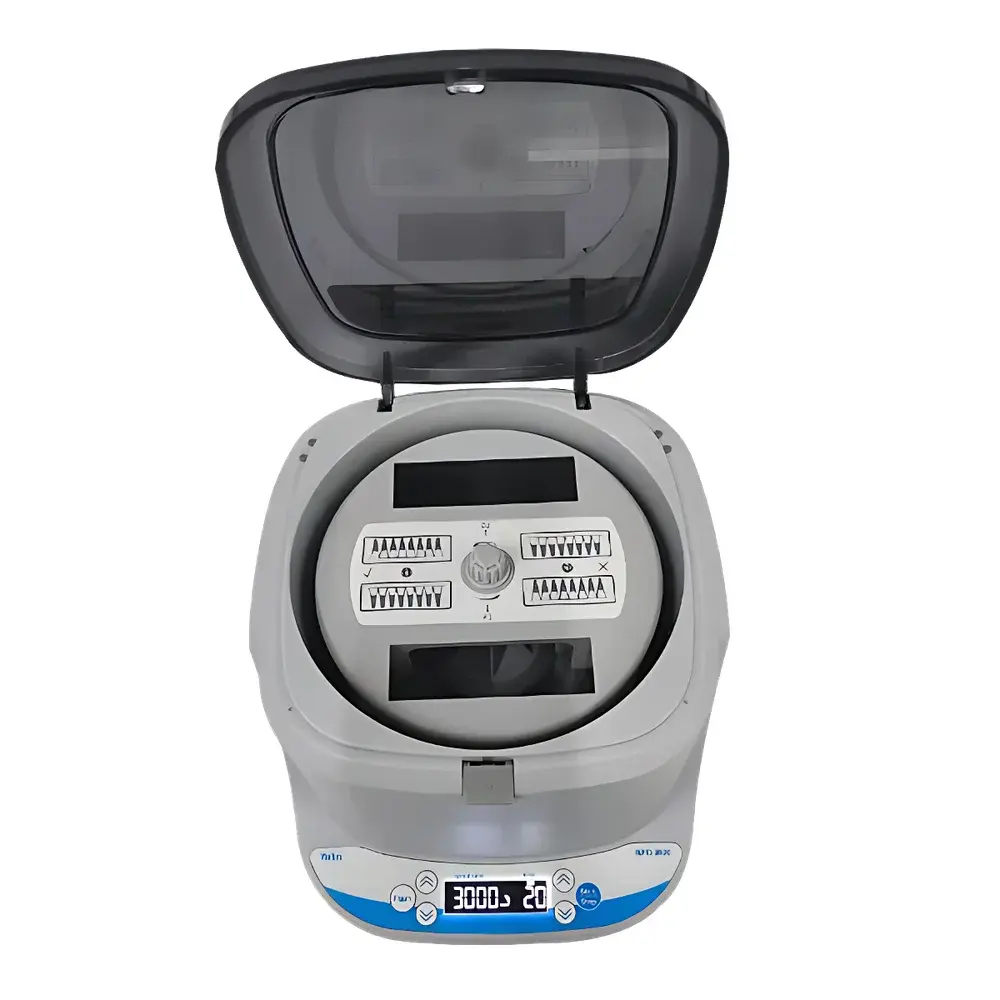
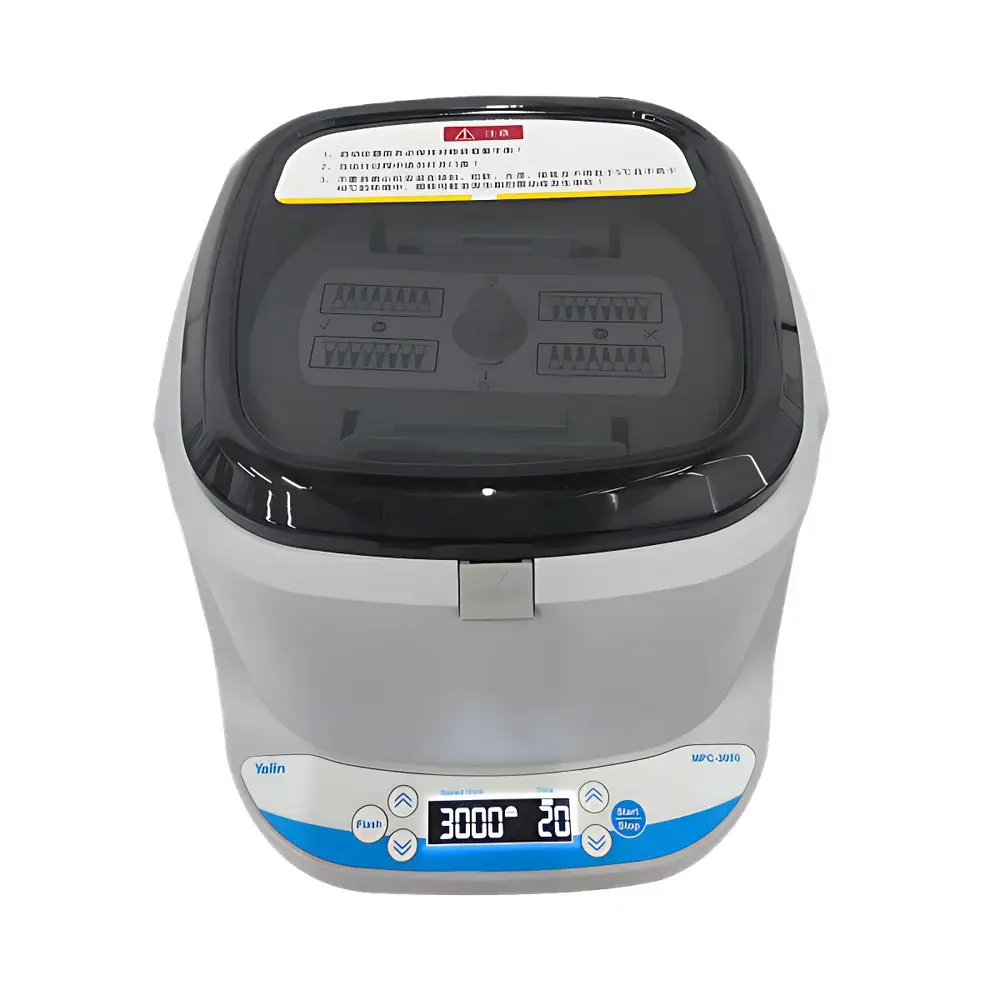
Yalin MPC3000 Benchtop Microplate Centrifuge
| Brand | Yalin |
|---|---|
| Origin | Shanghai, China |
| Manufacturer Type | Direct Manufacturer |
| Product Category | Domestic |
| Model | MPC3000 |
| Instrument Type | Benchtop Microplate Centrifuge |
| Function | Standard Microplate Centrifugation |
| Maximum RCF | 608 ×g |
| Speed Range | 300–3000 ±15 rpm |
| Sample Capacity | 2 × 96-well PCR plates |
| Acceleration Time | ≤6 s |
| Deceleration Time | ≤5 s |
| Noise Level | 60 dB(A) |
| Power Supply | DC 24 V / 2.75 A |
| Dimensions (L×W×H) | 225 × 255 × 215 mm |
| Weight | 3.9 kg |
| Environmental Operating Range | 5–40 °C, ≤80% RH |
| Ingress Protection | IP21 |
| Electromagnetic Compatibility | EN 61010-1, EN 61010-2-020, EN 61326-1, EN 61010-3-2/A2 |
Overview
The Yalin MPC3000 is a compact, high-efficiency benchtop microplate centrifuge engineered for precise and rapid pelleting of liquid samples in standard microplates used across molecular biology, clinical diagnostics, and drug discovery workflows. It operates on the principle of radial acceleration to generate controlled relative centrifugal force (RCF), enabling efficient removal of air bubbles, condensation, and wall-adherent droplets from wells—critical for downstream assay integrity in ELISA, qPCR, NGS library preparation, and cell-based assays. Designed specifically for compatibility with ANSI/SLAS-standard 96-well and 384-well plates—including skirted, unskirted, and semi-skirted PCR plates—the MPC3000 delivers reproducible performance without requiring plate adapters or manual repositioning. Its brushless DC motor (24 V) ensures low thermal drift, minimal vibration, and long-term operational stability—key attributes for integration into automated lab environments and GLP-compliant laboratories.
Key Features
- Ultra-fast acceleration: Reaches maximum speed (3000 rpm) in ≤6 seconds, minimizing total processing time per run.
- Precise speed control: Adjustable in 10-rpm increments across a validated range of 300–3000 ±15 rpm, supporting both gentle pelleting and robust condensate removal.
- Dual-plate capacity: Simultaneously processes two 96-well plates in a single run—optimized for throughput without compromising balance or rotor integrity.
- Real-time safety monitoring: Integrated imbalance detection, overspeed protection, and lid interlock system halt operation immediately upon fault detection and display standardized error codes on the high-brightness LCD screen.
- Acoustic feedback: Audible alert accompanies visual error code display for immediate operator awareness during abnormal conditions (e.g., lid open mid-run, rotor imbalance).
- Low-noise operation: Engineered acoustic enclosure maintains noise levels at ≤60 dB(A) at 1 m distance—suitable for shared lab spaces and laminar flow hoods.
- Programmable timing: Independent control of centrifugation duration from 1 second to 99 minutes 59 seconds, with automatic stop and brake engagement.
Sample Compatibility & Compliance
The MPC3000 accommodates all ANSI/SLAS-format microplates (96-well and 384-well), including thin-wall PCR plates, full-skirted, half-skirted, and non-skirted variants. Plate loading is vertical and tool-free—eliminating risk of misalignment or cross-contamination. The instrument complies with international safety and electromagnetic compatibility standards essential for regulated environments: EN 61010-1 (Safety Requirements for Electrical Equipment for Measurement, Control, and Laboratory Use), EN 61010-2-020 (Particular Requirements for Centrifuges), EN 61326-1 (EMC for Laboratory Equipment), and EN 61010-3-2/A2 (Harmonic Current Emissions). While not certified under FDA 21 CFR Part 11, its deterministic error logging and non-volatile parameter retention support audit-ready documentation when integrated with LIMS or electronic lab notebook (ELN) systems.
Software & Data Management
The MPC3000 operates via an embedded firmware interface with no external software dependency. All parameters—including speed, time, and error history—are retained in non-volatile memory across power cycles. The LCD interface provides real-time status feedback, elapsed time, remaining time, and diagnostic codes (e.g., “E01” = lid open, “E03” = imbalance detected). Though it lacks USB or Ethernet connectivity, its deterministic behavior and repeatable mechanical response enable seamless inclusion in SOP-driven workflows. For labs requiring traceability, timestamped operation logs can be manually recorded alongside batch identifiers—fully compatible with ISO/IEC 17025 documentation requirements and internal QA/QC validation protocols.
Applications
- Pre-PCR spin-down: Rapid removal of condensation and residual transfer fluid from reaction plates prior to thermal cycling.
- ELISA and immunoassay plate conditioning: Ensuring uniform well bottom contact and eliminating meniscus artifacts before optical reading.
- Cell culture supernatant collection: Gentle pelleting of adherent cells or debris from 96-well assay plates without plate deformation.
- High-throughput screening (HTS) support: Integration into robotic workcells where footprint, power efficiency (55 W), and DC input simplify electrical infrastructure.
- Point-of-care and field-deployable settings: Compact dimensions (225 × 255 × 215 mm) and lightweight design (3.9 kg) facilitate transport and benchtop use in mobile labs or satellite testing sites.
FAQ
Does the MPC3000 support 384-well plates?
Yes—it accepts standard ANSI/SLAS 384-well plates, though maximum rated capacity remains two 96-well plates; 384-well plates are processed one at a time.
Is the rotor autoclavable?
No—the rotor assembly is not designed for autoclaving; cleaning is recommended with 70% ethanol or isopropanol and lint-free wipes.
Can I program custom acceleration/deceleration profiles?
No—the MPC3000 uses fixed ramp rates optimized for microplate integrity; variable ramp control is not supported.
What maintenance is required?
Routine maintenance is limited to exterior cleaning and periodic inspection of the lid latch mechanism and rotor seating; no lubrication or calibration is required under normal operating conditions.
Is the device suitable for GMP-regulated environments?
It meets core electrical safety and EMC standards applicable to Class I laboratory equipment; however, formal GMP qualification requires site-specific IQ/OQ documentation performed by the end user or authorized service provider.