
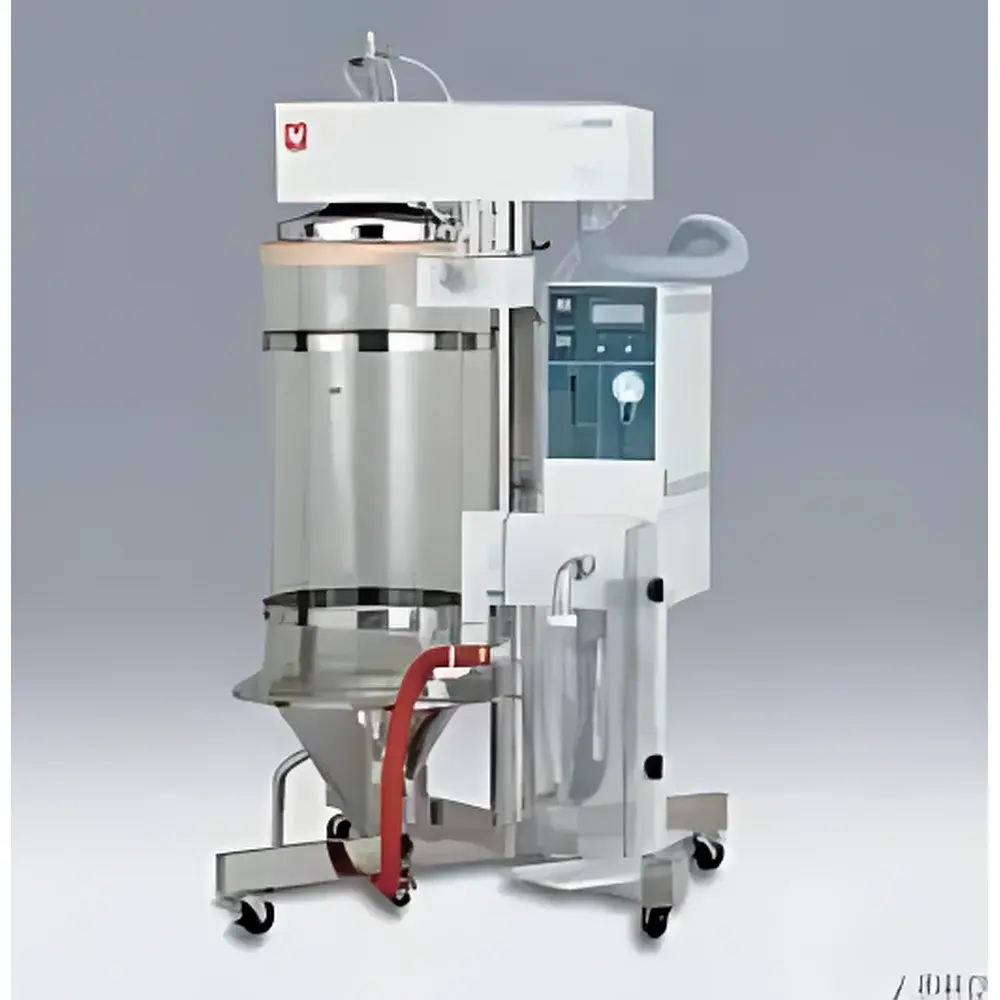
YAMATO DL410 Laboratory Spray Dryer
| Brand | YAMATO |
|---|---|
| Origin | Japan |
| Model | DL410 |
| Maximum Water Evaporation Rate | 3000 mL/h |
| Atomization Method | Two-Fluid Nozzle (Orifice Diameter: 0.7 mm) |
| Drying Configuration | Co-Current Downward Spray |
| Inlet Air Temperature Range | 0–300 °C |
| Outlet Air Temperature Monitoring | K-Type Thermocouple |
| Drying Chamber Dimensions | Ø457 mm × H975 mm (Borosilicate Glass) |
| Chamber & Cyclone Material | Ultra-Hard Borosilicate Glass |
| Feed Pump | Precision Peristaltic Type, 0–70 mL/min Adjustable |
| Hot Air Flow Control | DC Brushless Blower, 0.3–1.0 m³/min |
| Heating System | Dual Stainless Steel Heaters, 2.0 kW × 2 |
| Nozzle Maintenance | Automated Pulse Cleaning (Probe Tapping + Purge Air) |
| Safety Features | Independent Over-Temperature Cut-Off, Leakage Current Protection, Feed Pump Reverse Rotation Detection, Electrostatic Discharge Brush, Integrated Safety Enclosure |
| Power Supply | AC 220 V, 50/60 Hz, 24 A |
| Dimensions (W×D×H) | 1060 × 880 × 1770 mm |
| Weight | ~180 kg |
Overview
The YAMATO DL410 is a high-precision laboratory-scale spray dryer engineered for reproducible production of spherical, free-flowing microparticles in the critical 40–100 µm size range—historically challenging to achieve with conventional benchtop systems. It operates on the principle of rapid solvent evaporation via co-current downward two-fluid atomization: liquid feed is pneumatically dispersed into fine droplets at the nozzle tip and immediately contacted by heated air flowing in parallel, minimizing thermal degradation while maximizing particle integrity. Designed specifically for R&D applications requiring scale-up fidelity—including pharmaceutical granulation, functional food ingredient development, ceramic precursor powder synthesis, and microencapsulation—the DL410 bridges the gap between analytical sample preparation and pilot-scale process validation. Its large-diameter borosilicate glass drying chamber (Ø457 mm × 975 mm height) provides extended residence time for complete desolvation of fine droplets, enabling robust formation of dense, low-moisture particles comparable in morphology and flowability to those produced in industrial rotary or fluid-bed dryers.
Key Features
- Two-fluid nozzle system with 0.7 mm orifice diameter, delivering narrow droplet size distribution and high atomization efficiency under controlled compressed air pressure
- Automated nozzle maintenance: integrated probe-tapping mechanism and purge-air jet prevent nozzle clogging during continuous operation with viscous or particulate-laden feeds
- Co-current downward spray configuration minimizes particle rebound and wall deposition, enhancing yield and reducing cross-contamination risk
- Dedicated cold air inlet port suppresses upward aerosol recirculation and mitigates thermal stress on sensitive actives near the chamber ceiling
- DC brushless blower enables precise, low-noise airflow regulation (0.3–1.0 m³/min) with real-time digital feedback
- PID-controlled inlet temperature regulation (0–300 °C) with ±1 °C stability and independent overtemperature cut-off circuitry
- Full-sight borosilicate glass drying chamber and cyclone separator allow real-time visual monitoring of spray pattern, particle trajectory, and agglomeration behavior
- Motorized head elevation mechanism facilitates safe, tool-free access to the drying chamber for cleaning and maintenance
- Standard electrostatic discharge brush and safety enclosure comply with IEC 61000-4-2 ESD immunity requirements for laboratory environments
Sample Compatibility & Compliance
The DL410 accommodates aqueous and organic solvent-based solutions, suspensions, and emulsions—including ethanol-, acetone-, and ethyl acetate-based formulations—when paired with optional GAS410 solvent recovery unit (ATEX-compliant design). Its ultra-hard borosilicate glass construction resists chemical etching from acidic, basic, or halogenated solvents, while stainless steel and silicone wetted parts meet USP Class VI biocompatibility standards. The system supports GLP/GMP-aligned workflows through configurable audit trail logging (via optional software interface), adherence to ASTM E2500-21 for equipment qualification, and compatibility with FDA 21 CFR Part 11–compliant data acquisition platforms when integrated with validated third-party controllers. All electrical components conform to IEC 61010-1 safety standards for laboratory equipment.
Software & Data Management
While the DL410 operates via intuitive front-panel controls with analog/digital hybrid instrumentation, it provides native 4–20 mA analog outputs for inlet and outlet temperature signals—enabling seamless integration into centralized SCADA or LIMS environments. Optional YAMATO Data Logger (DL-Log Pro) software supports time-stamped parameter recording (temperature, airflow, feed rate, nozzle pressure), trend analysis, and export to CSV or PDF for regulatory submission. All critical operational events—including temperature excursions, pump fault detection, and safety interlock activation—are timestamped and stored locally for traceability. The system architecture supports IQ/OQ documentation packages aligned with ISO 9001 and ISO/IEC 17025 quality management frameworks.
Applications
- Pharmaceutical preformulation: production of inhalable dry powders, enteric-coated microparticles, and amorphous solid dispersions with controlled residual moisture (<0.5% w/w)
- Food science: encapsulation of probiotics, omega-3 oils, and heat-labile flavors using maltodextrin or gum arabic matrices
- Materials research: synthesis of spherical LiFePO₄ cathode precursors, silica nanoparticles, and metal-organic framework (MOF) microspheres
- Agrochemical development: formulation of water-dispersible granules (WDG) and controlled-release pesticide carriers
- Academic methodology studies: comparative evaluation of atomization parameters, residence time distribution, and thermal history effects on particle crystallinity
FAQ
What particle size distribution can the DL410 consistently achieve?
With optimized feed concentration, inlet temperature, and airflow, the DL410 delivers a median particle size (D50) of 60–90 µm and span (D90/D10) <2.0 for standard polymer and carbohydrate solutions.
Is the DL410 suitable for heat-sensitive biological samples?
Yes—its co-current configuration and rapid evaporation kinetics enable effective drying of proteins, enzymes, and vaccines at inlet temperatures as low as 80–120 °C, provided outlet temperature is maintained below 45 °C.
Can organic solvents be processed safely?
When equipped with the optional GAS410 solvent recovery system and explosion-proof accessories, the DL410 complies with IEC 60079-0 for Group II, Category 2G hazardous area use.
How is cleaning validated between batches?
The motorized head lift, wide-diameter glass chamber, and automated nozzle purge facilitate visual inspection and residue swabbing per ASTM E1847-22; cleaning verification reports may be generated using optional DL-Log Pro.
Does the system support 21 CFR Part 11 compliance?
The base unit does not include electronic signature or audit trail functionality, but its analog outputs and relay interfaces are fully compatible with validated third-party Part 11–compliant data acquisition systems.
Related Products



