
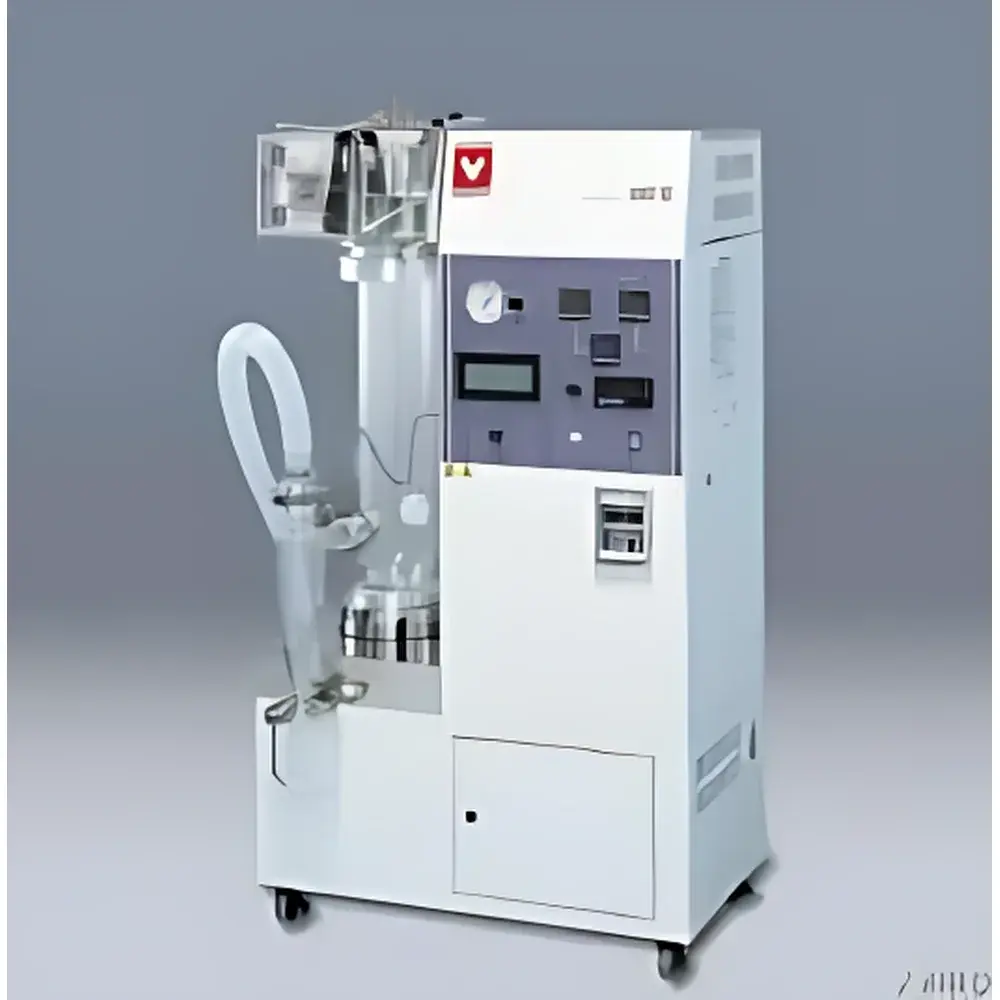
YAMATO GB210-A Benchtop Spray Dryer
| Brand | YAMATO |
|---|---|
| Origin | Japan |
| Model | GB210-A |
| Input Voltage Range | AC 200–240 V (50/60 Hz) |
| Inlet Air Temperature Range | 40–220 °C (±1 °C PID control) |
| Outlet Air Temperature Range | 0–60 °C |
| Drying Air Flow | 0–0.7 m³/min |
| Atomizing Air Pressure | 0–0.6 MPa |
| Feed Pump Flow Rate | 0–26 mL/min |
| Power Consumption | 2.0–2.88 kW |
| Dimensions (W×D×H) | 760 × 420 × 1350 mm |
| Weight | 110 kg |
Overview
The YAMATO GB210-A is a compact, benchtop-scale spray dryer engineered for precise, reproducible powder synthesis from small-volume liquid feedstocks—down to 0.5 g of solid content. It operates on the principle of flash evaporation: a peristaltic feed pump delivers solution or suspension to a pneumatic two-fluid nozzle, where high-velocity atomizing air disperses the feed into fine droplets; these are rapidly dried by controlled hot air (inlet: 40–220 °C) in a stainless-steel drying chamber. Due to the short residence time (< 1–2 s) and direct heat transfer via convection, thermally labile compounds—including proteins, enzymes, polymers, and pharmaceutical actives—retain structural integrity and functional stability. The system’s low-mass airflow design and efficient cyclonic collection enable recovery of sub-1 µm particles with minimal agglomeration and negligible oxidation—critical for nanomaterials, inhalable therapeutics, and catalyst precursors.
Key Features
- Integrated electric lift mechanism for automated, repeatable positioning of glassware components—reducing operator variability during assembly/disassembly and improving alignment repeatability between runs.
- Dual-mode temperature control: independent PID-regulated inlet and outlet air temperature monitoring, with selectable control priority (inlet-locked for process consistency or outlet-locked for product moisture targeting).
- Advanced nozzle management system comprising active nozzle cooling (dual Φ10.5 mm coolant ports), manual pulse-jet cleaning (compressed air burst from nozzle tip), and anti-clogging needle probe—ensuring stable atomization across aqueous and organic solvent systems.
- Universal power architecture supporting AC 200 V / 220 V / 240 V (50/60 Hz) without hardware modification—facilitating global deployment in academic labs, CMC development suites, and contract manufacturing organizations.
- Dedicated 2 A AC 220 V service outlet for inline magnetic stirrers, enabling continuous homogenization of suspensions during feeding—essential for nanoparticle dispersions and colloidal formulations.
- 4–20 mA analog output for real-time logging of inlet/outlet temperatures, compatible with external SCADA or LIMS platforms for audit-ready data capture under GLP/GMP environments.
Sample Compatibility & Compliance
The GB210-A accommodates aqueous solutions, water-miscible organics (e.g., ethanol, acetone, DMF), and emulsions—provided solvent recovery is implemented via the optional GAS410 condensation unit. Its inert glass collection vessel and stainless-steel wetted path minimize metal leaching and surface adsorption. All thermal sensors conform to IEC 60584-1 (K-type thermocouples); temperature controllers comply with IEC 61000-4 electromagnetic immunity standards. When operated with validated protocols and calibrated sensors, the system supports documentation required for regulatory submissions under USP , ISO 20938 (spray drying of pharmaceuticals), and ASTM E2915 (thermal stability assessment of dried biologics). Optional COV30C safety enclosure meets EN 61000-3-11 for harmonic current emission limits.
Software & Data Management
The capacitive touchscreen HMI provides intuitive navigation across six operational screens: System Status, Parameter Setup, Real-Time Trending, Alarm History, Language Selection (English/Chinese/Japanese), and Maintenance Log. All setpoints, actual values, and alarm events (e.g., overtemperature, pump reversal, nozzle disconnect) are timestamped and stored internally for ≥30 days. Export is supported via USB to CSV format—retaining full traceability for internal QA review or FDA 21 CFR Part 11-compliant validation when paired with third-party electronic signature software. No cloud connectivity or remote access is embedded, preserving data sovereignty in regulated research settings.
Applications
- Early-stage formulation development of amorphous solid dispersions (ASDs) for enhanced oral bioavailability.
- Rapid screening of excipient compatibility using microgram-scale APIs.
- Synthesis of porous silica, calcium phosphate, or PLGA microparticles for controlled release profiling.
- Preparation of enzyme-loaded microparticles for diagnostic assay development.
- Production of battery cathode precursors (e.g., NMC, LFP) from nitrate-based precursor solutions.
- Generation of inhalable dry powders meeting USP aerodynamic particle size distribution criteria.
FAQ
Can the GB210-A handle chlorinated solvents such as chloroform or dichloromethane?
Yes—when coupled with the GAS410 solvent recovery system, which includes explosion-proof internal compressors, condenser coils rated to –20 °C, and integrated pressure relief valves compliant with ISO 8573-1 Class 2 purity standards.
Is outlet temperature control available as a primary setpoint mode?
Yes—though it requires manual confirmation of stable inlet conditions and feed rate prior to activation; this mode is recommended for moisture-sensitive products where residual water activity must remain below 2% w/w.
What is the minimum detectable particle size recoverable from the cyclone collector?
Submicron particles down to ~0.3 µm can be consistently collected using the standard borosilicate glass cyclone; for enhanced recovery of nanoparticles <100 nm, optional electrostatic precipitator integration is supported via auxiliary port.
Does YAMATO provide IQ/OQ documentation templates for GMP environments?
Yes—validated protocol packages including Installation Qualification (IQ), Operational Qualification (OQ), and Preventive Maintenance (PM) checklists are available upon request and align with Annex 15 of the EU GMP Guidelines.
How often does the peristaltic pump tubing require replacement under continuous operation?
With silicone tubing (standard), typical service life is 200–300 hours at 15 mL/min; TYLON® fluoropolymer tubing (optional) extends this to ≥800 hours in aggressive solvent environments.



