
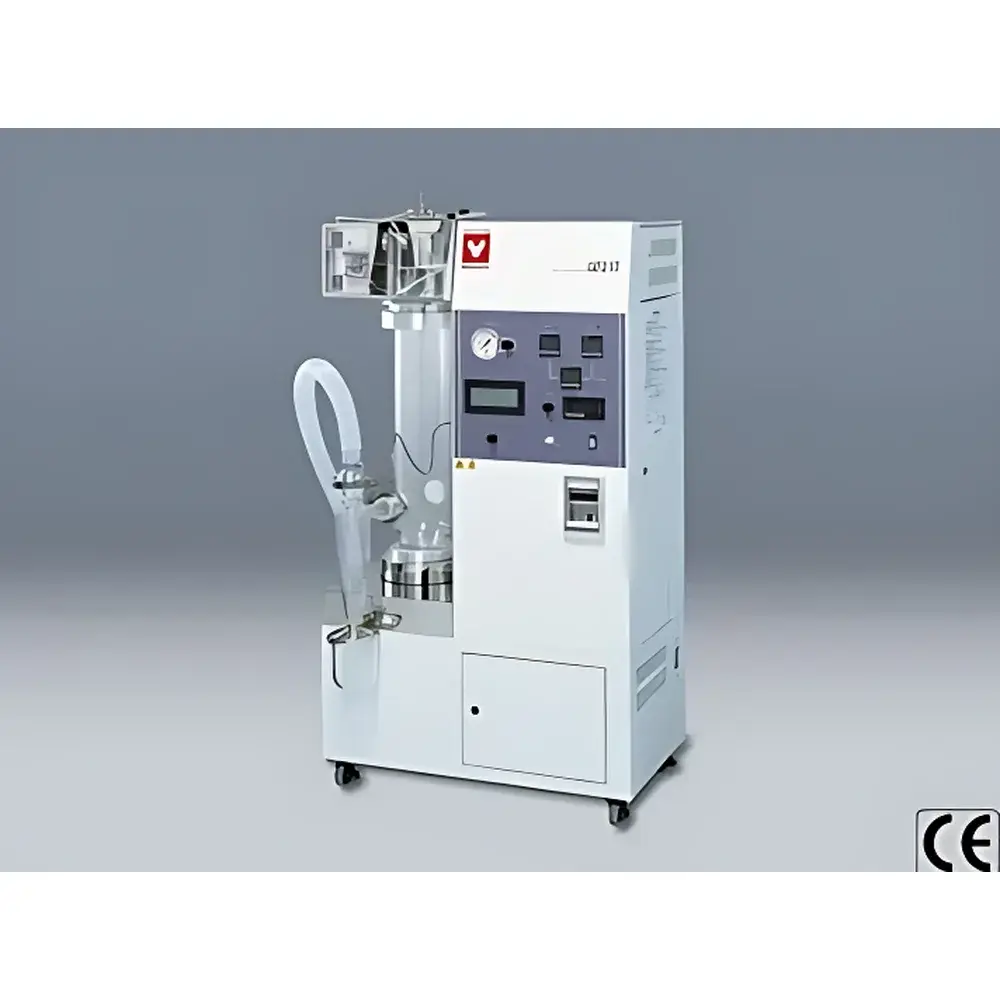
YAMATO GB210 Benchtop Spray Dryer for Aqueous & Organic Solvent Solutions
| Brand | YAMATO |
|---|---|
| Origin | Japan |
| Model | GB210 |
| Inlet Temp Range | 40–220 °C (±1 °C) |
| Outlet Temp Range | 0–60 °C |
| Air Flow | 0–0.7 m³/min |
| Atomizing Air Pressure | 0–0.6 MPa |
| Feed Pump Flow | 0–26 mL/min |
| Power Supply | AC200–240 V, 16–18 A |
| Dimensions | 760 × 420 × 1350 mm |
| Weight | 110 kg |
| Compliance | CE-marked, GLP-ready architecture, 21 CFR Part 11–compatible data logging (with optional temperature recorder) |
Overview
The YAMATO GB210 is a compact, benchtop spray dryer engineered for high-precision drying of low-volume, thermally sensitive samples—down to just 0.5 g of total solids—in both aqueous and organic solvent systems. It operates on the principle of flash evaporation via concurrent-flow atomization: liquid feed is pneumatically atomized into fine droplets within a heated drying chamber, where rapid solvent removal yields free-flowing, low-moisture micropowders in a single continuous step. Unlike conventional lyophilization or oven drying, the GB210 minimizes thermal residence time (<1–2 s), preserving labile biomolecules (e.g., peptides, enzymes, mRNA-LNPs), polymers, and pharmaceutical actives without degradation, oxidation, or cross-contamination. Its design adheres to core ISO 22000 and ASTM E2656 guidelines for controlled drying environments and supports GMP-aligned workflows when integrated with validated accessories.
Key Features
- Ultra-low sample requirement: Reliable powder generation from as little as 0.5 g total dissolved solids—ideal for precious R&D intermediates and early-stage API screening.
- Dual-solvent capability: Native compatibility with water-based solutions; extended to flammable organic solvents (e.g., acetone, ethanol, dichloromethane) when coupled with the optional GAS410 solvent recovery unit (CE-certified, explosion-proof air handling).
- Thermal precision engineering: PID-controlled inlet temperature regulation (±1 °C accuracy) and selectable inlet/outlet temperature control modes ensure reproducible particle morphology and residual solvent levels.
- Stable atomization system: Integrated peristaltic feed pump (0–26 mL/min, pulse-free delivery), cooled nozzle assembly (dual Φ10.5 mm coolant ports), and programmable pulse-jet cleaning prevent nozzle clogging during prolonged operation with viscous or particulate-laden feeds.
- Modular expandability: Optional GF200 granulation kit converts the system into a top-spray fluid-bed granulator; COV30C safety enclosure meets IEC 61000-3-2 EMC and local lab ventilation requirements.
- Global human-machine interface: Multilingual (English/Chinese/Japanese) capacitive touchscreen with real-time monitoring of inlet/outlet temperatures, airflow, feed rate, and alarm status—configured via intuitive icon-driven menus compliant with ISO 9241-110 usability standards.
Sample Compatibility & Compliance
The GB210 accommodates a broad range of feedstocks including protein solutions, polymer dispersions, nanosuspensions, colloidal silica, and small-molecule APIs dissolved in water, methanol, THF, or ethyl acetate. When paired with the GAS410 solvent recovery module, it meets OSHA 1910.106 and ATEX Zone 2 classification requirements for Class I, Group D vapor handling. All wetted parts contact-grade borosilicate glass (DIN ISO 3585), PTFE, and 316L stainless steel—fully traceable per EN 10204 3.1 material certifications. The system supports audit-ready documentation: analog 4–20 mA outputs for inlet/outlet temperature archiving, optional FDA 21 CFR Part 11–compliant temperature recorder (model TR-GB210), and GLP-compliant electronic logbooks when interfaced with LIMS via RS-485 Modbus RTU.
Software & Data Management
While the GB210 operates as a standalone instrument with embedded firmware (v3.2+), its analog outputs and relay-controlled peripherals enable seamless integration into centralized lab automation platforms. Raw temperature and flow signals can be logged directly into LabArchives ELN or Thermo Fisher SampleManager LIMS using standard 4–20 mA signal conditioners. Optional digital upgrades include Ethernet-enabled data acquisition modules supporting CSV export, timestamped event tagging (e.g., “nozzle clean cycle initiated”), and alarm history retention ≥30 days. All firmware updates are distributed via YAMATO’s secure FTP portal with SHA-256 integrity verification and version-controlled release notes aligned with ICH Q9 risk management principles.
Applications
- Pharmaceutical development: Production of inhalable dry powders, amorphous solid dispersions (ASDs), and sterile-filtered nanoparticle formulations without post-drying milling.
- Biotechnology: Stabilization of monoclonal antibodies, viral vectors, and CRISPR ribonucleoprotein complexes under mild thermal conditions (inlet ≤120 °C).
- Materials science: Synthesis of battery cathode precursors (e.g., LiCoO₂ nanoparticles), MOF powders, and functionalized silica microspheres with narrow PSD (Dv50 = 2–10 µm, CV <15%).
- Food & nutraceuticals: Encapsulation of probiotics, omega-3 oils, and heat-labile vitamins without Maillard browning or lipid oxidation (residual moisture <2.5 wt%, per AOAC 925.09).
- Academic research: High-throughput formulation screening across solvent polarity gradients, supported by rapid method transfer between GB210 and pilot-scale YAMATO SD-06 units.
FAQ
What is the minimum recommended feed volume for reproducible powder yield?
For consistent particle size distribution and ≥85% collection efficiency, we recommend ≥5 mL of feed solution at ≥1 wt% solids concentration. Sub-gram drying is feasible but requires calibration with reference standards (e.g., PVP K30 in water).
Can the GB210 operate continuously for >8 hours?
Yes—under stable ambient conditions (<25 °C, <60% RH) and with scheduled pulse-jet nozzle cleaning every 90 minutes, the system maintains thermal equilibrium and pump linearity over extended runs.
Is the GAS410 solvent recovery unit required for all organic solvents?
Mandatory for Class I flammable solvents (flash point <60 °C); optional but strongly advised for chlorinated solvents to meet EPA 40 CFR Part 63 emission thresholds.
How is compliance with 21 CFR Part 11 ensured?
Through optional TR-GB210 temperature recorder with electronic signatures, audit trail encryption, and role-based user access—validated per Annex 11 and aligned with YAMATO’s IQ/OQ/PQ protocol templates.
Does the GB210 support remote monitoring via Ethernet or Wi-Fi?
Native Ethernet port is not included; however, third-party IoT gateways (e.g., Advantech ECU-1251) can be deployed to bridge RS-485 Modbus data to cloud dashboards with TLS 1.2 encryption.



