
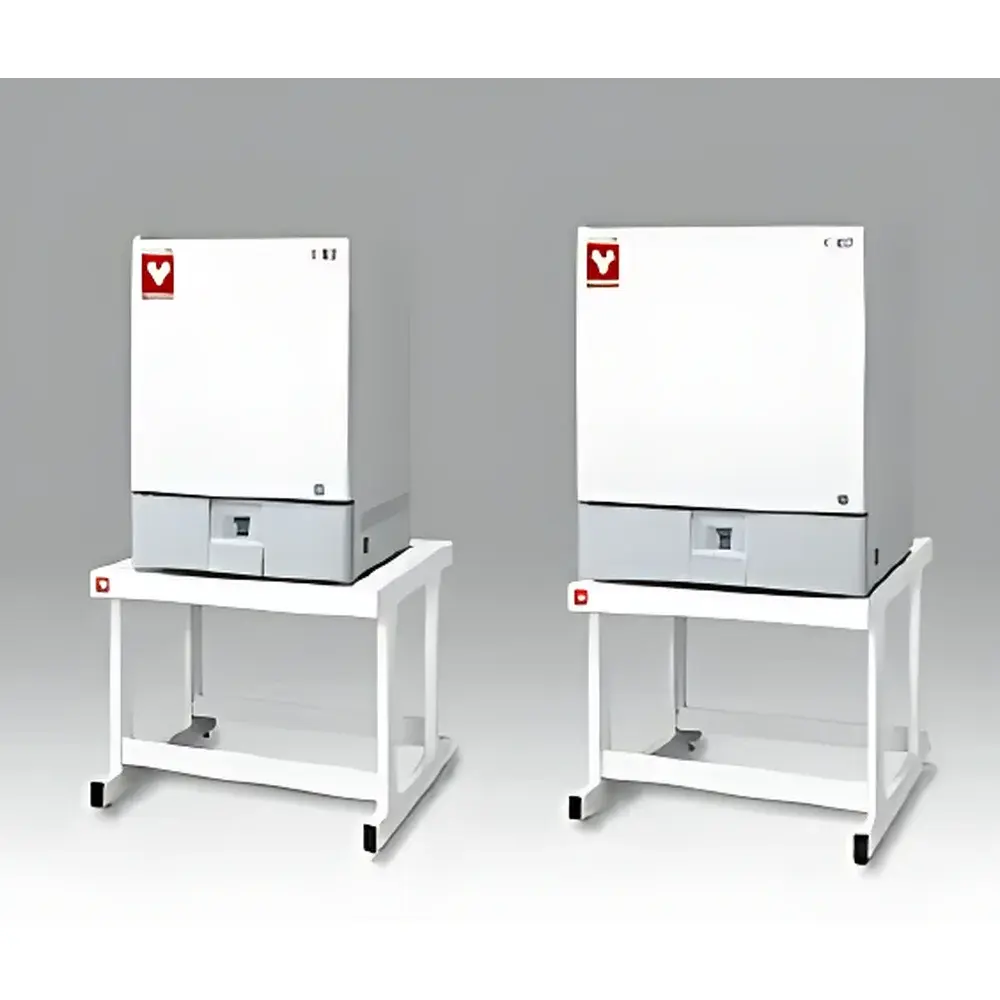
YAMATO IC612C Constant-Temperature Incubator
| Brand | YAMATO |
|---|---|
| Origin | Japan |
| Model | IC612C |
| Temperature Range | Ambient +5°C to 80°C |
| Temperature Uniformity | ±1.0°C |
| Capacity | 159 L |
| Humidity Control | Not equipped |
| Configuration | Air-jacketed, Dual-door, Reinforced Glass Inner Door |
| Safety Features | Self-diagnostic Circuit (temperature sensor failure, heater open-circuit, SSR short-circuit, over-temperature prevention), Independent Over-Temperature Protector, Earth Leakage Circuit Breaker, Keypad Lock |
| Control Modes | Setpoint Operation, Auto Start/Stop, Rapid Stop, Offset Calibration |
Overview
The YAMATO IC612C Constant-Temperature Incubator is an air-jacketed, microprocessor-controlled incubation system engineered for long-term stability and operational reliability in life science laboratories. Designed and manufactured in Japan, the IC612C employs convection-based heat transfer via a surrounding air jacket—ensuring uniform thermal distribution without reliance on forced-air circulation or internal fans. This passive, low-turbulence architecture minimizes vibration and desiccation risks, making it especially suitable for sensitive cell culture maintenance, microbial growth studies, enzyme activity assays, and stability testing of biological reagents where consistent thermal conditions are critical. Its robust stainless-steel interior chamber, seamless welded corners, and double-door configuration—including a reinforced tempered glass inner door—support both contamination control and real-time visual monitoring without compromising thermal integrity. The unit operates across a broad temperature range from ambient +5°C to 80°C, with a certified temperature uniformity of ±1.0°C at setpoint—a specification validated under steady-state conditions per ISO 13408-1 and ASTM E2875 guidelines for incubator performance verification.
Key Features
- Air-jacketed thermal design ensures homogeneous temperature distribution without fan-induced airflow, reducing mechanical stress on cultured specimens.
- Dual-door construction—comprising an insulated outer door and a transparent reinforced glass inner door—minimizes heat loss during observation and enhances energy efficiency.
- Microprocessor-based PID temperature controller with intuitive membrane keypad interface supports multiple operational modes: setpoint hold, scheduled auto-start, timed auto-stop, and rapid shutdown.
- User-configurable offset calibration allows fine-tuning of displayed vs. actual chamber temperature, supporting traceable adjustments compliant with GLP documentation requirements.
- Comprehensive safety architecture includes redundant over-temperature protection: primary electronic limit control, independent mechanical over-temperature cut-off, self-diagnostic circuitry for sensor/heater/SSR faults, earth leakage circuit breaker, and programmable keypad lock.
Sample Compatibility & Compliance
The IC612C accommodates standard laboratory vessels including Petri dishes, multi-well plates, flasks (up to 2 L), and roller bottles within its 159 L usable chamber volume. Its non-humidified design eliminates condensation-related contamination risks and simplifies validation for dry-heat applications such as media sterilization pre-incubation, BSL-1 microbiological work, and thermal aging of diagnostic kits. The unit conforms to IEC 61010-1 (Safety Requirements for Electrical Equipment for Measurement, Control, and Laboratory Use) and meets electromagnetic compatibility standards per IEC 61326-1. While not certified for GMP manufacturing environments, its design supports audit-ready operation in GLP-compliant research labs, with full support for 21 CFR Part 11–compatible data logging systems when integrated externally.
Software & Data Management
The IC612C operates as a standalone instrument with embedded firmware; no proprietary software is required for basic functionality. However, analog voltage output (0–5 V DC) and RS-485 communication interface (Modbus RTU protocol) enable integration into centralized lab monitoring platforms (e.g., LabVantage, Thermo Fisher SampleManager, or custom SCADA systems). Users may record temperature logs at configurable intervals (1–60 min) using external data acquisition hardware. All parameter settings—including setpoint, offset, timer values, and lock status—are retained through power cycles. Audit trail generation requires third-party middleware, but the controller’s deterministic response time (<1 s) and non-volatile memory ensure reproducible execution of programmed sequences across repeated runs.
Applications
- Maintenance of mammalian and insect cell lines requiring stable, low-vibration thermal environments.
- Growth and enumeration of mesophilic and thermotolerant bacterial strains (e.g., E. coli, Bacillus subtilis) under standardized incubation protocols (ISO 4833-1, AOAC 977.27).
- Enzyme kinetics studies where temperature drift must remain below ±0.5°C over multi-hour assays.
- Accelerated stability testing of biologics, vaccines, and diagnostic reagents per ICH Q1A(R2) guidelines.
- Pre-incubation of agar plates prior to streaking or antimicrobial susceptibility testing (CLSI M07-A10).
FAQ
Does the IC612C support humidity control?
No. The IC612C is a dry-air incubator with no built-in humidification system. For applications requiring controlled relative humidity, consider YAMATO’s RH-series or other dedicated CO₂/humidity incubators.
Is the temperature uniformity specification verified at all setpoints?
Yes—±1.0°C uniformity is guaranteed across the full operating range (ambient +5°C to 80°C) when measured at nine defined locations per ISO 13408-1 Annex C.
Can the IC612C be validated for regulated environments?
While the unit itself does not include factory-issued IQ/OQ documentation, its design, repeatability, and interface options support third-party qualification per GAMP5 and FDA guidance for laboratory equipment used in regulated workflows.
What maintenance is required for long-term reliability?
Annual verification of temperature sensor calibration and inspection of door gaskets and heating element connections are recommended. No routine lubrication or filter replacement is necessary due to the absence of moving parts in the thermal path.
Is the reinforced glass inner door resistant to chemical exposure?
The inner door uses alkali-resistant tempered glass compatible with common lab disinfectants (e.g., 70% ethanol, 1% sodium hypochlorite); prolonged exposure to strong acids or organic solvents is not advised.





