
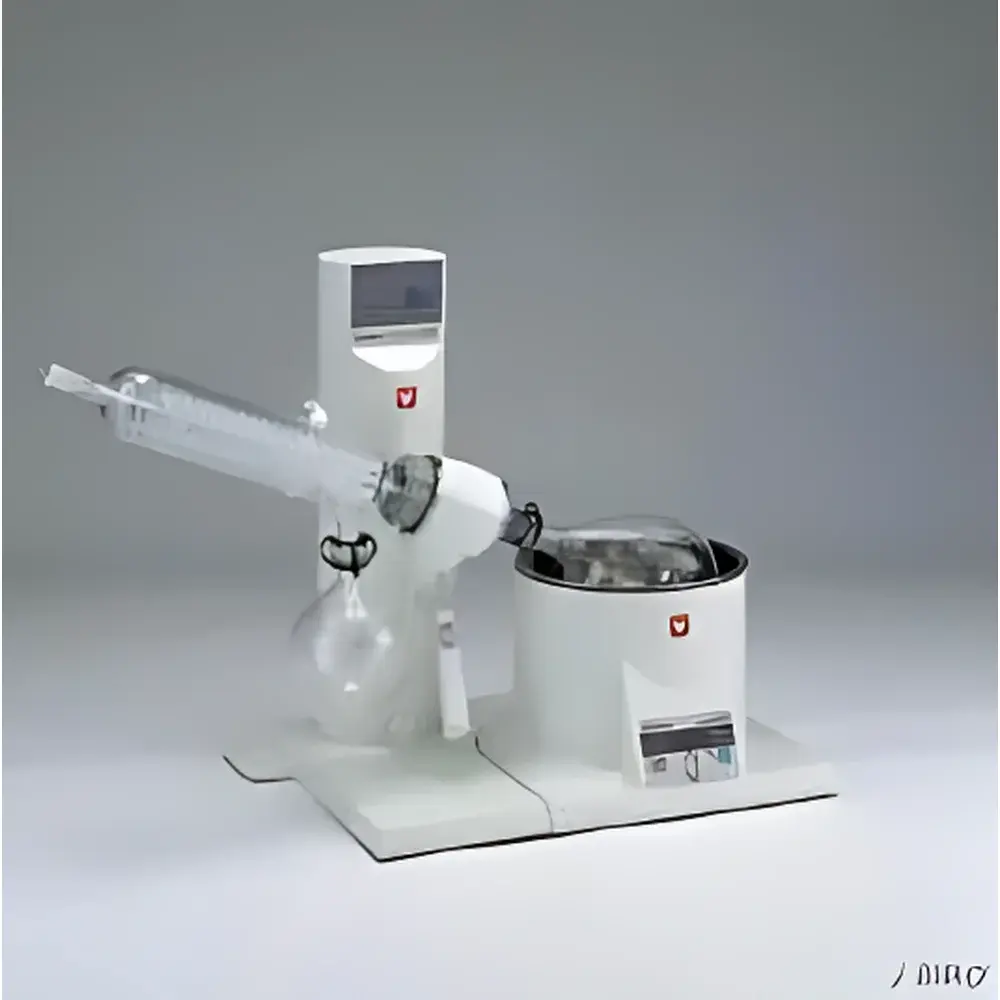
YAMATO RE301 Rotary Evaporator
| Brand | YAMATO |
|---|---|
| Origin | Japan |
| Model | RE301 |
| Capacity | 1 L |
| Rotation Speed | 20–250 rpm |
| Lift Stroke | 130 mm |
| Power Supply | AC 100–240 V, 50/60 Hz |
| Dimensions (with Glass Assembly A) | 828 × 400 × 586 mm (H716 mm with lift raised) |
| Weight | 14.4 kg (main unit only, excluding glassware and bath) |
| Motor Type | Brushless DC (rotation), DC (lift) |
| Control | Potentiometer-based digital speed setting and display |
| Safety Features | Mechanical lower limit stop, motor overload protection |
| Lift Function | Motorized lift with power-failure auto-retract |
Overview
The YAMATO RE301 Rotary Evaporator is a compact, benchtop solvent removal system engineered for precision, reproducibility, and operational safety in academic, pharmaceutical, and industrial R&D laboratories. It operates on the fundamental principle of reduced-pressure distillation: by rotating a sample flask under vacuum while applying controlled heating via an external water or oil bath, the effective surface area for evaporation increases, and the boiling point of solvents decreases—enabling gentle, efficient concentration or purification of heat-sensitive compounds. Designed to meet international laboratory space constraints, the RE301 features a space-optimized footprint compatible with standard fume hood installations (W828 × D400 × H586 mm with Glass Assembly A). Its dual-motor architecture—brushless DC for rotation and dedicated DC for vertical lift—ensures long-term stability, minimal maintenance, and consistent torque delivery across the full 20–250 rpm range.
Key Features
- Motorized vertical lift with 130 mm stroke, activated via front-panel switch; includes automatic upward retraction upon power loss to prevent collision with condenser or bath.
- Digital speed control and real-time RPM display via potentiometer interface—no external controller required.
- Universal voltage compatibility (AC 100–240 V, 50/60 Hz) eliminates need for transformers or regional power adapters.
- Integrated mechanical lower-limit stop and electronic motor overload protection safeguard both operator and drive system during extended runs or viscous sample handling.
- Modular glassware support: accommodates three standardized configurations (Assembly A, B, C) to match diverse flask sizes (up to 1 L) and condenser types—including vertical, diagonal, and cold-finger variants.
- Lightweight main unit (14.4 kg, excluding glassware and bath) facilitates repositioning within shared lab environments without structural reinforcement.
Sample Compatibility & Compliance
The RE301 supports a broad spectrum of organic and aqueous solvents—including acetone, ethanol, ethyl acetate, dichloromethane, and hexane—under vacuum conditions down to ≤10 mbar (dependent on connected vacuum source). Its stainless-steel and PTFE-sealed rotary joint ensures chemical resistance and low-volatility leakage rates compliant with ISO 8573-1 Class 4 for compressed air–assisted vacuum systems. While the instrument itself does not carry CE, UL, or CSA certification as a standalone device, its electrical design conforms to IEC 61010-1:2010 requirements for laboratory electrical equipment when operated within specified voltage and ambient temperature ranges (10–30 °C). When integrated into GxP workflows (e.g., API intermediate purification), users may document operational parameters—including speed, bath temperature, vacuum level, and run duration—in accordance with ALCOA+ data integrity principles.
Software & Data Management
The RE301 is a stand-alone analog-digital hybrid system with no embedded microprocessor or network interface. All operational parameters are set manually and monitored locally: rotation speed is displayed numerically on an LED panel; lift position is indicated by mechanical scale markings. For regulated environments requiring audit trails, integration with external data loggers (e.g., Omega OM-DAQPRO-5300 or Testo 176 T4) is recommended to capture time-stamped RPM, bath temperature (via PT100 probe), and vacuum pressure (via digital gauge). Such configurations support compliance with FDA 21 CFR Part 11 when paired with validated software platforms that enforce user authentication, electronic signatures, and immutable record retention.
Applications
- Concentration of natural product extracts (e.g., plant alkaloids, essential oils) without thermal degradation.
- Removal of reaction solvents following Grignard, Suzuki, or esterification syntheses.
- Preparative-scale solvent exchange (e.g., THF → toluene) prior to crystallization or chromatography.
- Routine QC sample preparation in food, environmental, and polymer testing labs—aligned with ASTM D129, ISO 661, and USP residual solvent methodology.
- Teaching laboratory demonstrations of phase equilibria, vapor pressure depression, and vacuum thermodynamics.
FAQ
Does the RE301 include a vacuum pump or heating bath?
No. The RE301 is a rotary evaporator main unit only. Users must supply a compatible vacuum source (e.g., diaphragm or scroll pump) and external heating bath (water or oil) separately.
Can the RE301 be used with corrosive solvents such as concentrated HCl or bromine?
Not without additional precautions. Standard glass assemblies use borosilicate 3.3 (e.g., Duran, Pyrex); however, aggressive halogenated or acidic vapors require optional PTFE-coated joints, corrosion-resistant condensers, and chemically rated vacuum traps.
Is firmware or software update capability available?
No. The RE301 contains no programmable logic or firmware. All functions are hardware-based and field-serviceable without software intervention.
What is the maximum recommended flask size?
The RE301 is rated for 1 L round-bottom flasks. Use of larger vessels may compromise rotational balance, vacuum integrity, and lift motor longevity.
How is calibration verified for rotation speed accuracy?
Speed calibration is traceable to internal tachometric feedback from the brushless DC motor. Users may validate output using a handheld optical tachometer per ISO/IEC 17025-accredited procedures, with typical deviation ≤±2 rpm across the operating range.



