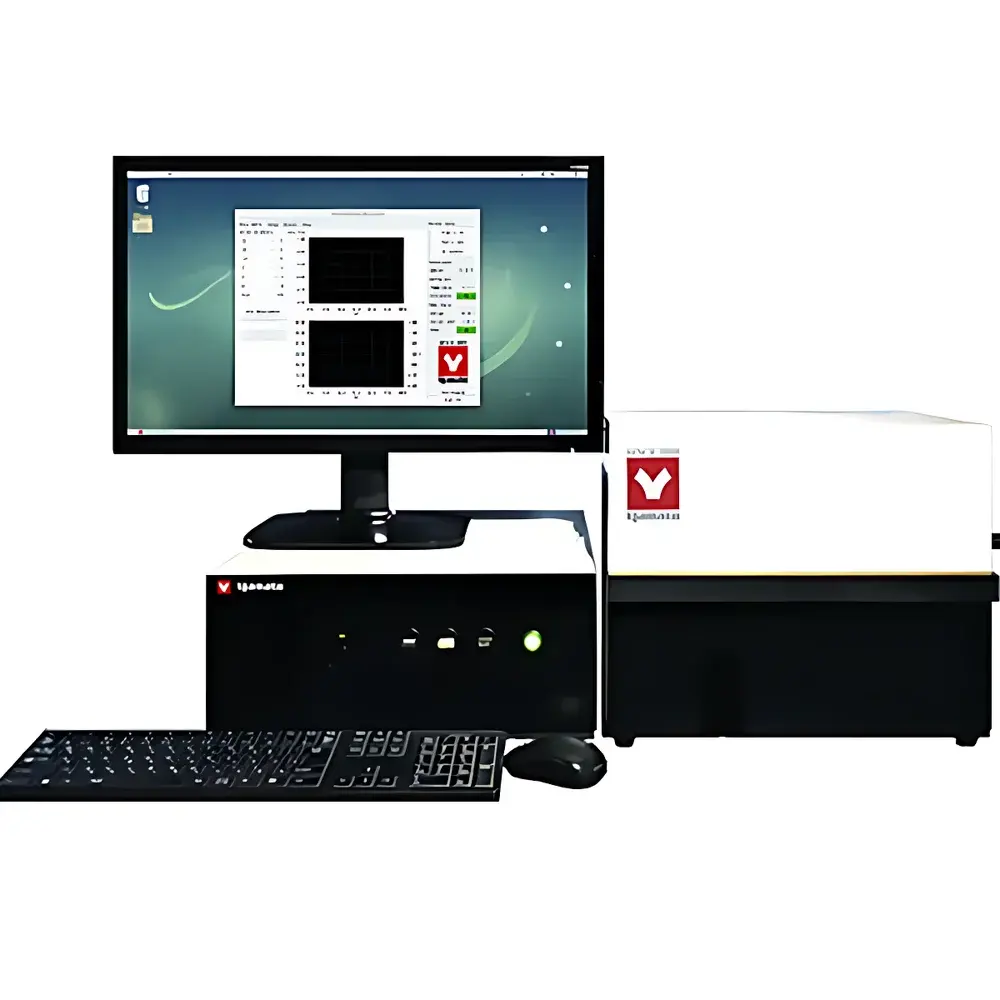
YAMATO TE100 Thermal Resistance Tester for Power Semiconductor Ceramic Substrates
| Brand | YAMATO |
|---|---|
| Origin | Japan |
| Model | TE100 |
| Compliance | ISO 4825-1:2023-01 |
| Sample Size | 30 × 30 mm |
| Load Force | 10 kg |
| Temperature Resolution | ≥0.01 °C |
| Electrical Resistance Measurement Error | ±0.1 mΩ (70–130 Ω) |
| Sampling Rate | up to 100 samples/sec |
| Power Supply | AC 100 V, 50/60 Hz |
| Controller Dimensions | W380 × D470 × H180 mm |
| Measurement Unit Dimensions | W380 × D400 × H320 mm |
| TEG Chip Dimensions | W5 × D5 × H0.35 mm |
| TEG Heat Generation Density | 1 kW/cm² |
| Max Input Power | ~250 W |
| Thermal Ramp Rate | 1.4 × 10⁴ K/sec |
| External Circulator Model | NeoCool CFA302 |
| Circulation Type | External Closed-Loop System |
| Cooling Method | Air-Cooled |
| Temperature Control Range | −10 to +60 °C |
| Circulator Power Supply | AC 100 V, 13.8 A |
| Circulator Dimensions | W380 × D565 × H725 mm |
Overview
The YAMATO TE100 Thermal Resistance Tester is a precision instrument engineered for the quantitative evaluation of thermal resistance (Rth) in ceramic substrates used in high-power semiconductor modules—particularly those based on Al₂O₃, AlN, and Si₃N₄. It operates on the principle of transient thermoreflectance-assisted Joule heating combined with high-speed thermal response capture, enabling direct measurement of thermal impedance under controlled mechanical load and boundary conditions. Designed in strict accordance with ISO 4825-1:2023-01 (“Semiconductor devices — Mechanical and climatic test methods — Part 1: Thermal resistance measurement method for power semiconductor packages”), the TE100 delivers traceable, repeatable data required for qualification of substrate-level thermal performance in automotive traction inverters, industrial motor drives, and renewable energy converters. Its architecture integrates a calibrated thermoelectric generator (TEG) chip as a localized heat source, coupled with microsecond-resolution temperature sensing and synchronized electrical resistance monitoring to decouple interfacial thermal resistance from bulk conduction effects.
Key Features
- ISO 4825-1:2023-01–compliant thermal resistance measurement protocol for ceramic substrates and discrete power module baseplates
- High-fidelity transient thermal response acquisition at up to 100 samples per second, supporting analysis of thermal time constants down to sub-millisecond scales
- Integrated 10 kg pneumatic loading system ensuring consistent interfacial contact pressure across 30 × 30 mm sample area—critical for minimizing contact resistance variability
- Ultra-high-density TEG chip (5 × 5 × 0.35 mm) capable of localized heat generation up to 1 kW/cm², enabling realistic simulation of hotspot conditions in SiC/GaN die attach regions
- Temperature resolution of ≥0.01 °C over full operational range (−10 to +60 °C), achieved via calibrated Pt100 sensors and low-noise signal conditioning
- Dual-channel synchronized acquisition: simultaneous recording of thermal transients and four-wire resistance drift (±0.1 mΩ accuracy within 70–130 Ω range)
- Modular external cooling interface compatible with NeoCool CFA302 closed-loop circulator, permitting stable thermal baseline control under dynamic load cycling
Sample Compatibility & Compliance
The TE100 is optimized for rigid planar ceramic substrates conforming to ISO 4825-1:2023-01 dimensional specifications (30 × 30 mm, thickness ≥0.25 mm). It supports both bare ceramic plates and metallized substrates (e.g., DBC, AMB) with Cu or Ag sintered layers. The system accommodates standard industry packaging formats including single-die test coupons and miniature half-bridge module bases. All measurement procedures are fully documented per ISO/IEC 17025 requirements for calibration traceability, and raw data files include embedded metadata compliant with ASTM E2927-22 (Standard Practice for Reporting Thermal Analysis Data). The instrument’s mechanical and thermal design meets IEC 61000-4-2 (ESD immunity) and IEC 61000-4-3 (radiated RF immunity) for laboratory-grade electromagnetic compatibility.
Software & Data Management
The TE100 is operated via YAMATO’s proprietary ThermalTest Suite v3.2—a Windows-based application supporting real-time waveform visualization, automated Rth calculation (per ISO 4825-1 Annex B), and export of time-stamped CSV/ASCII datasets. Software features include configurable trigger logic, multi-segment ramp profiling, and built-in uncertainty propagation modeling based on GUM (JCGM 100:2019). Audit trails record all parameter changes, operator logins, and calibration events in accordance with FDA 21 CFR Part 11 requirements. Data archives support hierarchical folder structures aligned with GLP documentation workflows, and optional integration with LIMS systems is available via OPC UA interface.
Applications
- Qualification of thermal interface materials (TIMs) between ceramic substrates and heat sinks
- Comparative evaluation of AlN vs. Al₂O₃ vs. Si₃N₄ substrate thermal performance under identical boundary conditions
- Failure analysis of delamination-induced thermal degradation in AMB substrates
- Validation of finite element thermal models used in power module package design
- Process control monitoring for sintering, metallization, and bonding steps in substrate manufacturing
- Supporting JEDEC JESD51-14 (transient dual-interface test) correlation studies
FAQ
Does the TE100 comply with automotive AEC-Q200 thermal stress testing requirements?
Yes—the system’s controlled loading, ISO-aligned thermal excitation profile, and traceable temperature/resistance metrology enable direct implementation of AEC-Q200-007 (thermal resistance verification) when paired with certified reference standards.
Can the TE100 measure thermal resistance of substrates with integrated passive components?
It can evaluate substrates with surface-mounted resistors or thin-film heaters, provided they do not interfere with the designated 5 × 5 mm TEG active zone and maintain planarity within ±5 µm tolerance.
Is the NeoCool CFA302 circulator mandatory for operation?
While the TE100 measurement unit functions independently, the CFA302 is required to achieve the specified −10 to +60 °C temperature control stability and repeatability mandated by ISO 4825-1:2023-01.
What calibration certificates are supplied with the instrument?
Each TE100 ships with NIST-traceable calibration reports for temperature sensors (Pt100), load cell (10 kg), and resistance measurement circuitry, valid for 12 months from date of shipment.
How is thermal contact resistance minimized during measurement?
Through a combination of precision-ground stainless steel platens, programmable 10 kg pre-load stabilization (≥30 sec dwell), and real-time resistance monitoring to confirm ohmic contact integrity prior to thermal transient initiation.