
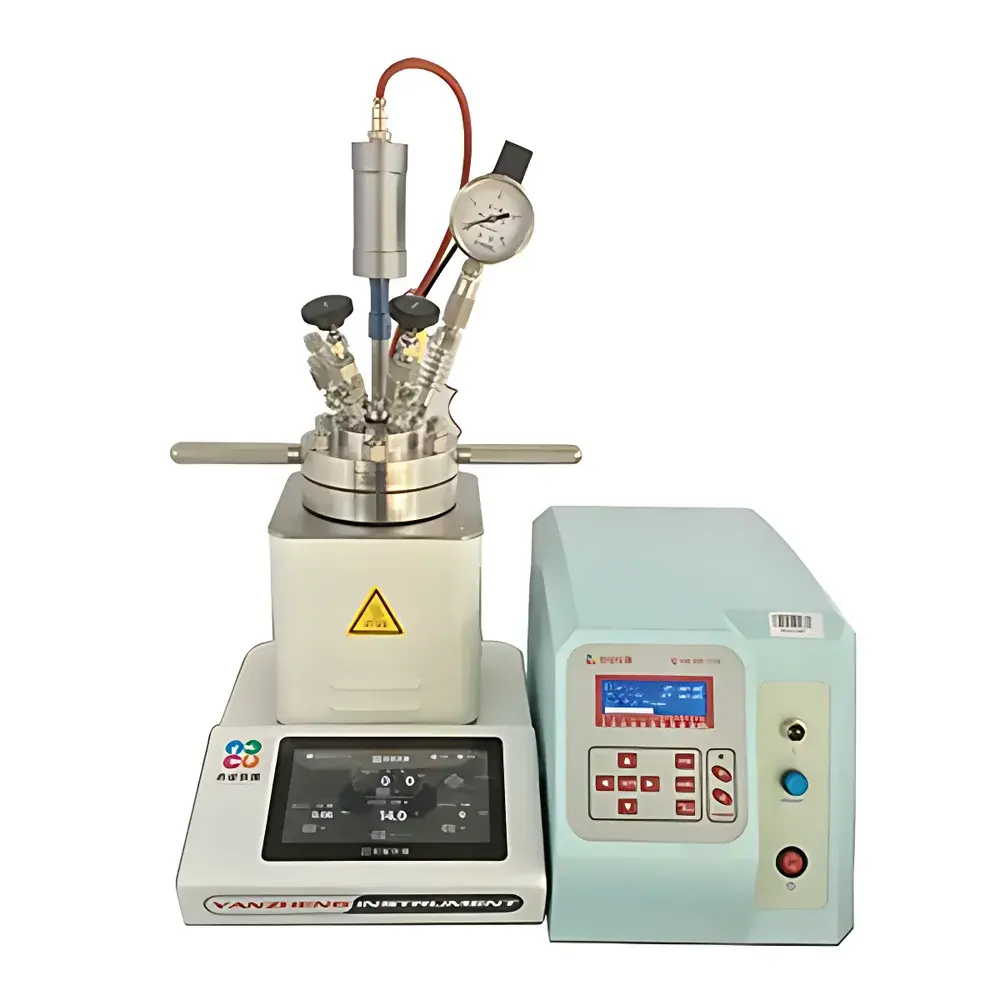
YAN ZHENG INSTRUMENT SCF-100/300 Series Supercritical Fluid Reaction Vessel
| Brand | YAN ZHENG INSTRUMENT |
|---|---|
| Origin | Shanghai, China |
| Manufacturer Type | Direct Manufacturer |
| Country of Origin | China |
| Model | SCF-100/300 Series |
| Vessel Volume | 100–500 mL |
| Construction Material | ASTM A240 316L Stainless Steel (custom options: Hastelloy C-276, Inconel 625, TA2 Titanium, Zirconium) |
| Design Pressure | 150 bar |
| Maximum Operating Pressure | ≤100 bar |
| Burst Pressure | 125 bar |
| Vacuum Capability | –1 MPa (gauge) |
| Design Temperature | 300 °C |
| Operating Temperature Range | 80–250 °C (ultrasonic-assisted mode: 60–70 °C) |
| Temperature Control Accuracy | ±1 °C (under non-extreme exo/endothermic conditions) |
| Heating Method | Electric Cartridge Heating |
| Heating Power | 500–1500 W (volume-dependent) |
| Stirring Mechanism | Magnetic Stirring |
| Stirring Speed | 150–1500 rpm |
| Ultrasonic Module | 450 W output, 20/25 kHz frequency, TA2 titanium alloy probe |
| Sealing | Dual-V-groove Linear Metal-to-Metal Seal with Bolted Flange |
| Control System | YZ-MRCTR Integrated Digital Controller with PID Algorithm |
| Compliance | ASME BPVC Section VIII Div. 1 (design basis), ISO 15148:2021 (supercritical process equipment), EN 13445-3 (unfired pressure vessels) |
Overview
The YAN ZHENG INSTRUMENT SCF-100/300 Series Supercritical Fluid Reaction Vessel is an engineered high-pressure, high-temperature batch reactor designed for conducting chemical synthesis and catalytic transformations under supercritical fluid (SCF) conditions. It operates on the physical principle that above their critical temperature (Tc) and critical pressure (Pc), substances such as CO2, H2O, propane, butane, or ethanol exhibit hybrid properties—density comparable to liquids, diffusivity and viscosity approaching those of gases—which collectively enhance mass transfer, solvation power, and phase miscibility. This enables precise modulation of reaction kinetics, selectivity, and equilibrium conversion—particularly in oxidation, hydrogenation, esterification, polymerization, and depolymerization processes. The vessel’s monolithic 316L stainless steel construction, dual-V-groove metal seal, and bolted flange interface ensure structural integrity across repeated thermal cycling and pressure ramping up to 100 bar at temperatures up to 250 °C.
Key Features
- Robust pressure containment architecture compliant with ASME BPVC Section VIII Div. 1 design principles, validated by finite element analysis (FEA) for fatigue life and stress distribution under cyclic loading.
- Integrated ultrasonic transduction system (450 W, 20/25 kHz) with TA2 titanium alloy probe—enabling cavitation-induced micromixing, localized heating, and enhanced interfacial mass transfer in heterogeneous SCF reactions.
- Precision digital control via YZ-MRCTR platform featuring real-time PID-regulated temperature profiling, pressure ramp/hold programming, and synchronized logging of T/P/stirring/ultrasound parameters.
- Volumetric scalability across 100 mL, 250 mL, and 500 mL configurations—each calibrated to identical thermal response time, pressure decay rate (<0.1 bar/h at 80 bar), and seal performance metrics.
- Electrical cartridge heating with distributed thermal zoning ensures axial temperature uniformity ±2 °C across the reaction zone; combined with magnetic stirring (150–1500 rpm), it mitigates thermal stratification and promotes homogeneous reaction environments.
- Optional material upgrades—including Hastelloy C-276 for halogenated SCF systems, zirconium for fluoride-containing media, and TA2 titanium for high-purity pharmaceutical intermediates—support GMP-aligned process validation.
Sample Compatibility & Compliance
The SCF-100/300 accommodates solid catalysts (e.g., Pd/C, Ru/Al2O3), liquid reagents, gaseous co-reactants (H2, O2, NH3), and powdered substrates without internal obstructions. Its cleanable internal geometry (Ra ≤ 0.4 µm electropolished finish) and absence of dead volumes meet USP <661.1> extractables/leachables requirements for early-phase API synthesis. All standard configurations comply with ISO 15148:2021 guidelines for supercritical process equipment safety and operational traceability. When configured with audit-trail-enabled firmware and electronic signature capability, the system supports FDA 21 CFR Part 11 compliance for regulated laboratory environments.
Software & Data Management
YZ-MRCTR firmware provides native CSV export of time-stamped sensor data (temperature, pressure, stir speed, ultrasonic amplitude) at user-defined intervals (100 ms–5 s resolution). Historical runs are indexed by batch ID, operator login, and environmental metadata (ambient T/P, calibration certificate IDs). Optional Ethernet/Wi-Fi connectivity enables integration into LIMS platforms via Modbus TCP or OPC UA protocols. Raw data files include embedded cryptographic hash signatures to ensure ALCOA+ principles (Attributable, Legible, Contemporaneous, Original, Accurate, Complete, Consistent, Enduring, Available) for GLP/GMP audits.
Applications
- Catalytic hydrogenation of unsaturated fatty acids in scCO2, eliminating solvent residues in nutraceutical synthesis.
- Supercritical water gasification (SCWG) of lignocellulosic biomass for hydrogen-rich syngas generation.
- Enzymatic transesterification of triglycerides under subcritical water conditions for biodiesel production.
- Continuous-flow precursor infusion into scCO2 followed by rapid depressurization (RESS) for nanoparticle formulation.
- Kinetic studies of Diels–Alder cycloadditions in tunable-density scC2H6, correlating solvent compressibility with activation volume.
- Extraction-coupled reaction (ECR) workflows where natural product isolation and derivatization occur in a single vessel.
FAQ
What pressure and temperature ranges are certified for continuous operation?
Continuous operation is certified for 80–250 °C and ≤100 bar; short-term excursions to 270 °C are permitted for ≤30 min per cycle, provided pressure remains ≤90 bar.
Can the vessel be used under vacuum prior to pressurization?
Yes—the integrated –1 MPa (gauge) vacuum capability enables degassing and inert purging; negative-pressure operation requires optional vacuum-rated pressure transducer and dedicated vacuum gauge.
Is third-party calibration documentation available?
Each unit ships with NIST-traceable calibration certificates for temperature (PT100 Class A), pressure (0.25% FS accuracy), and ultrasonic power (calorimetric method), valid for 12 months.
How is cleaning validated between batches?
The smooth, crevice-free internal surface supports automated CIP cycles using scCO2/ethanol mixtures; residue limits are verified by FTIR-ATR surface scanning per ICH Q5C.
Does the system support automated pressure ramping profiles?
Yes—up to 10 programmable pressure segments (ramp/hold/decay) can be scheduled independently of temperature profiles, with ramp rates configurable from 0.1 to 5 bar/min.



