
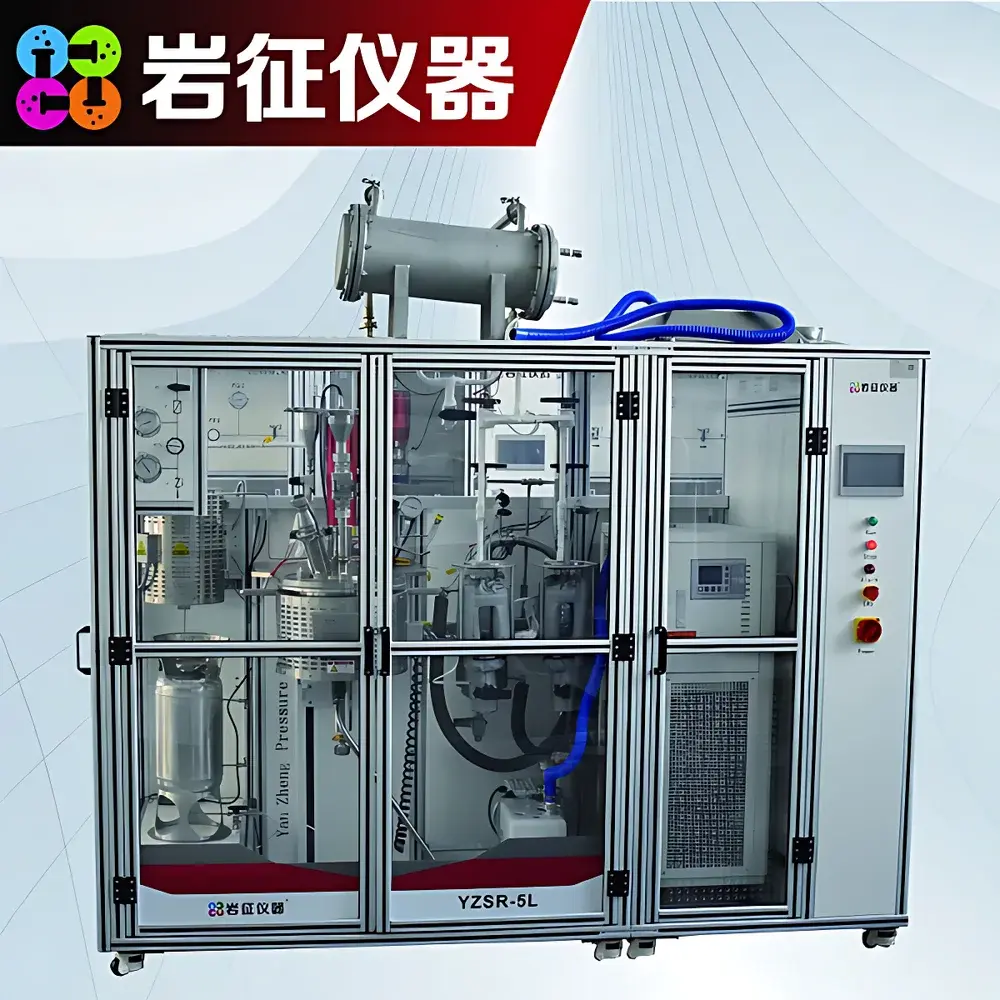
YAN ZHENG YZ82510 Heavy Oil Hydroprocessing Pilot System
| Brand | YAN ZHENG INSTRUMENT |
|---|---|
| Origin | Shanghai, China |
| Manufacturer Type | OEM Manufacturer |
| Country of Origin | China |
| Model | YZ82510 |
| Quotation | Upon Request |
| Reactor Volume | 500 mL |
| Feed Volume | 150–350 mL |
| Operating Pressure | 20 MPa |
| Operating Temperature | 500 °C (±1 °C) |
| H₂ Flow Range | 0–3000 mL/min & 0–1000 mL/min |
| Construction Material | ASTM A240 316L stainless steel |
| Control System | Siemens PLC-based hardware + custom SCADA monitoring software |
| Safety Systems | Multi-level interlocked over-temperature, over-pressure, and emergency power cutoff protection |
Overview
The YAN ZHENG YZ82510 Heavy Oil Hydroprocessing Pilot System is a fully integrated, bench-scale catalytic hydroprocessing test platform engineered for rigorous evaluation of heavy oil upgrading reactions under high-pressure, high-temperature conditions. Designed in accordance with ASME BPVC Section VIII Div. 1, ISO 13702, and relevant API RP 14C safety guidelines, the system implements continuous-flow fixed-bed or slurry-phase reaction configurations—depending on catalyst loading and feed introduction methodology—with precise control over hydrogen partial pressure, residence time, temperature gradient, and thermal management. Its core operational principle relies on catalytic hydrogenation, hydrodesulfurization (HDS), hydrodenitrogenation (HDN), and hydrocracking mechanisms occurring within a 500 mL 316L stainless steel autoclave rated to 20 MPa and 500 °C. The reactor integrates axial heating modules with dual-zone thermal profiling, internal thermocouple arrays, and jacketed cooling coils connected to an external low-temperature circulator—enabling simultaneous exothermic heat removal and isothermal zone stabilization during endothermic cracking events.
Key Features
- ASME-certified 316L stainless steel reactor vessel (500 mL working volume) with full traceability documentation and hydrostatic test certification at 1.5× design pressure
- Dual independent high-pressure H₂ mass flow control channels: Brooks 5850E series MFCs (0–3000 mL/min and 0–1000 mL/min ranges), each rated to 20 MPa and equipped with NIST-traceable calibration certificates
- Integrated gas handling subsystem featuring Swagelok ultra-high-purity tubing and fittings, Tescom ER5000 series pressure regulators, Badger pneumatic control valves, and SMC I/P transducers for analog-to-pneumatic signal conversion
- Multi-tiered safety architecture including real-time pressure/temperature deviation detection, audible-visual alarm activation, automatic furnace power cutoff upon Thigh-high exceedance, and rupture disk–protected emergency venting routed through dedicated high-pressure flare line
- Modular process train comprising gas conditioning, reaction, condensation/separation, tail-gas quantification, and safety interlock units—all mounted on a rigid structural skid with seismic-rated anchoring points
- Siemens S7-1200 PLC-based control system with redundant Ethernet communication, OPC UA server interface, and audit-trail-enabled SCADA software compliant with ALCOA+ data integrity principles
Sample Compatibility & Compliance
The YZ82510 accommodates viscous, asphaltene-rich feedstocks including vacuum residue (VR), deasphalted oil (DAO), bitumen, and heavy synthetic crudes. Feed introduction supports both batch pre-charge (150–350 mL) and continuous co-injection modes via bottom-entry dip tube. All wetted surfaces meet ASTM A240 316L chemical resistance specifications for sulfidic and naphthenic acid environments. The system conforms to ISO/IEC 17025 requirements for testing laboratory competence and supports GLP-compliant operation per OECD Series 110–129 test guidelines. Pressure relief devices are certified to PED 2014/68/EU Annex I essential safety requirements; electrical components comply with IEC 60079-0 for non-explosive area classification.
Software & Data Management
The embedded control interface provides real-time visualization of >60 process variables—including reactor wall temperature profiles, differential pressure across catalyst bed (if configured), H₂ consumption rate, cumulative tail-gas volume (via长春阿尔法 W-NM series wet-test meter with RS485 Modbus RTU output), and safety loop status. All data are timestamped, stored locally on industrial-grade SSD with 12-month retention, and exportable in CSV/Excel format. Audit trails record user logins, setpoint modifications, alarm acknowledgments, and emergency shutdown triggers—fully aligned with FDA 21 CFR Part 11 electronic records and signatures requirements. Optional integration with LIMS platforms is supported via standardized API endpoints.
Applications
- Screening and kinetic modeling of NiMo/Al₂O₃, CoMo/Al₂O₃, and noble metal catalysts under industrially representative conditions
- Investigation of coke deposition rates, catalyst deactivation mechanisms, and sulfur/nitrogen removal efficiency as functions of H₂ partial pressure and LHSV
- Thermal stability assessment of heavy feedstocks under hydrogen-rich atmospheres to quantify gas make, distillate yield, and Conradson carbon residue (CCR) reduction
- Process validation for downstream integration with hydrotreating/hydrocracking unit design studies
- Regulatory submission support for EPA Tier 2 fuel specification compliance and IMO 2020 sulfur cap impact analysis
FAQ
What is the maximum allowable operating temperature and pressure for long-term continuous operation?
The reactor is rated for continuous service at 500 °C and 20 MPa, validated by fatigue life calculations per ASME Section VIII Div. 2, Part 5, and confirmed via 100-hour creep rupture testing at design conditions.
Can the system be configured for trickle-bed versus slurry-phase operation?
Yes—by modifying the internal reactor internals (e.g., installing structured packing or static mixers) and adjusting feed injection strategy, the unit supports both configurations without hardware replacement.
Is third-party calibration documentation provided for all flowmeters and pressure transducers?
All Brooks MFCs, Siemens pressure sensors, and长春阿尔法 wet-test meters ship with factory calibration certificates traceable to NIST or BIPM standards, including uncertainty budgets and recalibration intervals.
Does the control system support remote access for off-site monitoring?
Remote desktop access is enabled via encrypted TLS tunnel; however, direct internet exposure is prohibited per IEC 62443-3-3 security recommendations—access requires authenticated VPN connection to customer’s corporate network.
What maintenance intervals are recommended for critical components such as the rupture disk and safety valves?
Rupture disks must be replaced after each activation or annually—whichever occurs first; spring-loaded safety valves require functional testing every 6 months and full recalibration annually per ISO 4126-1.
Related Products



