
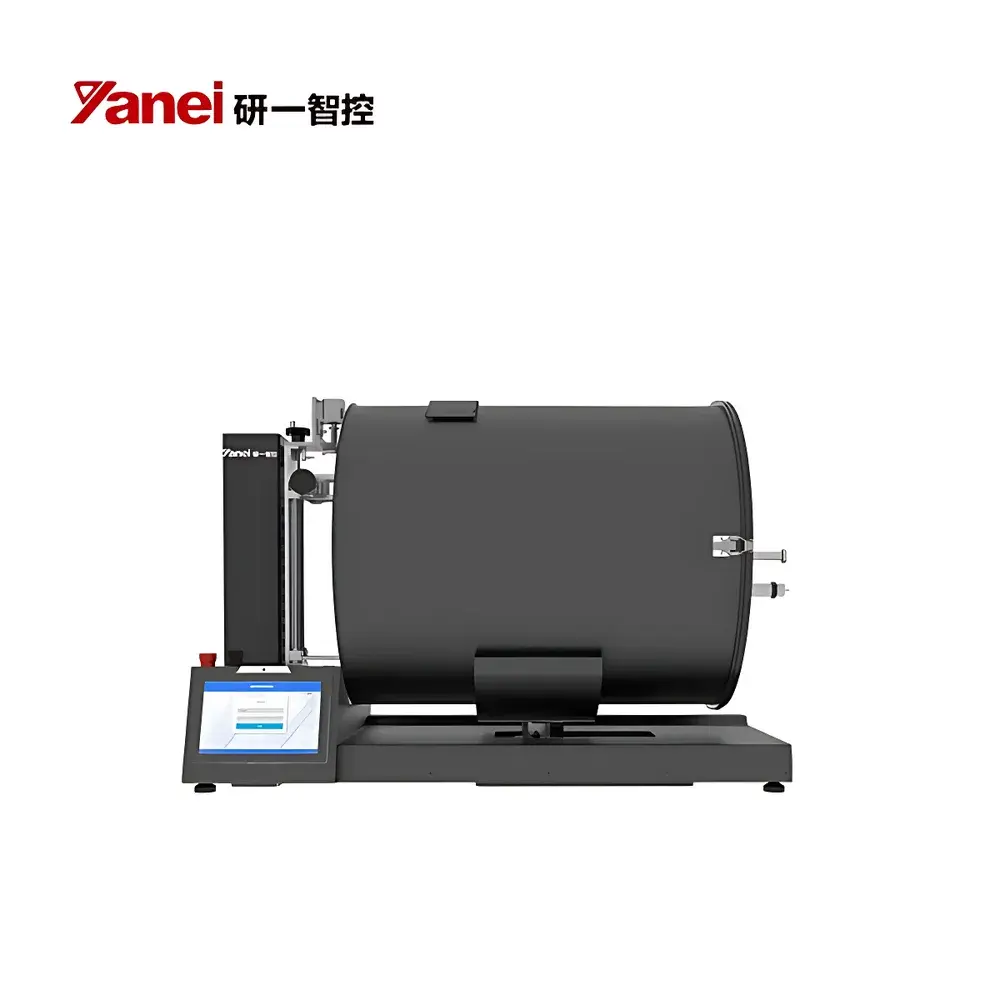
Yanei DG07-D Enclosed Space Ignitability Tester for Aerosol Products
| Brand | Yanei |
|---|---|
| Origin | Zhejiang, China |
| Manufacturer Type | Direct Manufacturer |
| Country of Origin | China |
| Model | DG07-D |
| Pricing | Upon Request |
| Operating Environment | −5°C to 45°C, <95% RH |
| Cylindrical Chamber Rotation Angle | 0–90° |
| Chamber Volume | 200 dm³ (Ø600 mm × L720 mm) |
| Nozzle-to-Chamber Distance | Adjustable 20–35 mm |
| Ignition Source | Adjustable-height candle flame |
| Compatible Can Height | 100–400 mm |
| Compatible Can Diameter | 20–80 mm |
| Detection Methods | Near-infrared (NIR) + Pressure Sensing |
| Pressure Range | 0–400 kPa, Accuracy: ±0.5% F.S. |
| Spectral Response | UV 185–260 nm, NIR 760–1100 nm |
| Spectral Sampling Rate | 5000 Hz |
| Timing Resolution | ±0.01 s |
| Instrument Dimensions (L×W×H) | 1200 × 660 × 780 mm |
Overview
The Yanei DG07-D Enclosed Space Ignitability Tester is an engineered safety assessment instrument designed to evaluate the ignition propensity of pressurized aerosol products under confined conditions. It operates on the principle of controlled ignition testing in a standardized 200 dm³ cylindrical chamber, simulating real-world scenarios where aerosol discharge occurs in poorly ventilated or enclosed environments—such as vehicle interiors, storage cabinets, or industrial enclosures. The system quantifies flammability risk by monitoring transient pressure rise, near-infrared flame emission signatures (760–1100 nm), and ultraviolet radical generation (185–260 nm) during and immediately after actuation. Its measurement architecture aligns with internationally recognized hazard classification frameworks, enabling regulatory-compliant determination of UN GHS Category 1–3 flammability classifications for aerosols.
Key Features
- Triple-modal detection system integrating calibrated pressure transduction (0–400 kPa, ±0.5% F.S.), high-speed NIR photometry (5000 Hz sampling), and UV spectral band monitoring for robust combustion event discrimination.
- Motorized 0–90° rotational chamber enables ergonomic candle placement pre-test and rapid post-test residue clearance—critical for minimizing cross-contamination between sequential trials.
- Adjustable nozzle-to-chamber distance (20–35 mm) accommodates diverse can geometries while maintaining consistent spray dispersion geometry relative to the ignition source.
- Redundant safety controls: hardware-based emergency stop button (direct power cutoff), programmable auto-ventilation cycle post-test, and fail-safe interlocks preventing operation outside environmental limits (−5°C to 45°C, <95% RH).
- Embedded industrial PC with 10.1″ capacitive touchscreen runs deterministic real-time test orchestration firmware—executing synchronized can actuation, flame initiation, multi-sensor acquisition, and pass/fail logic per ASTM/UN criteria.
- Tri-mode operational control: local touchscreen interface, IR remote activation, and IEEE 802.11n wireless network command—enabling operator standoff during hazardous phase transitions.
Sample Compatibility & Compliance
The DG07-D supports aerosol containers ranging from 100 mm to 400 mm in height and 20 mm to 80 mm in diameter, covering standard consumer, industrial, and agrochemical formulations—including propellant-based disinfectants, lubricants, insecticides (per NY/T 1860 Part 27), and specialty coatings. It is validated against multiple harmonized regulatory protocols: UN Manual of Tests and Criteria, Section 31.5 (Enclosed Space Ignition Test); GB/T 21631–2008; GAT 536 for fire hazard grading; and equivalent ISO/IEC 17025-accredited national standards. All test sequences generate timestamped, audit-ready data packages compliant with GLP documentation requirements—including raw sensor waveforms, annotated event markers, and final classification outputs traceable to reference standards.
Software & Data Management
Built-in test management software provides ISO/IEC 17025-aligned data integrity features: role-based user authentication, electronic signature capture, immutable audit trails, and 21 CFR Part 11–compatible electronic records (with optional digital certificate integration). Raw pressure traces and spectral time-series are stored in vendor-neutral HDF5 format, supporting third-party analysis in MATLAB, Python (NumPy/Pandas), or LabVIEW. Wireless networking enables centralized fleet monitoring—up to 16 units per subnet—with automated synchronization of calibration logs, test history, and firmware revision metadata to a secure on-premise or cloud-hosted SQL database.
Applications
- Regulatory submission testing for UN transport classification (Class 2.1 Flammable Gas / Class 2.2 Non-flammable Gas differentiation)
- Formulation development screening for propellant–solvent–active ingredient systems
- Quality control release testing of production batches per GMP Annex 19 (Pharmaceutical Aerosols)
- Fire safety engineering assessments for enclosed-space usage instructions and labeling compliance
- Technical due diligence in chemical supply chain audits (e.g., REACH SVHC screening support)
FAQ
What standards does the DG07-D directly implement?
It executes UN Manual of Tests and Criteria Section 31.5, GB/T 21631–2008, GAT 536, and NY/T 1860 Part 27 with full procedural fidelity—including chamber conditioning, actuation timing, and pass/fail thresholds.
Can the instrument distinguish between flash fire and sustained flame propagation?
Yes—via synchronized pressure ramp rate analysis (>20 kPa/s indicates deflagration) and NIR intensity duration (>1.2 s above 50% peak confirms self-sustaining combustion).
Is calibration traceable to national metrology institutes?
Pressure sensors are factory-calibrated against NIM (China National Institute of Metrology)–certified deadweight testers; optical channels are verified using NIST-traceable UV-NIR reference lamps.
Does the system support automated report generation for regulatory submissions?
Yes—generates PDF/HTML reports containing test parameters, raw data plots, compliance statements, and digital signatures per ISO/IEC 17025 Clause 7.8.2.
What maintenance intervals are recommended for long-term accuracy?
Chamber interior cleaning after every 50 tests; candle holder alignment verification quarterly; full sensor recalibration annually or after impact events.





