
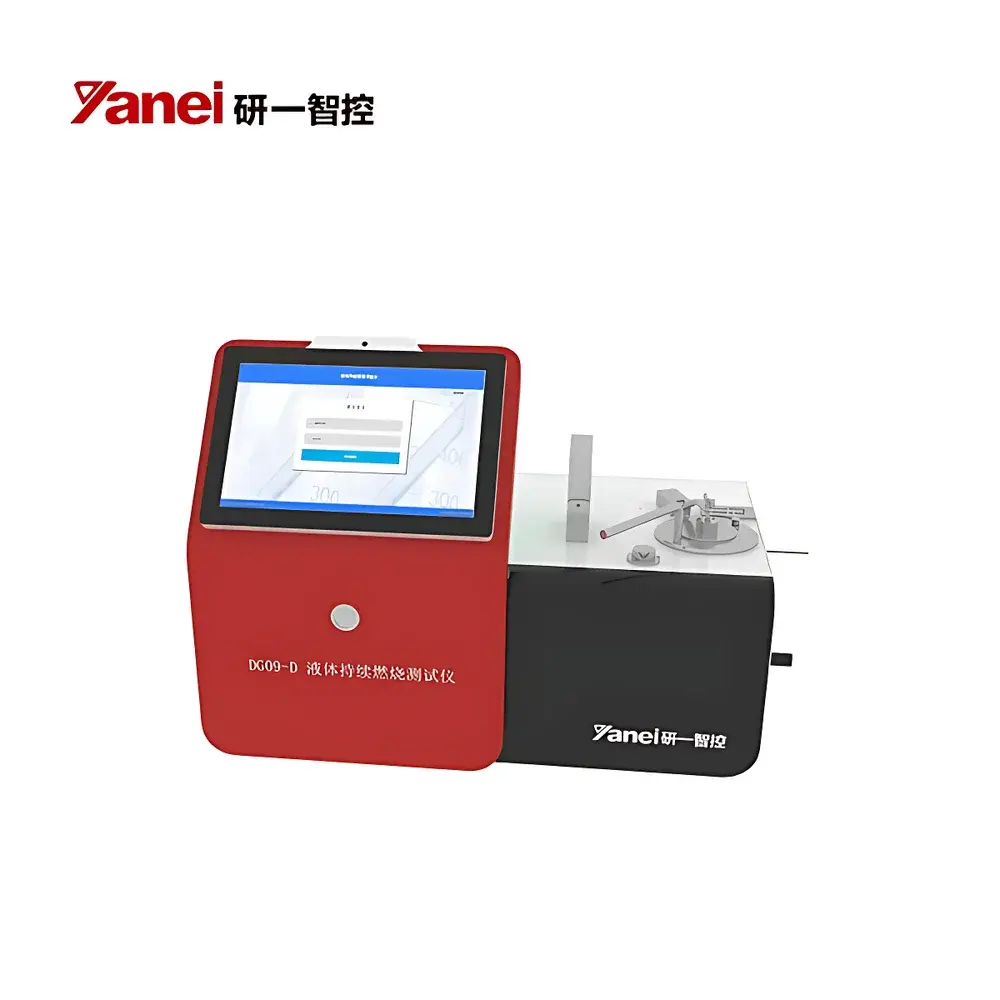
Yanei DG09-D Continuous Combustion Tester for Flammable Liquids
| Brand | Yanei |
|---|---|
| Origin | Zhejiang, China |
| Manufacturer Type | Direct Manufacturer |
| Origin Category | Domestic (China) |
| Model | DG09-D |
| Pricing | Available Upon Request |
| Operating Environment | −5°C to 45°C, <95% RH |
| Atmospheric Pressure Range | 0–110 kPa (±0.25% FS) |
| Temperature Control Range | Ambient +5°C to 100°C (±0.5°C accuracy) |
| Standard Test Temperatures | 60.5°C and 75°C |
| Sample Volume | 1–5 mL (≤0.03 mL dispensing accuracy) |
| Timing Range | 0–999 s (±0.01 s accuracy) |
| Flame Detection Method | Near-Infrared (NIR) Array Spectroscopy |
| Ignition Method | Electronic Spark Ignition |
| Ignition Source Positioning | Motorized Rotational Alignment |
| Dimensions (L×W×H) | 570 mm × 350 mm × 350 mm |
| Sample Holder Options | Stainless Steel or Anodized Aluminum Crucibles |
| Integrated Control System | Embedded Industrial PC with 10.1″ Capacitive Touchscreen |
| Connectivity | Wi-Fi-enabled for multi-unit remote operation and centralized data management |
Overview
The Yanei DG09-D Continuous Combustion Tester is a purpose-built instrument engineered for the precise determination of whether a liquid substance sustains combustion under standardized thermal and ignition conditions. It operates on the fundamental principle of controlled thermal exposure followed by calibrated flame initiation, with real-time monitoring of flame persistence duration — a critical parameter in flammability classification per global transport and regulatory frameworks. Designed specifically for laboratories engaged in hazardous materials characterization, this tester implements a rigorously defined test sequence aligned with UN Manual of Tests and Criteria, Part III, Section 32.5.2 (Test L.2), GB/T 21622–2008, GA/T 536, and GB 5085.4. Its architecture integrates environmental compensation, automated ignition sequencing, and NIR-based flame validation to ensure metrological traceability and inter-laboratory reproducibility.
Key Features
- Real-time atmospheric pressure measurement (0–110 kPa, ±0.25% FS) with automatic temperature correction — ensuring test validity across varying altitudes and barometric conditions.
- Dual-material sample crucibles (stainless steel and anodized aluminum) optimized for thermal stability and chemical resistance during repeated high-temperature exposure.
- Motor-driven rotational alignment system for precise, repeatable positioning of the electronic ignition source relative to the sample surface.
- Near-infrared array spectroscopy for non-contact, high-temporal-resolution flame detection — minimizing interference from ambient light and enabling accurate burn-duration quantification.
- Integrated fire suppression mechanism: upon detection of sustained combustion beyond the pass/fail threshold, a motor-actuated fire shield descends to isolate the sample from ambient oxygen, terminating combustion safely and without manual intervention.
- Programmable temperature setpoints (ambient +5°C to 100°C, ±0.5°C control accuracy), supporting both standard-compliant tests (60.5°C and 75°C) and method development protocols.
- Embedded industrial-grade PC platform with 10.1″ capacitive touchscreen interface, running deterministic real-time control firmware and preloaded compliant test templates.
Sample Compatibility & Compliance
The DG09-D accommodates liquid samples in volumes ranging from 1.0 to 5.0 mL, with volumetric delivery accuracy ≤0.03 mL — sufficient for representative testing of low-viscosity hydrocarbons, solvents, coatings, and waste streams. All hardware interfaces comply with IEC 61000-6-2/6-4 for electromagnetic compatibility and meet IP20 enclosure rating for laboratory indoor use. The instrument supports full audit trail generation, user access control, and electronic signature capability — facilitating adherence to GLP (Good Laboratory Practice) and internal quality system requirements. While not certified to UL/IEC 61010-1 as a standalone safety device, its operational logic conforms to the risk mitigation hierarchy specified in ISO/IEC 17025:2017 Clause 7.1.3 for test method validation.
Software & Data Management
The embedded operating environment delivers a validated, single-purpose application interface with role-based login (administrator, operator, reviewer). Each test run generates a timestamped, immutable record containing environmental parameters (pressure, ambient temperature, humidity), thermal profile, ignition event log, NIR flame signal waveform, measured burn duration, and final classification outcome (pass/fail per selected standard). Data export is supported in CSV and PDF formats, with optional XML schema compliance for LIMS integration. Wireless networking enables centralized deployment: up to 16 units may be managed remotely via secure TLS-encrypted Wi-Fi connection, with synchronized database logging to a designated network share or cloud-hosted repository. All software updates are digitally signed and version-controlled in accordance with FDA 21 CFR Part 11 Annex A guidance for electronic records.
Applications
This instrument serves core functions in regulatory testing laboratories, chemical manufacturing QA/QC departments, and hazardous waste characterization facilities. Typical use cases include: classification of industrial solvents against UN Class 3 criteria; verification of flash point correlation for borderline flammable liquids; screening of recycled or recovered solvent streams prior to reuse; validation of fire-retardant additive efficacy in formulation development; and support for SDS authoring under GHS Annex 7 requirements. Its programmable thermal ramping and flexible timing resolution also enable comparative research into ignition delay kinetics and flame quenching thresholds under controlled oxidative environments.
FAQ
Does the DG09-D require external calibration services?
No — all critical sensors (pressure transducer, PT100 temperature probe, timer circuit, NIR detector) are factory-calibrated with NIST-traceable references. Users perform routine performance verification using certified reference liquids per GB/T 21622–2008 Annex B.
Can test methods be modified beyond the listed standards?
Yes — the instrument’s firmware supports user-defined protocols including custom temperature ramps, variable hold times, and alternative flame-detection thresholds, subject to internal validation documentation.
Is the NIR detection system susceptible to interference from ambient lighting?
No — the detector employs narrow-band spectral filtering centered at 1.45 µm, where hydrocarbon flame emission peaks and ambient visible/NIR background radiation exhibit minimal overlap.
What maintenance intervals are recommended?
Crucible cleaning after each test; optical window inspection every 50 runs; annual verification of ignition energy output and pressure sensor linearity using manufacturer-provided check tools.
How is data integrity ensured during power interruption?
The embedded controller features non-volatile memory with atomic write operations — all active test data is committed to flash storage before each critical state transition, preventing partial-record corruption.






