
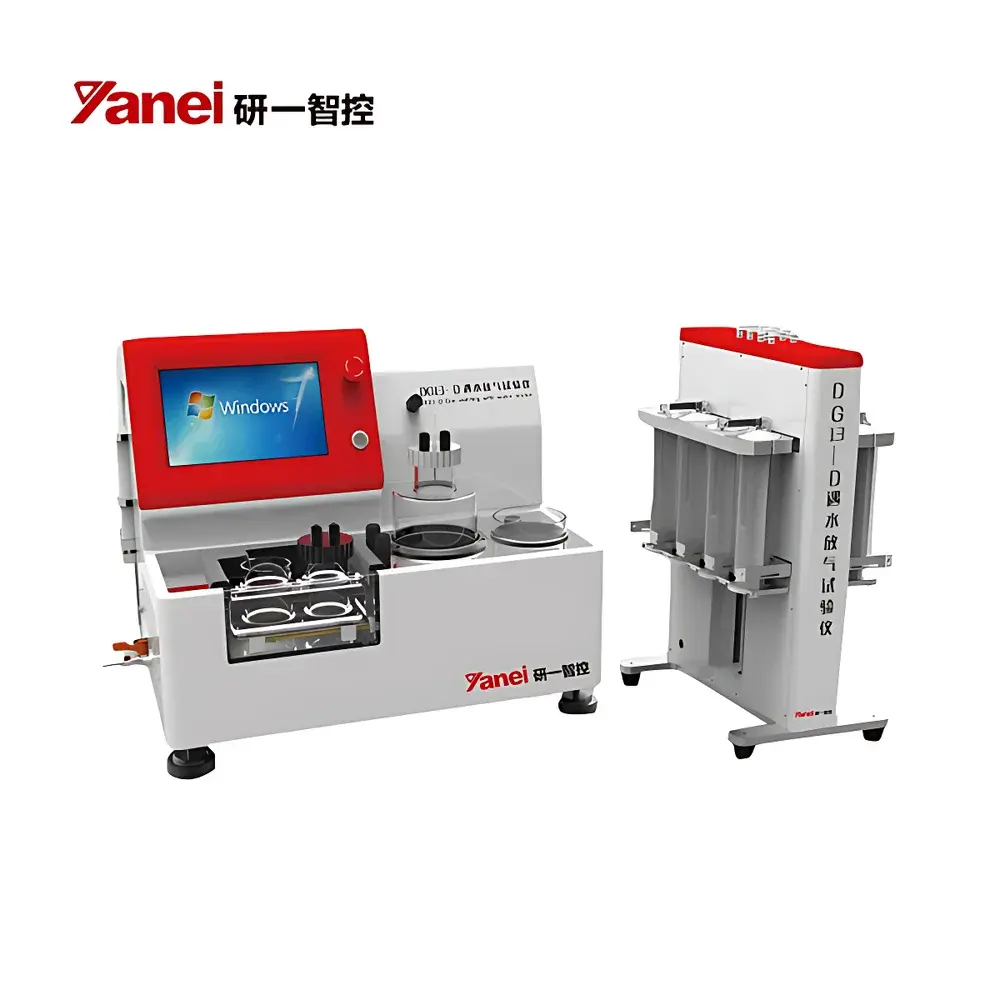
Yanei DG13-D Water-Reactivity Gas Evolution Tester for Hazardous Chemical Classification
| Brand | Yanei |
|---|---|
| Origin | Zhejiang, China |
| Manufacturer Type | Manufacturer |
| Country of Origin | Domestic (China) |
| Model | DG13-D |
| Pricing | Upon Request |
| Operating Environment | −5°C to 45°C, <95% RH |
| Gas Volume Measurement Accuracy | ±1.5 mL, Resolution: 0.01 mL |
| Gas Evolution Rate Range | 0–36 L/min |
| Gas Collection Capacity | 0–1.5 L |
| Water Injection Volume | 0–100 mL, Accuracy: ≤±1 mL |
| Pressure Measurement Range | 0–120 kPa, Accuracy: ±0.05% F.S. |
| Mass Measurement Range | 0–3100 g, Accuracy: ±0.01 g |
| Timing Range | 0–200 h, Accuracy: ±0.01 s |
| Reaction Vessel Temperature Control | 20 ± 0.5 °C |
| Dimensions (L×W×H) | Main Unit: 620 × 520 × 485 mm |
| Gas Collection Module | 320 × 210 × 480 mm |
Overview
The Yanei DG13-D Water-Reactivity Gas Evolution Tester is an engineered solution for the standardized assessment of hazardous substances that may evolve flammable gases upon contact with water—a critical parameter in UN transport classification (UN Test N.5), GHS hazard communication, and regulatory compliance under national frameworks including GB/T 21619-2008, GB 5085.5, and NY/T 1860 Part 29. The instrument operates on a dual-principle methodology: dynamic pressure equilibrium combined with high-precision mass-based gas volume quantification. Rather than relying solely on volumetric displacement or pressure transduction—both susceptible to temperature drift and condensation artifacts—the DG13-D measures the mass of displaced water in a calibrated collection system, then applies the ideal gas law (Clapeyron equation) to convert real-time volume, temperature, and pressure data into standardized conditions (0 °C, 101.325 kPa). This thermodynamically grounded approach ensures metrological traceability and reproducibility across laboratories, aligning with ISO/IEC 17025 requirements for test method validation.
Key Features
- Integrated pressure-balanced gas collection system maintaining continuous atmospheric equivalence during reaction, eliminating backpressure-induced kinetic suppression or premature termination
- High-resolution mass measurement (±0.01 g) of displaced water coupled with real-time P–T monitoring (±0.05% F.S. pressure, ±0.5 °C thermal stability) for rigorous STP correction
- Automated syringe-driven water dosing mechanism with ≤±1 mL volumetric accuracy and programmable injection profiles (single-step, multi-stage, or time-triggered)
- Dual-module architecture: isolated reaction chamber (20 ± 0.5 °C thermostatically controlled) and modular gas collection unit with disposable PTFE-lined collection bags
- Embedded industrial PC with 10.1-inch capacitive touchscreen running deterministic real-time control firmware; supports audit-trail-enabled operation per GLP/GMP principles
- Red emergency stop button with hardware-level power cutoff, independent of software state, meeting IEC 61508 SIL-2 functional safety requirements
- Wireless mesh networking capability enabling centralized remote operation, synchronized multi-instrument testing, and secure TLS-encrypted data upload to LIMS or cloud repositories
Sample Compatibility & Compliance
The DG13-D accommodates solid, powdered, granular, and paste-like samples up to 3100 g total mass, with reaction vessels designed for containment of exothermic or corrosive reactions. All wetted components—including gas transfer lines, seals, and collection interfaces—are constructed from virgin PTFE (ASTM D4894-compliant), ensuring chemical inertness toward strong acids, alkalis, oxidizers, and organometallic compounds. The system fulfills mandatory test protocols defined in the UN Manual of Tests and Criteria (Rev. 7, Section 33.5.4, Test N.5), as well as harmonized Chinese standards GB/T 21619-2008, NY/T 1860.29, and GAT 536. It further supports method adaptation for supplementary assessments including immersion, drip, and static water exposure tests—enabling comprehensive reactivity profiling within a single platform. Data records comply with FDA 21 CFR Part 11 requirements via electronic signatures, immutable audit logs, and user-access-controlled role permissions.
Software & Data Management
Pre-installed Yanei ReactSoft v3.2 provides full lifecycle test management: method configuration (water volume, temperature setpoint, duration, pass/fail thresholds), live visualization of gas evolution rate (mL/min), cumulative volume (mL), mass change (g), and ambient P–T traces. All raw sensor outputs are timestamped at 100 Hz and stored in encrypted SQLite databases with SHA-256 checksum integrity verification. Export options include CSV (for statistical analysis in JMP or Minitab), PDF test reports with embedded digital signatures, and XML files compliant with ASTM E2084 for inter-laboratory data exchange. Remote access is enabled via HTTPS-based web interface supporting concurrent user sessions, automated backup scheduling, and integration with enterprise Active Directory authentication.
Applications
- UN transport classification (Packing Group I/II/III assignment) for metals (e.g., sodium, calcium carbide), metal hydrides, alkyl aluminum compounds, and phosphides
- Regulatory submission support for REACH registration dossiers, EPA TSCA pre-manufacture notices, and MHRA/EMA chemical safety assessments
- Quality control of desiccants, moisture-scavenging packaging materials, and reactive intermediates in fine chemical synthesis
- Reaction hazard evaluation during process safety reviews (CCPS guidelines) and HAZOP studies for batch reactor water ingress scenarios
- Research into hydrolysis kinetics of novel energetic materials, battery electrolyte decomposition products, and nanomaterial surface reactivity
FAQ
What regulatory test standards does the DG13-D directly support?
It is validated for UN Test N.5, GB/T 21619-2008, NY/T 1860.29, GAT 536, and GB 5085.5—with built-in calculation modules applying the exact pass/fail criteria specified in each standard.
Can the instrument distinguish between hydrogen, acetylene, and other flammable gases?
No—it quantifies total evolved gas volume and rate only. Gas identification requires coupling with optional GC-TCD or FTIR modules, which can be integrated via standardized analog/digital I/O ports.
Is calibration traceable to national metrology institutes?
Yes. Mass sensors are factory-calibrated against NIM-certified weights; pressure transducers are certified to JJG 860; temperature controllers are verified using PT100 reference probes accredited to CNAS-CL01.
How is data integrity maintained during extended tests (e.g., 200-hour protocols)?
The embedded controller uses wear-leveling flash memory with cyclic redundancy checks (CRC32) on every write operation, plus automatic journaling to prevent data loss during unexpected power interruption.
Does the system support 21 CFR Part 11 compliance for pharmaceutical applications?
Yes—full electronic signature workflow, audit trail with immutable timestamps, and role-based access control (administrator, analyst, reviewer) are enabled by default and configurable per site policy.
Related Products






