
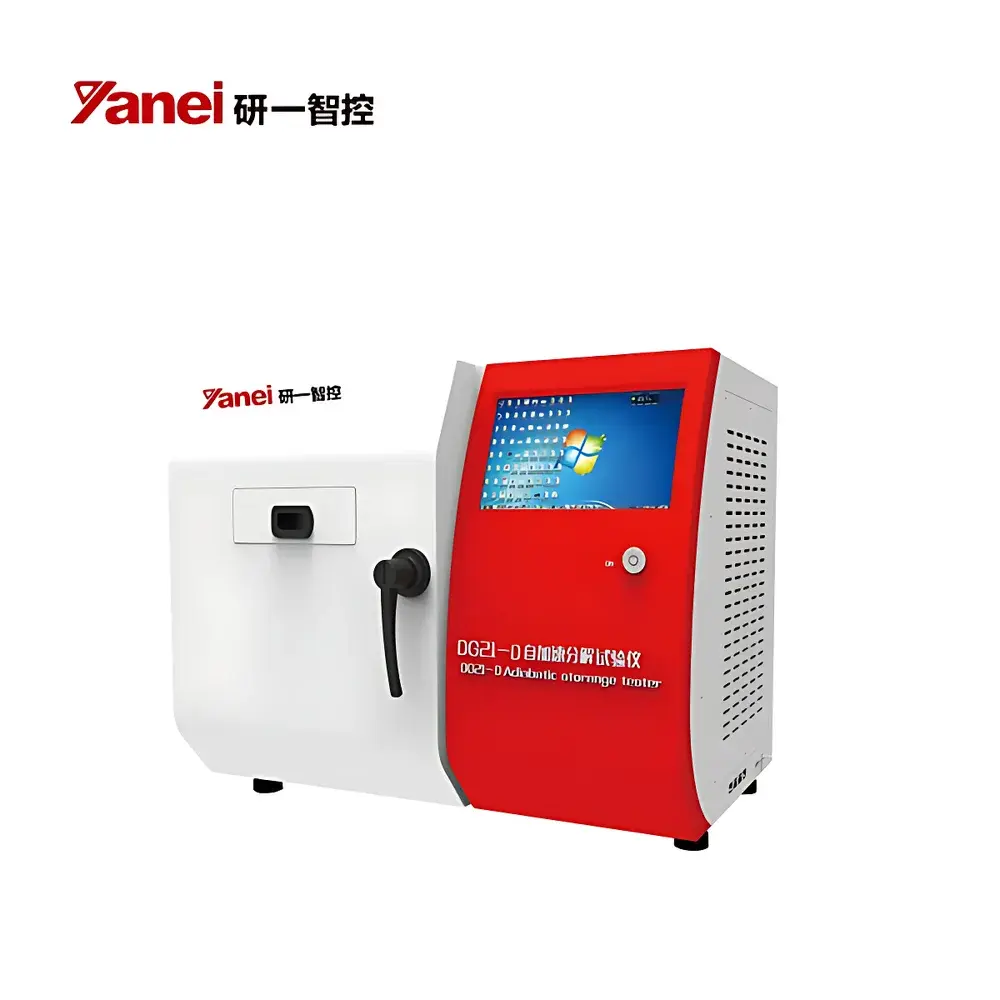
Yanei DG21-D Self-Accelerating Decomposition Testing Instrument
| Brand | Yanei |
|---|---|
| Origin | Zhejiang, China |
| Manufacturer Type | Manufacturer |
| Country of Origin | Domestic (China) |
| Model | DG21-D |
| Pricing | Upon Request |
| Temperature Range | −50 °C to 400 °C |
| Temperature Accuracy | ±0.2 °C (−50 °C to 150 °C), ±0.3 °C (150 °C to 400 °C) |
| Dewar Thermal Loss Rate | ≤10 mW |
| Constant Power Range | 0.1–2 W |
| Constant Power Accuracy | ≤0.01 W |
| Furnace Temperature Control Range | Ambient +5 °C to 220 °C |
| Furnace Temperature Stability | ±0.5 °C |
| Heating Rate Range | 0–2 °C/min |
| Coolant Circulation Flow | 3 L/min |
| Dewar Material | 316L Stainless Steel |
| Dewar Volume | 1000 mL |
| Dimensions (L×W×H) | 720 mm × 520 mm × 520 mm |
Overview
The Yanei DG21-D Self-Accelerating Decomposition Testing Instrument is an engineered calorimetric system designed for the quantitative determination of self-heating behavior in thermally unstable substances—particularly organic peroxides, nitro compounds, azo initiators, and other reactive hazardous chemicals. It operates on the principle of adiabatic calorimetry, wherein a sample is thermally isolated within a high-efficiency Dewar vessel while subjected to controlled, low-power resistive heating. By continuously monitoring temperature rise under near-adiabatic conditions (thermal loss ≤10 mW), the instrument captures the onset, acceleration, and runaway phases of exothermic decomposition. The core output—a self-accelerating decomposition temperature (SADT)—is derived through integration of measured heat generation kinetics with container-specific thermal resistance data, enabling regulatory-compliant packaging and transport classification per UN TDG, GB 5085.5, and equivalent national standards.
Key Features
- Adaptive variable-load temperature control algorithm dynamically adjusts heating power based on real-time specific heat capacity estimation, maintaining inter-sample temperature uniformity within ±0.5 °C across diverse material classes.
- Precision constant-power regulation (0.1–2 W, accuracy ≤0.01 W) implemented via resistive circuit negative feedback, ensuring long-duration stability critical for multi-day SADT trials.
- Integrated real-time heater filament continuity monitoring prevents undetected open-circuit failures during extended operation, preserving data integrity.
- Annular monolithic ceramic fiber heating architecture eliminates radial and axial thermal gradients, delivering spatially homogeneous temperature fields (<0.3 °C variation across 1000 mL Dewar volume).
- Fail-safe rapid pressure relief system activates automatically upon detection of abnormal pressure rise or temperature overshoot, mitigating explosion risk during energetic decomposition events.
- Dual-layer thermal protection: active external coolant circulation (3 L/min glycol/water) coupled with secondary overtemperature cutoff and remote emergency power disconnection.
- Onboard thermophysical modeling engine computes sample-specific heat capacity, identifies optimal exothermic rate profiles, and extrapolates SADT, control temperature (Tc), and emergency temperature (Te) using ASTM E1981–22 and ISO 8007–2 compliant algorithms.
- Physically segregated test chamber and electronics enclosure prevent vapor ingress, corrosion, or ignition hazards from volatile or corrosive analytes.
- Full automation includes in-situ thermal loss correction, time-temperature trajectory logging, post-run curve generation (dT/dt vs. T), and automated SADT inference—even after unscheduled power interruption (non-volatile memory retention).
Sample Compatibility & Compliance
The DG21-D accommodates solid, liquid, and paste-like samples up to 500 g mass in standard 1000 mL 316L stainless steel Dewar vessels. Its design conforms to the adiabatic storage test methodology specified in Section 28.4.2 (Test H.2) of the UN Recommendations on the Transport of Dangerous Goods: Manual of Tests and Criteria. It further supports compliance with GB 5085.5–2019 “Identification Standards for Hazardous Wastes – Reactivity Identification”, as well as harmonized equivalents including ASTM E698 (kinetic analysis of decomposition), ISO 8007–2 (thermal stability testing of organic peroxides), and IEC 60079–10–1 (hazardous area classification). Data audit trails meet GLP and GMP documentation requirements, with optional 21 CFR Part 11–compliant electronic signatures available via software configuration.
Software & Data Management
The instrument embeds an industrial-grade PC motherboard running a deterministic real-time OS, interfaced via a 10.1-inch capacitive touchscreen with intuitive graphical workflow navigation. Pre-installed YaneiTherm v4.x software provides full experiment lifecycle management: method setup (ramp rate, power setpoint, alarm thresholds), live parameter visualization (T, dT/dt, P, Q), automatic calibration logging, and export-ready reports (PDF, CSV, XML). Wireless IEEE 802.11ac connectivity enables centralized remote operation of multiple units from a single workstation; all raw and processed data are stored in a structured SQLite database with configurable network backup to NAS or LIMS. Audit logs record user actions, system events, and environmental anomalies with timestamped, immutable entries—supporting traceability for regulatory submissions and internal QA reviews.
Applications
- Determination of SADT for UN transport classification (Packing Groups I–III) of organic peroxides and self-reactive substances.
- Thermal safety screening of intermediates and final products in fine chemical, pharmaceutical, and agrochemical manufacturing.
- Validation of thermal stabilization strategies (e.g., inhibitors, diluents, refrigerated transport protocols).
- Supporting process safety information (PSI) development per OSHA 1910.119 and CCPS guidelines.
- Generation of kinetic parameters (Ea, A) for computational thermal hazard modeling (e.g., in TSS, DIERS, or SuperChems environments).
- Regulatory dossier preparation for REACH, CLP, and EPA TSCA submissions requiring decomposition onset and propagation data.
FAQ
What standards does the DG21-D explicitly support?
It implements Test H.2 (adiabatic storage) per UN Manual of Tests and Criteria, Section 28.4.2, and fully complies with GB 5085.5–2019. Equivalent methodologies include ISO 8007–2 and ASTM E1981–22.
Can the instrument handle highly corrosive or volatile samples?
Yes—the 316L stainless steel Dewar and physical isolation between sample chamber and electronics provide robust compatibility with halogenated solvents, acidic nitrates, and low-boiling peroxides.
Is data export compatible with LIMS or enterprise QA systems?
All measurement data, metadata, and audit logs are exportable in CSV, PDF/A, and XML formats; RESTful API access and ODBC drivers are available for direct LIMS integration.
How is thermal loss calibrated for different package configurations?
The system performs in situ thermal loss characterization using reference materials (e.g., KNO3) and applies correction factors during SADT calculation per ISO 8007–2 Annex B.
Does the DG21-D support 21 CFR Part 11 compliance?
With optional software license and hardware security module (HSM), it delivers electronic signatures, role-based access control, and immutable audit trails required for FDA-regulated environments.



