
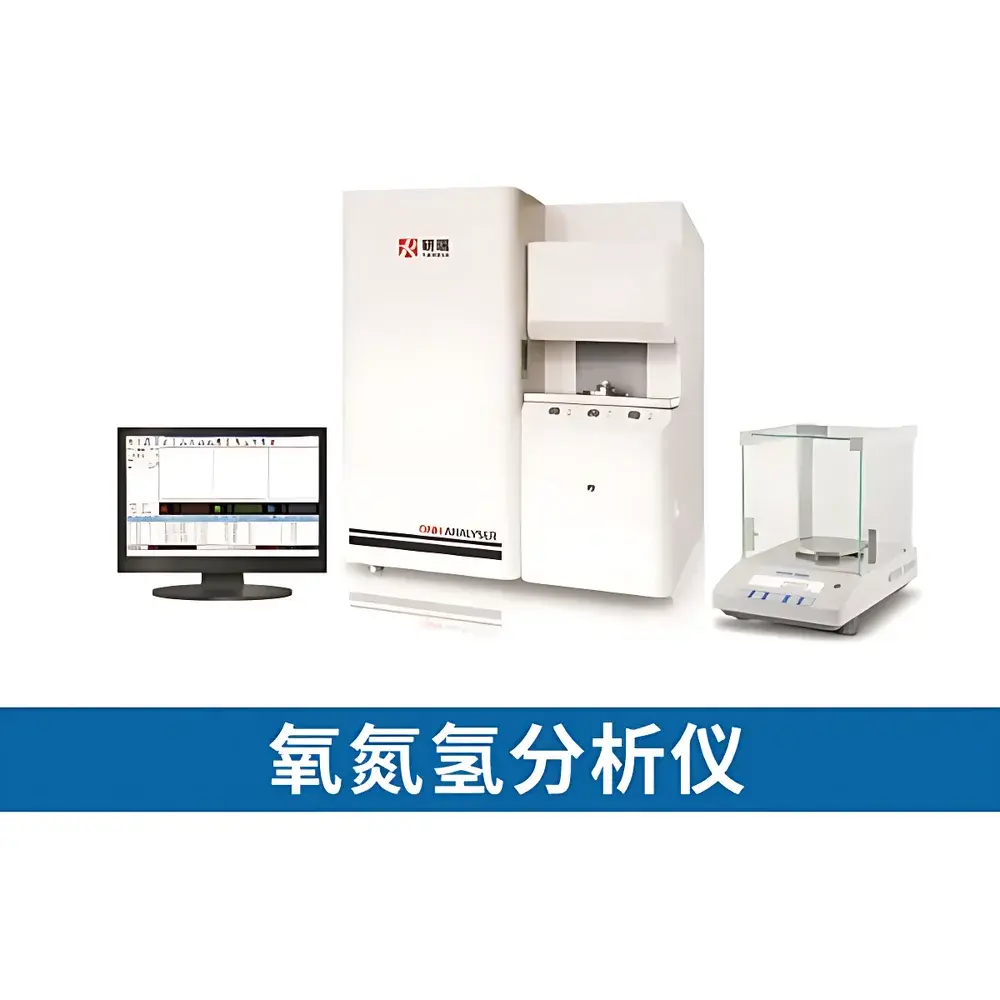
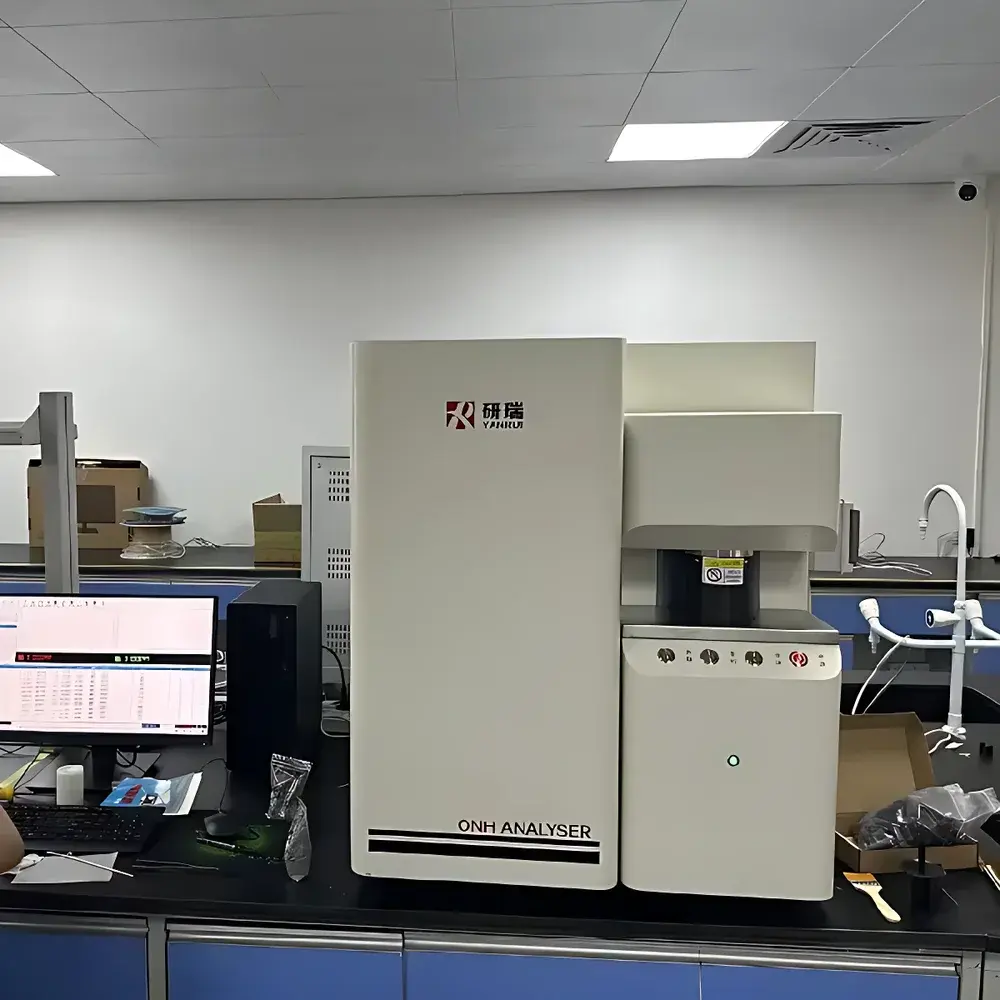
Yanrui ONH-530 Oxygen-Nitrogen-Hydrogen Analyzer
| Brand | Yanrui |
|---|---|
| Model | ONH-530 |
| Origin | Chongqing, China |
| Instrument Type | Oxygen-Nitrogen-Hydrogen Elemental Analyzer |
| Analysis Elements | O, N, H |
| Sample Types | Ferrous & non-ferrous metals, ceramics, superconductors, semiconductors, refractory materials (e.g., steel, iron, copper, zirconium, titanium, tantalum, niobium, rare earths, hard alloys) |
| Analysis Principle | Inert gas fusion coupled with infrared absorption (O, H) and thermal conductivity detection (N) |
| Analysis Range | Low-O: 0.0001–3.0 wt% |
| Optional high-O | 0.1–50.0 wt% |
| Low-N | 0.0001–3.0 wt% |
| Optional high-N | 0.1–60.0 wt% |
| H | 0.00001–0.50 wt% |
| Detection Limit | 0.1 ppm (O, N) |
| Precision | O/N: ±0.0001 wt% or RSD ≤ 1.0% |
| H | ±0.0002 wt% or RSD ≤ 2.0% |
| Analysis Time | < 180 s per sample |
| Pulse Electrode Furnace Power | 8.5 kW (max. 9 kW), operating current ≤ 1500 A, peak temperature > 3500 °C |
| Balance Resolution | 0.1 mg |
| Reagents | Magnesium perchlorate (H₂O trap), sodium hydroxide asbestos (CO₂ absorbent), copper oxide (CO → CO₂ converter) |
| Dimensions (W×D×H) | 700 × 770 × 820 mm |
| Net Weight | ~165 kg |
| Compliance | Designed to support GLP/GMP workflows |
Overview
The Yanrui ONH-530 is a high-performance inert gas fusion elemental analyzer engineered for the simultaneous quantitative determination of oxygen (O), nitrogen (N), and hydrogen (H) in solid inorganic materials. It operates on the principle of high-temperature pulse furnace fusion under purified helium or argon atmosphere—effectively liberating interstitial and combined gaseous elements from the matrix. Released oxygen and hydrogen are converted to CO and H₂O via controlled oxidation in a copper oxide reactor, then quantified by dual-channel infrared absorption cells. Nitrogen is measured directly by high-sensitivity thermal conductivity detection (TCD) following separation through selective chemical traps and catalytic purification. This integrated physical-chemical detection architecture ensures trace-level sensitivity, robust interference rejection, and metrological consistency across diverse sample classes—including low-alloy steels, titanium alloys, zirconium sponge, niobium-tantalum compounds, ceramic oxides, and advanced powder metallurgy feedstocks.
Key Features
- Modular, fully integrated instrument architecture with optimized thermal and pneumatic zoning to minimize cross-contamination and baseline drift
- High-stability pulse electrode furnace delivering up to 9 kW power, capable of sustained operation above 3500 °C with precise current regulation (≤1500 A) and real-time thermal feedback control
- Dual-range infrared detection system with thermoelectrically cooled detectors, enabling accurate quantification across both ultra-trace (ppm-level) and high-concentration (up to 60 wt% N) ranges
- Multi-stage gas purification train incorporating Mg(ClO₄)₂ (moisture removal), NaOH-asbestos (CO₂ scrubbing), and CuO (CO oxidation), ensuring baseline stability and long-term detector protection
- High-resolution analytical balance (0.1 mg readability) integrated into the autosampler interface with automatic tare compensation and gravimetric calibration traceability
- Windows 10–based control software featuring intuitive workflow navigation, method-driven analysis sequencing, and built-in diagnostic logging for preventive maintenance scheduling
Sample Compatibility & Compliance
The ONH-530 supports analysis of conductive and semi-conductive solids requiring no prior dissolution or derivatization—including cast iron, stainless steel, nickel-based superalloys, aluminum alloys, tungsten carbide, silicon nitride, yttria-stabilized zirconia, and rare-earth permanent magnet powders. Non-conductive samples may be analyzed using graphite or tungsten boat carriers with appropriate flux optimization. The system complies with core methodology standards referenced in ASTM E1447 (Standard Test Method for Determination of Hydrogen in Titanium and Titanium Alloys), ASTM E1019 (Standard Test Methods for Determination of Carbon, Sulfur, Nitrogen, and Oxygen in Steel, Iron, Nickel, and Cobalt Alloys), and ISO 14284:1996 (Steel and iron — Sampling and preparation of samples for the determination of chemical composition). When deployed with role-based user management, electronic signatures, and audit trail activation, the software framework aligns with data integrity expectations under FDA 21 CFR Part 11 and EU Annex 11 for regulated QC laboratories.
Software & Data Management
The ONH-530 Control Suite provides a deterministic, event-logged acquisition environment supporting method templates, multi-point calibration curves (linear and quadratic), drift correction algorithms, and automated blank subtraction. All raw signal traces (IR absorbance, TCD voltage, furnace current/temperature) are archived in vendor-neutral binary format with embedded metadata (operator ID, timestamp, sample ID, reagent lot, furnace cycle log). Export options include CSV, PDF analytical reports, and structured XML for LIMS integration. Audit trail functionality records all critical events—including method edits, calibration updates, result overrides, and user logins—with immutable timestamps and operator attribution. Data backups are configurable via network share or external USB storage, adhering to ALCOA+ principles (Attributable, Legible, Contemporaneous, Original, Accurate, Complete, Consistent, Enduring, Available).
Applications
- Quality control of aerospace-grade titanium alloys where hydrogen embrittlement thresholds demand sub-1 ppm detection capability
- Process validation of powder metallurgy feedstock powders used in additive manufacturing, ensuring O/N/H levels remain within AM-specific material specifications (e.g., ASTM F3001)
- Research-grade characterization of high-entropy alloys and MAX phase ceramics, where stoichiometric deviations in light-element content directly impact mechanical performance
- Failure analysis labs quantifying interstitial contamination in failed bearing steels or nuclear-grade zirconium cladding materials
- Contract testing facilities performing certified reference material (CRM) verification per ISO/IEC 17025 requirements
FAQ
What sample forms are compatible with the ONH-530?
Solid metallic chips, turnings, or drillings (typically 0.1–1.0 g) are preferred. Powders require containment in graphite crucibles; brittle ceramics may be fragmented manually or cryogenically. Liquid or organic samples are not supported.
Is carrier gas purity critical for accurate results?
Yes. Helium or argon must meet ≥99.999% purity with H₂O and O₂ impurities < 0.1 ppm. Optional gas purifiers (e.g., heated getter traps) are recommended for extended operational stability.
How often does the system require recalibration?
Daily zero/gain checks are advised. Full multi-point calibration using certified reference materials (CRMs) is required before each analytical batch or after major maintenance—per ISO/IEC 17025 Clause 7.7.
Can the ONH-530 be integrated into an existing LIMS environment?
Yes. The software supports ODBC-compliant database export and HL7-compatible result transmission. Custom API integration is available upon request for enterprise-scale deployment.
What maintenance intervals are recommended for the infrared cells and TCD sensor?
IR cell windows should be inspected quarterly and cleaned with spectroscopic-grade methanol if deposits are observed. TCD filaments require annual resistance verification; replacement is typically needed every 2–3 years under normal usage conditions.
Related Products




