
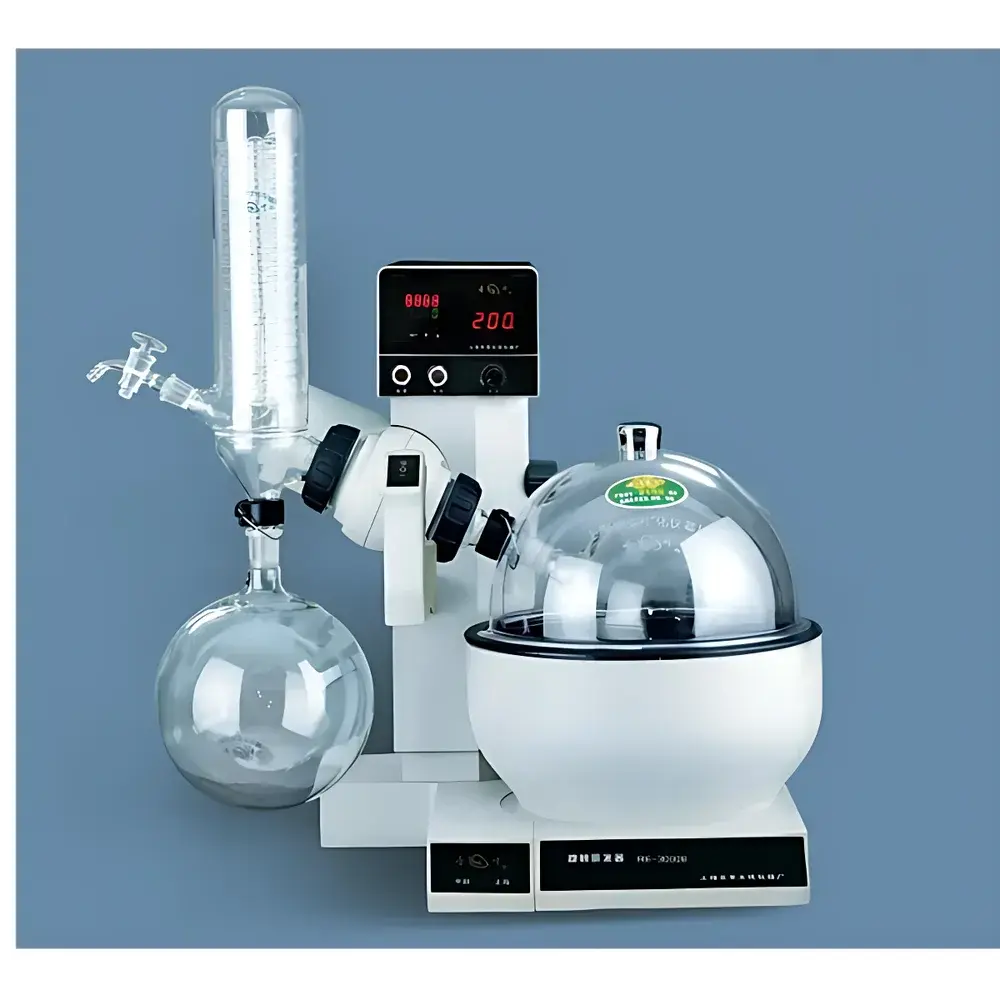
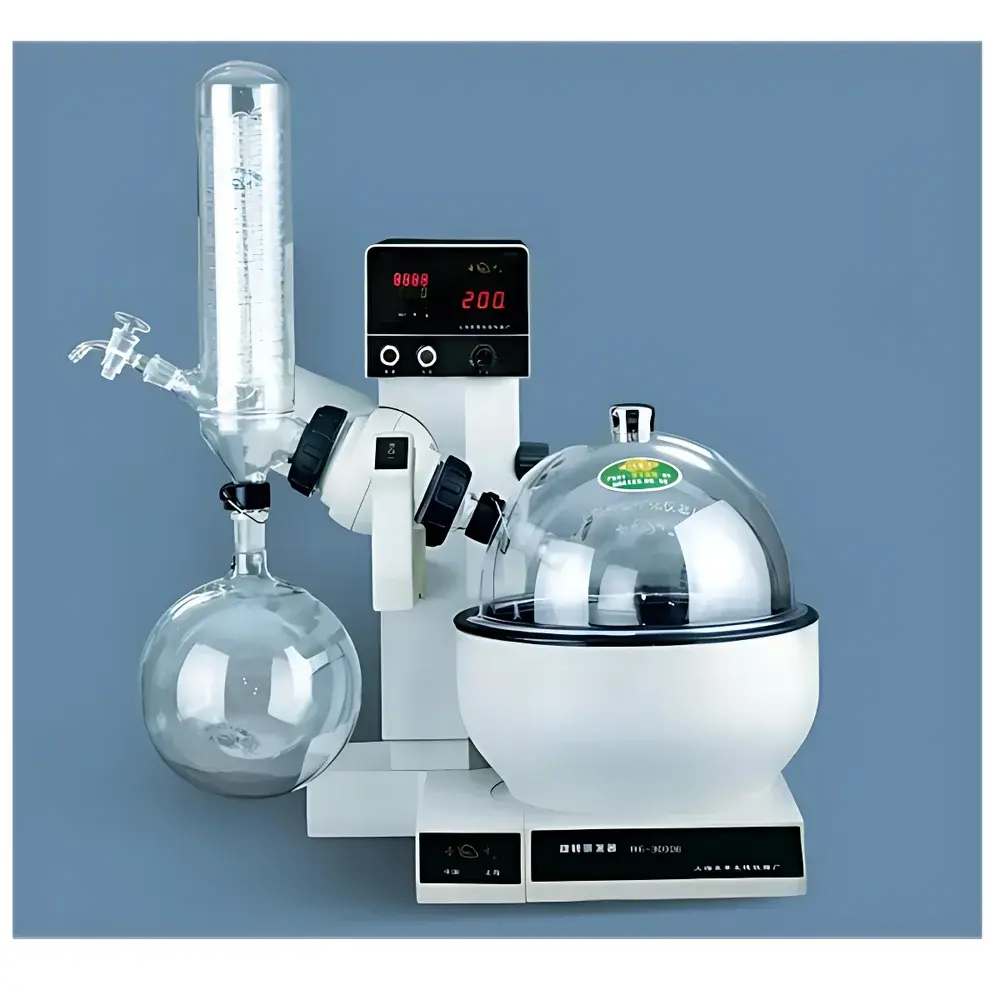
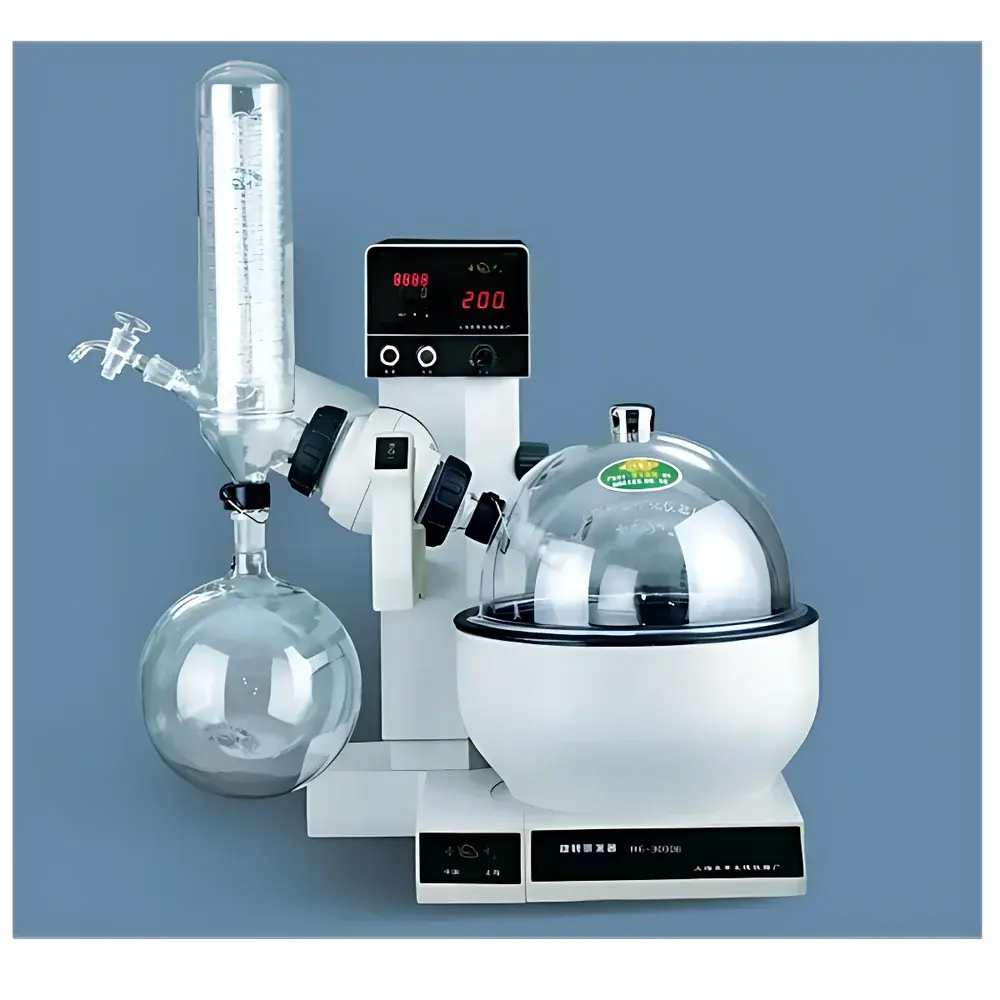
Yarong RE-2000A Standard-Configuration Rotary Evaporator
| Brand | Yarong |
|---|---|
| Origin | Shanghai, China |
| Manufacturer Type | Authorized Distributor |
| Country of Origin | China |
| Model | RE-2000A (Standard Configuration) |
| Quotation | Available upon Request |
| Display | Dual-color LCD touchscreen (main unit + water bath) |
| Control Interface | Rotary encoder + membrane keypad |
| Communication | RS485 inter-device synchronization |
| Temperature Range | Ambient to 99 °C (PID-controlled) |
| Temperature Accuracy | ±1 °C in water bath |
| Rotational Speed | 0–200 rpm (frequency-converter driven) |
| Timer Range | 0–99 h 59 min |
| Automatic Lift Stroke | 0–150 mm (track-guided, shock-free) |
| Condenser Type | Dual-reflux spherical-joint condenser |
| Condensing Area | 0.15 m² |
| Evaporation Rate (H₂O) | ≥1.2 L/h |
| Bath Capacity | 4 L PTFE-coated stainless steel |
| Compatible Flask Sizes | 50–2000 mL (conical ground-glass joint) |
| Heating Power | 1200 W |
| Motor Power | 40 W |
| Voltage/Frequency | 220 V / 50 Hz |
| Dimensions (W×D×H) | 450 × 400 × 850 mm |
| Net Weight | 36 kg |
| Sealing Material | High-elasticity PTFE gaskets |
| Safety Features | Transparent polycarbonate bath cover, overheat protection, auto-stop on lift limit |
Overview
The Yarong RE-2000A Standard-Configuration Rotary Evaporator is an engineered solution for efficient, reproducible solvent removal under reduced pressure in research laboratories, quality control environments, and pilot-scale synthesis workflows. Based on the fundamental principle of rotary evaporation—where a rotating flask increases surface area while vacuum lowers boiling points—the RE-2000A integrates precise thermal regulation, stable mechanical rotation, and intelligent lift actuation to optimize recovery yield and operator safety. Its dual-display architecture separates operational control (main unit) from thermal management (water bath), enabling independent parameter tuning without cross-interference. Designed for compatibility with standard ISO/KS/JIS conical ground-glass joints (e.g., 24/29, 29/32), it supports routine use across organic synthesis, natural product isolation, polymer purification, and pharmaceutical intermediate processing.
Key Features
- Dual high-resolution color LCD displays: Independent touchscreen interfaces for main unit (rotation, timer, lift control) and water bath (temperature setpoint, PID status), both featuring intuitive menu navigation and real-time feedback.
- Track-guided automatic lift mechanism: Smooth, noiseless vertical travel (0–150 mm) with mechanical end-stop protection and programmable descent speed; eliminates manual handling risks during solvent collection or flask exchange.
- Frequency-converter-driven motor: Delivers consistent torque across 0–200 rpm range with <±1 rpm speed stability, minimizing sample splashing and ensuring uniform film formation on flask walls.
- PTFE-sealed spherical-joint condenser system: Dual-reflux design with 0.15 m² effective cooling area; constructed from borosilicate 3.3 glass with reinforced PTFE bushings for chemical resistance and vacuum integrity up to 10 Pa.
- 4 L PTFE-coated stainless steel heating bath: Equipped with transparent polycarbonate insulation cover to reduce heat loss by >35%, improve energy efficiency, and prevent ambient contamination of heated media.
- RS485 communication interface: Enables synchronized operation with external vacuum controllers or temperature monitoring systems, supporting integration into GLP-compliant lab automation frameworks.
Sample Compatibility & Compliance
The RE-2000A accommodates standard ground-glass flasks (50–2000 mL) via its conical joint locking system with adjustable ring-nut retention—ensuring leak-tight sealing across volatile solvents including acetone, ethyl acetate, dichloromethane, and methanol. All wetted parts comply with USP Class VI and ISO 10993 biocompatibility requirements. The PTFE gasket material withstands continuous exposure to temperatures up to 260 °C and exhibits resistance to strong acids, bases, and halogenated solvents. While not certified to IEC 61010-1 as a standalone medical device, the unit meets CE marking requirements for laboratory equipment (2014/30/EU EMC Directive and 2014/35/EU LVD Directive) and incorporates overtemperature cutoff, motor stall detection, and lift-limit sensors aligned with EN 60335-1 safety provisions.
Software & Data Management
The RE-2000A operates via embedded firmware with non-volatile memory storing up to 20 user-defined protocols—including ramp-hold profiles, multi-stage timers, and conditional lift triggers. Parameter logs (temperature, rpm, time, bath status) are timestamped and exportable via USB flash drive in CSV format for audit trail generation. Though no proprietary PC software is bundled, the RS485 port supports Modbus RTU protocol for third-party SCADA or LIMS integration. All settings adhere to ALCOA+ data integrity principles when used within validated environments; full audit trails—including operator ID, parameter changes, and execution timestamps—can be maintained when paired with compliant external logging systems meeting FDA 21 CFR Part 11 requirements.
Applications
- Concentration of heat-sensitive natural extracts (e.g., terpenes, flavonoids) under controlled low-temperature vacuum conditions.
- Removal of reaction solvents post-coupling (e.g., DMF, THF, DMSO) prior to chromatographic analysis or crystallization.
- Preparative-scale dehydration of aqueous polymer dispersions without coagulation.
- Recovery and reuse of high-purity solvents in QC labs operating under ISO/IEC 17025-accredited methods.
- Parallel evaporation support when integrated with vacuum manifold systems compliant with ASTM D1655 (aviation fuel testing) or USP <467> residual solvents protocols.
FAQ
What vacuum level is recommended for optimal performance with the RE-2000A?
For most common solvents (bp <100 °C at atm), a vacuum range of 10–50 mbar is advised; lower pressures may be required for high-boiling-point compounds. Use of a diaphragm or oil-free scroll pump is strongly recommended to avoid backstreaming contamination.
Can the water bath operate independently of the main unit’s rotation and lift functions?
Yes—the bath features dedicated membrane keys and LED display, allowing standalone temperature control without powering the drive motor or lift actuator.
Is the condenser compatible with dry ice/acetone cooling?
The dual-reflux condenser accepts standard coolant circulation; however, direct dry ice/acetone immersion is not advised due to thermal shock risk on borosilicate glass. Chilled glycol/water mixtures down to –20 °C are fully supported.
Does the RE-2000A include documentation for IQ/OQ validation?
Factory calibration certificates for temperature sensor (NIST-traceable Pt100) and rotational encoder are provided. Full IQ/OQ protocols must be developed per site-specific SOPs in accordance with ISO 8655-7 and GAMP5 guidelines.
What maintenance intervals are recommended for long-term reliability?
PTFE gaskets should be inspected quarterly and replaced annually or after 500 operational cycles. Bath fluid (distilled water or silicone oil) requires replacement every 6 months; drive belt tension verification is advised biannually.



