
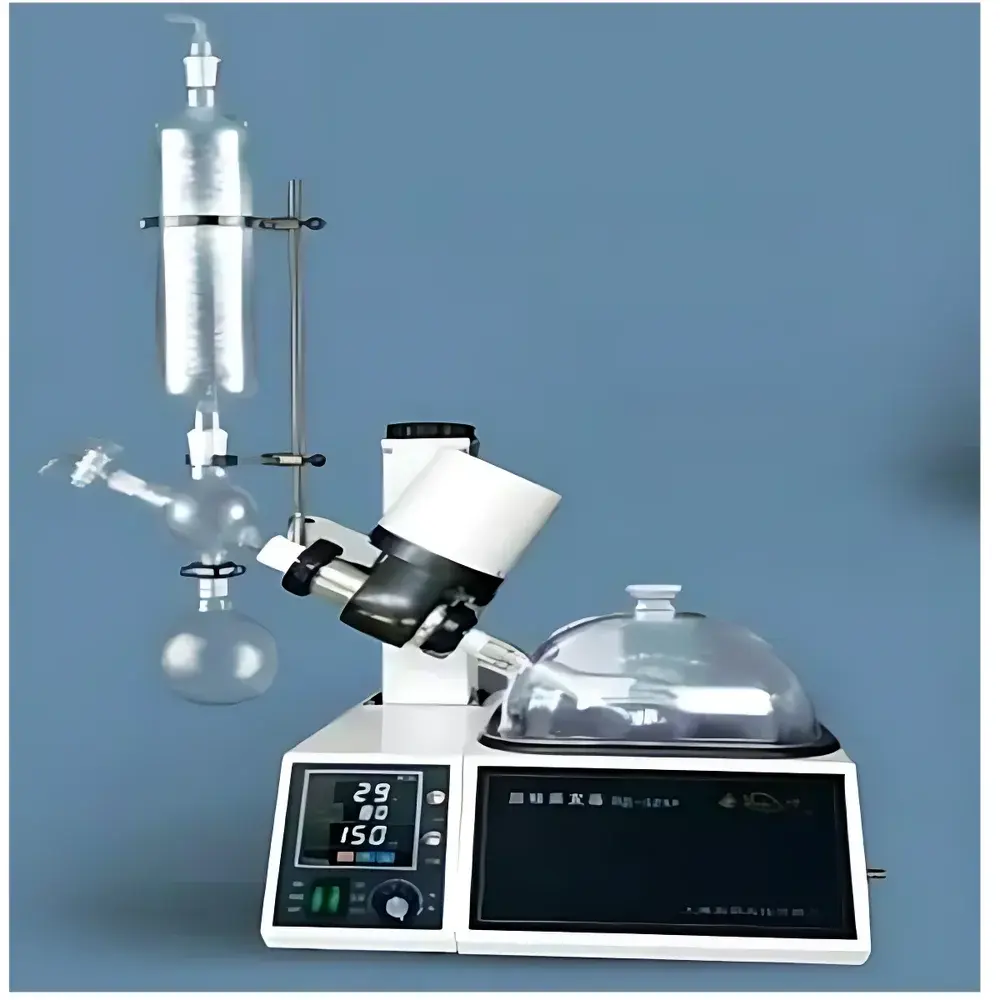
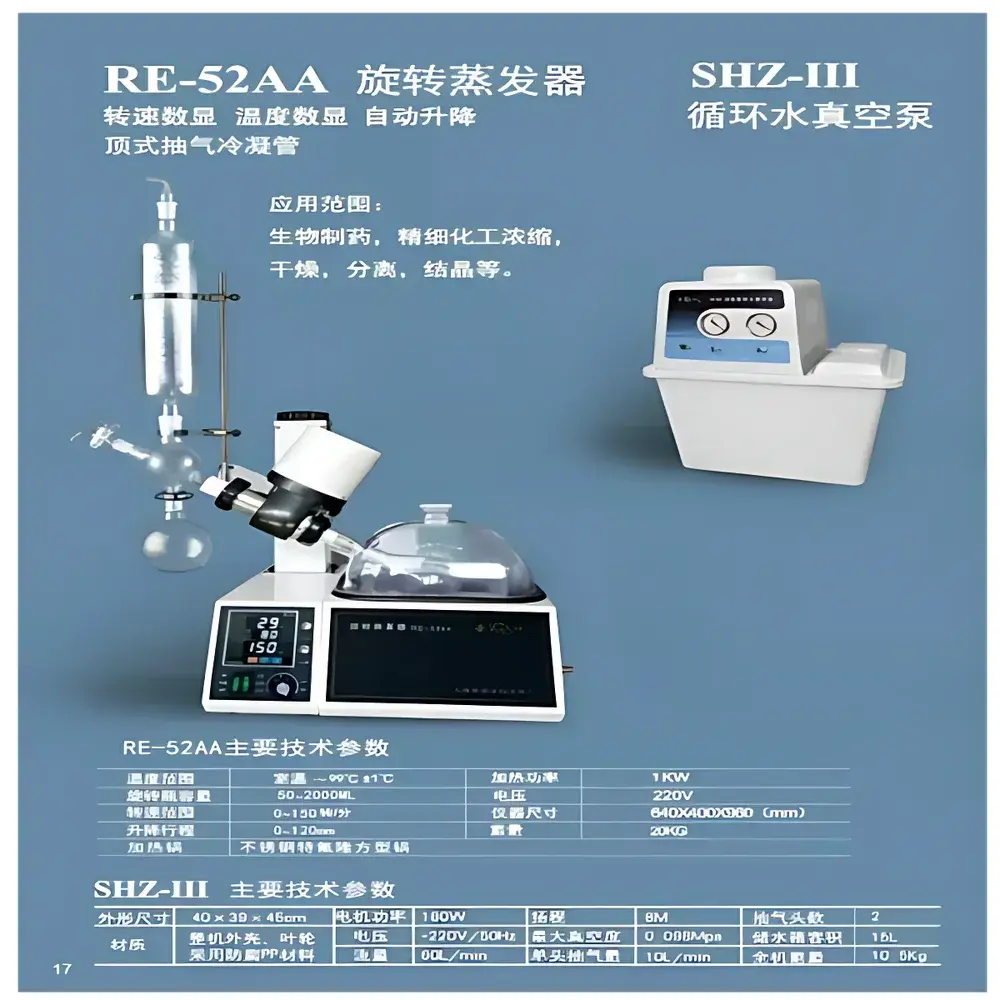
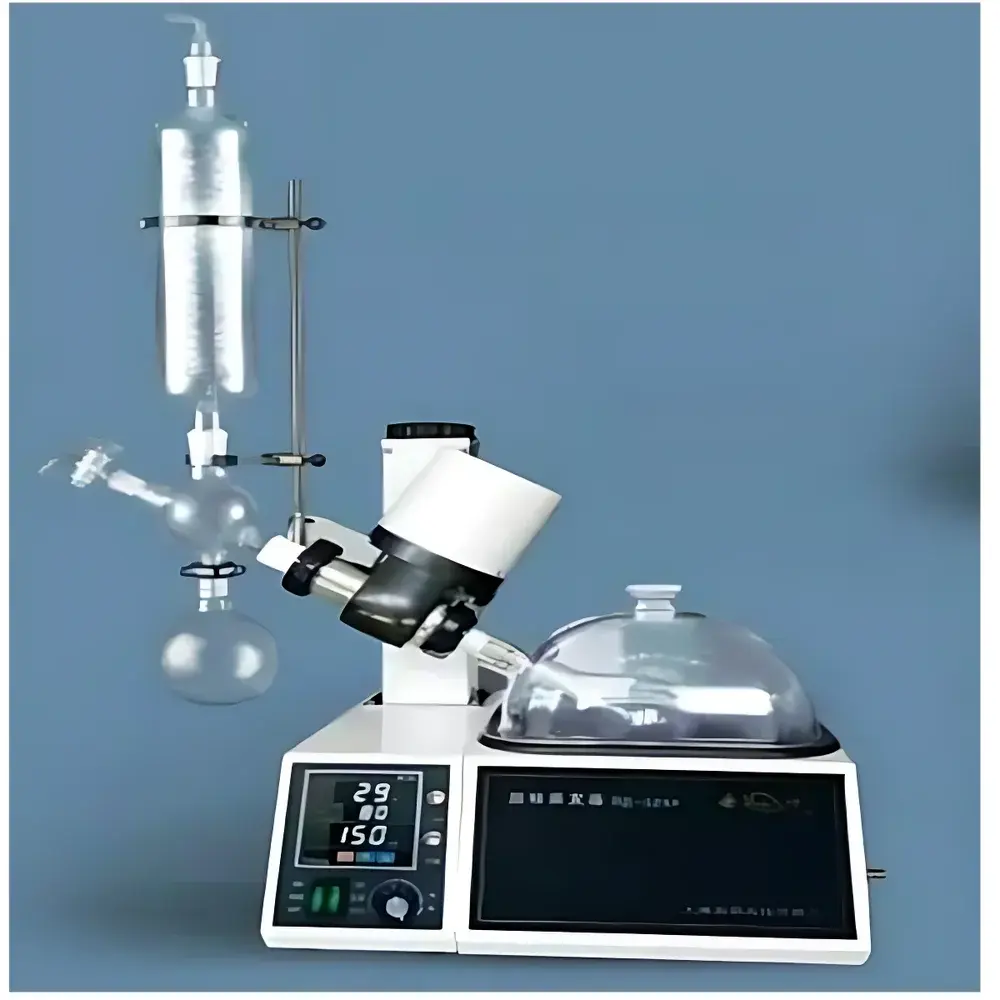
Yarong RE-52AA Rotary Evaporator
| Brand | Yarong |
|---|---|
| Origin | Shanghai, China |
| Model | RE-52AA |
| Rotational Speed Range | 0–150 rpm (digital display, electronic stepless adjustment) |
| Temperature Control Range | Ambient to 99 °C ±1 °C |
| Heating Power | 1000 W |
| Bath Type | Stainless steel square heating bath with PTFE coating |
| Bath Dimensions | Square, uniform temperature distribution |
| Vertical Condenser | Dual-flow reflux design with large-diameter condensing tube and evaporation tube |
| Lift Mechanism | Manual + motorized vertical lift, 0–120 mm travel |
| Cooling System | Air-cooled or external coolant-compatible (not integrated) |
| Vacuum Requirement | External vacuum pump required (e.g., SHZ-III type) |
| Safety Enclosure | Full-height transparent polycarbonate guard |
| Net Weight | 20 kg |
| Voltage | 220 V AC |
Overview
The Yarong RE-52AA Rotary Evaporator is an entry-level yet robust benchtop system engineered for efficient solvent removal, concentration, and gentle distillation of heat-sensitive compounds under reduced pressure. It operates on the fundamental principle of rotary evaporation: simultaneous rotation of the sample flask induces thin-film formation on its inner surface, increasing surface area and enhancing evaporation kinetics; concurrent application of vacuum lowers the boiling point of solvents, while precise thermal control of the heating bath ensures reproducible distillation without thermal degradation. Designed for routine laboratory workflows in organic synthesis, natural product isolation, pharmaceutical QC, and academic research, the RE-52AA integrates mechanical simplicity with essential digital instrumentation—providing reliable performance for laboratories requiring consistent, scalable evaporation across diverse sample volumes (typically 20–1000 mL).
Key Features
- Digital rotational speed control: Micro-motor-driven, stepless electronic adjustment from 0 to 150 rpm with real-time LED display—enabling precise optimization of film thickness and evaporation rate for viscous or volatile samples.
- Precision temperature regulation: PT100 platinum resistance sensor coupled with intelligent PID algorithm delivers stable bath temperature control from ambient to 99 °C ±1 °C—critical for maintaining compound integrity during low-boiling-point solvent removal.
- Uniform heating architecture: Square stainless steel heating bath with integrated PTFE anti-corrosion coating ensures homogeneous thermal distribution and long-term chemical resistance against common organic solvents and acidic/basic media.
- Vertical dual-flow condenser: Large-diameter glass condensing tube with auxiliary feed tube supports high-efficiency reflux and minimizes bumping or foaming—particularly beneficial for multi-component mixtures and high-solvent-load applications.
- Hybrid lift mechanism: Motor-assisted vertical elevation (0–120 mm travel) with manual override allows rapid flask immersion/extraction and safe alignment with condenser, reducing operator fatigue during repeated batch processing.
- Integrated safety enclosure: Full-height transparent polycarbonate shield meets basic lab safety requirements for splash and implosion protection—compatible with standard fume hood placement and routine maintenance access.
Sample Compatibility & Compliance
The RE-52AA accommodates standard ground-glass jointed flasks (typically 24/29 or 29/32 taper), including round-bottom, pear-shaped, and short-path variants. Its modular design permits adaptation to varying sample viscosities (from aqueous solutions to medium-viscosity extracts) and volatility profiles (e.g., diethyl ether, dichloromethane, ethyl acetate, ethanol, and water-based systems). While not certified to ISO/IEC 17025 or GLP-specific validation protocols out-of-the-box, the instrument’s traceable temperature sensing (PT100), repeatable speed control, and documented operational parameters support internal method qualification and audit-readiness when paired with validated vacuum pumps (e.g., SHZ-III) and calibrated thermometers. Users implementing this system in regulated environments should perform periodic verification of bath temperature accuracy and rotational stability per internal SOPs aligned with ASTM E29 or ISO/IEC 17025 clause 5.9.
Software & Data Management
The RE-52AA operates as a standalone analog-digital hybrid instrument with no embedded microprocessor-based software or network connectivity. All operational parameters—rotational speed and bath temperature—are set and monitored via front-panel controls and LED displays. No data logging, remote control, or electronic record retention is provided natively. For laboratories requiring 21 CFR Part 11 compliance or electronic audit trails, integration with external data acquisition systems (e.g., USB-connected thermocouple loggers or PLC-controlled vacuum manifolds) is feasible but requires third-party configuration. Documentation of operating conditions must be manually recorded in lab notebooks or LIMS-integrated forms to satisfy GLP/GMP documentation standards.
Applications
- Solvent recovery and concentration of reaction mixtures post-synthesis
- Removal of low-boiling solvents (e.g., hexane, acetone, THF) prior to chromatographic analysis
- Preparative-scale purification of natural product extracts (e.g., plant alkaloids, essential oils)
- Lyophilization pre-concentration steps in biopolymer and peptide workflows
- Quality control testing of excipient solubility and residual solvent content in pharmaceutical intermediates
- Teaching laboratory demonstrations of phase equilibria, vapor pressure depression, and thin-film evaporation dynamics
FAQ
Is a vacuum pump included with the RE-52AA?
No. An external vacuum source—such as the SHZ-III circulating water vacuum pump—is required and must be purchased separately.
What is the maximum recommended flask size?
The system is mechanically optimized for 1 L rotary flasks; use of larger vessels may compromise rotational stability and condensation efficiency.
Can the heating bath accommodate non-standard flask geometries?
Yes—the square bath design provides greater lateral clearance than round baths, facilitating use of pear-shaped or short-path flasks with wider bases.
Does the unit support inert gas purging?
The standard joint configuration does not include a dedicated inert gas inlet port; modification requires aftermarket adapters compatible with 24/29 or 29/32 joints.
What maintenance intervals are recommended for long-term reliability?
Biannual inspection of PTFE bath coating integrity, condenser joint lubrication, and motor drive belt tension (if applicable) is advised; vacuum hose and gasket replacement should follow manufacturer guidelines for connected pump systems.



