
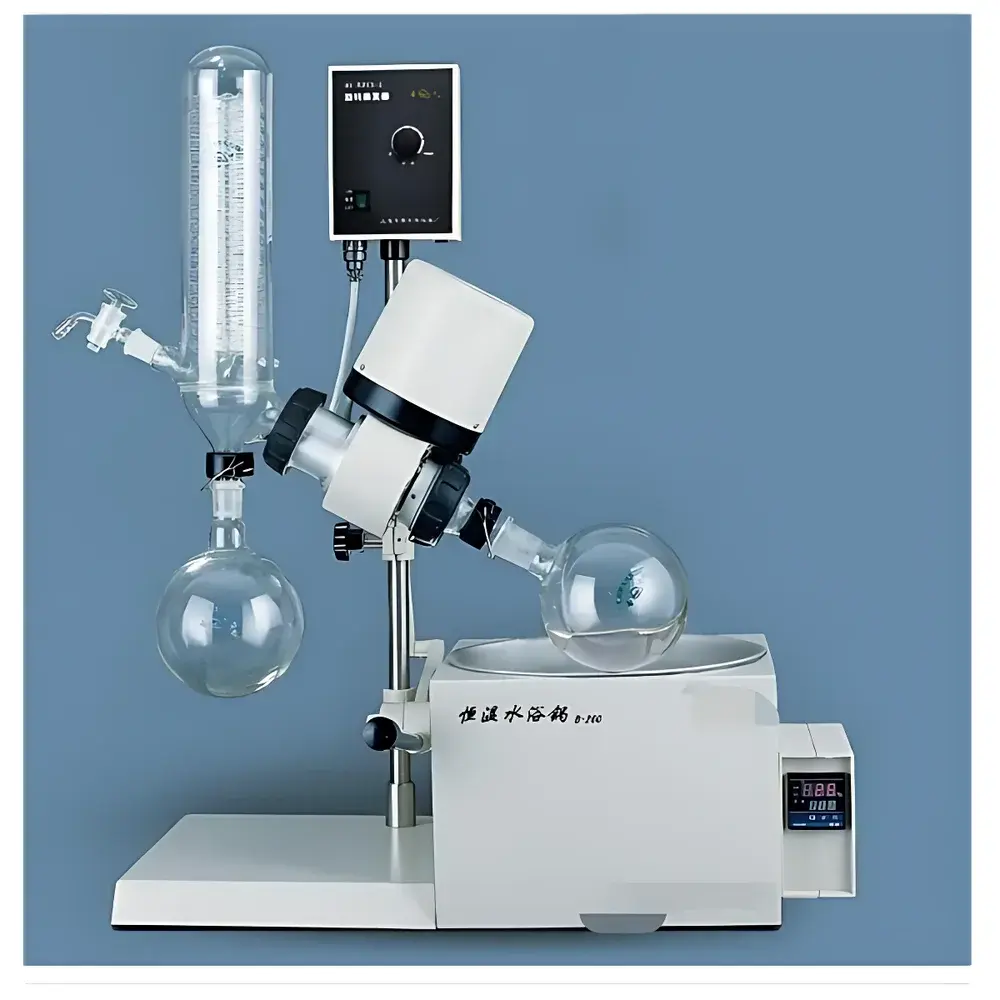
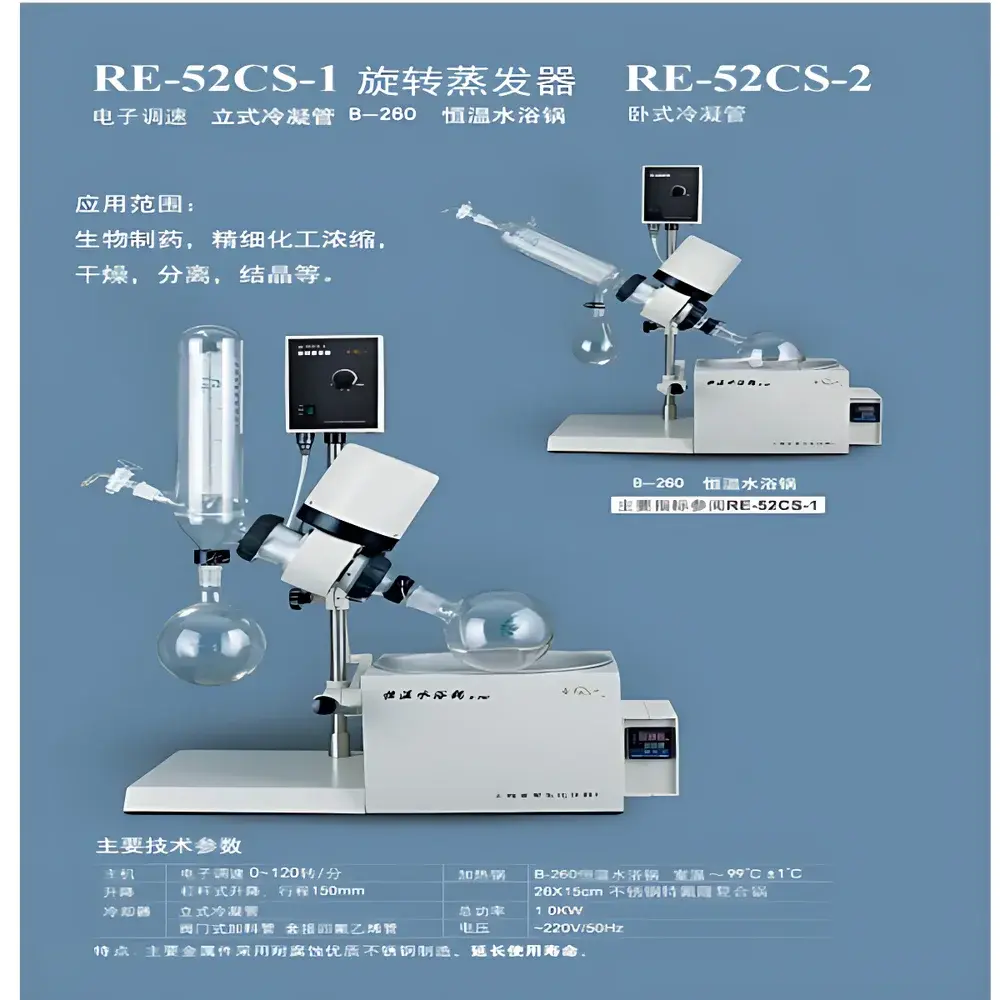
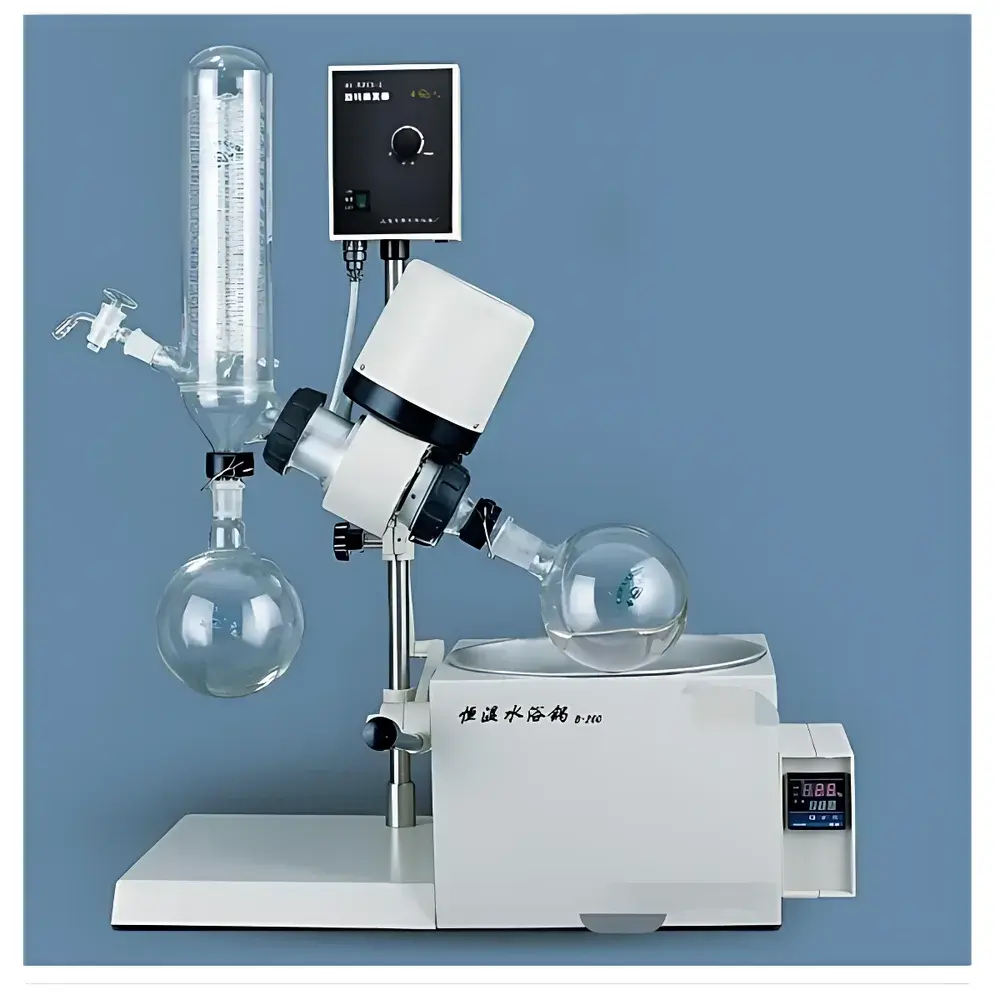
Yarong RE-52CS-1 Vertical Condenser Rotary Evaporator
| Brand | Yarong |
|---|---|
| Origin | Shanghai, China |
| Model | RE-52CS-1 |
| Temperature Range | Ambient to 99 °C (±1 °C) |
| Rotation Speed | 0–120 rpm (electronic stepless control) |
| Condenser Type | Vertical double-layer glass condenser |
| Feed Tube | Valve-type adjustable addition tube |
| Lift Mechanism | Lever-type vertical lift, max travel 150 mm |
| Water Bath Pan | 26 × 15 cm stainless steel with PTFE-coated interior |
| Power Rating | 1.0 kW |
| Supply Voltage | 220 V AC / 50 Hz |
Overview
The Yarong RE-52CS-1 is a benchtop vertical-condenser rotary evaporator engineered for reliable solvent removal, concentration, and recovery under reduced pressure in synthetic chemistry, pharmaceutical development, natural product isolation, and analytical sample preparation. It operates on the principle of thin-film evaporation: a rotating flask immersed in a thermostatically controlled water bath generates a large, continuously renewed surface area, while vacuum lowers the boiling point of solvents—enabling gentle, efficient evaporation at temperatures well below atmospheric boiling points. The vertical dual-layer condenser ensures high condensation efficiency across a broad range of volatile solvents (e.g., acetone, ethanol, dichloromethane, ethyl acetate), minimizing vapor loss and improving recovery yield. Designed for stability and repeatability in routine laboratory workflows, the RE-52CS-1 integrates mechanical simplicity with functional precision—making it suitable for both teaching laboratories and regulated R&D environments where consistent process parameters are essential.
Key Features
- Vertical double-layer glass condenser with high-surface-area cooling geometry, optimized for rapid vapor-to-liquid phase transition and minimal backstreaming.
- Electronic stepless speed control (0–120 rpm) with digital feedback, enabling precise adjustment of rotational shear and film thickness for diverse viscosities and boiling points.
- Lever-actuated vertical lift mechanism with 150 mm maximum travel—provides smooth, repeatable flask positioning without manual torque or alignment drift.
- PTFE-coated stainless steel water bath pan (26 × 15 cm) offering corrosion resistance, uniform thermal distribution, and compatibility with acidic or basic aqueous media.
- Integrated temperature regulation (ambient to 99 °C ±1 °C) via calibrated immersion sensor and PID-controlled heating element—ensuring stable bath conditions during extended runs.
- Valve-type feed tube allows controlled reagent addition under vacuum without system venting, supporting sequential reaction workups and fractional distillation protocols.
Sample Compatibility & Compliance
The RE-52CS-1 accommodates standard ground-glass jointed flasks (typically 0.5–2 L capacity, interchangeable via ISO 29/32 or 24/29 joints) and is compatible with common laboratory vacuum sources (e.g., diaphragm or water aspirators; optional vacuum controller recommended for fine pressure tuning). Its construction meets general laboratory equipment safety standards per IEC 61010-1 for electrical safety and thermal hazard mitigation. While not certified for GMP manufacturing use out-of-the-box, its design supports GLP-compliant documentation when paired with external logging systems—particularly for method validation studies requiring traceable temperature, rotation, and time parameters. It is routinely employed in academic labs conducting ASTM D86 or ISO 3405–aligned distillation training and in QC labs performing USP solvent residue assessments.
Software & Data Management
The RE-52CS-1 is a standalone analog-digital hybrid instrument with no embedded microprocessor or network interface. All operational parameters—including bath temperature setpoint, rotation speed, and lift position—are manually configured and monitored via front-panel dials and analog indicators. For audit-ready data capture, integration with external USB or RS-232 temperature loggers (e.g., Omega OM-DAQPRO series) or PLC-based lab automation platforms is supported. When used in regulated environments, users may implement procedural controls—such as pre-run checklists, operator sign-offs, and manual logbook entries—to satisfy FDA 21 CFR Part 11 requirements for electronic records, provided metadata (date/time, operator ID, batch ID) is consistently recorded alongside instrument settings.
Applications
- Concentration of heat-sensitive natural extracts (e.g., plant alkaloids, essential oils) without thermal degradation.
- Solvent recovery and recycling in multi-step organic synthesis workflows, reducing chemical waste and operational costs.
- Removal of low-boiling solvents prior to lyophilization or NMR sample preparation.
- Distillative purification of reaction mixtures containing volatile by-products or unreacted monomers.
- Teaching core principles of vacuum distillation, Raoult’s law, and mass transfer in undergraduate physical chemistry laboratories.
- Preparative-scale dehydration of polymer solutions prior to film casting or rheological characterization.
FAQ
What is the maximum recommended flask size for the RE-52CS-1?
The unit is mechanically rated for standard 2 L round-bottom flasks with ISO 29/32 joints; operation beyond this volume may compromise rotational balance and condenser efficiency.
Is the water bath temperature calibration traceable to national standards?
The built-in sensor is factory-calibrated; for ISO/IEC 17025 compliance, users should perform periodic verification using an NIST-traceable thermometer (e.g., Fluke 1523) and document deviations.
Can the RE-52CS-1 be operated under inert gas purge?
Yes—via optional gas inlet adapter installed at the vapor duct or feed tube port, enabling Schlenk-line-compatible solvent evaporation under nitrogen or argon.
Does the lever lift mechanism support motorized actuation upgrades?
No—the mechanical lever system is fixed-design; third-party motorized lift retrofits are not supported and may void structural integrity warranties.
What vacuum level is required for optimal performance with ethanol at 40 °C?
A stabilized pressure of ≤15 mbar (≈11 torr) is typically sufficient to achieve brisk evaporation while maintaining condenser capacity; lower pressures require cold trap integration to prevent pump oil contamination.



